
One of my favorite books is a war report nearly two thousand years old, written by a man who switched sides halfway through the war. I read The Jewish War by Josephus years ago, in English, and it never left me. The man telling the story had every reason on earth to bend it. I love the book anyway, and catching him at it is half the fun. I’d hand it to anybody who likes their history with blood on it.
Pick the wrong translation, though, and you’ll quit by page forty. I wouldn’t blame you.
I’ve got something like 980,000 photographs in my archive, and the lens decided every one of them before the shutter fired. A cheap lens softens everything. A tinted filter shifts every color in the frame, and you don’t notice until you hold the print next to the scene.
Josephus works the same way. You’re looking at the Roman-Judean wars through two lenses stacked one on top of the other: his own, and the translator’s. Get a bad one at either end and the picture goes soft. Get both wrong and you’re staring at fog.
Why I keep coming back to Josephus
I like that time period. I’m an avid reader of history, especially Roman history, and I love military history.
Rome is great history, and I mean all of it.
Josephus is the man who documented the Roman-Judean wars, and he did it at a scale that’s hard to believe for the period. I remember the book as three volumes, and huge. The Jewish War runs seven books in the original, and the Loeb Classical Library edition splits it across three volumes, so my memory holds up.
It’s relatively easy to read if you get the right translation. It’s been a long time since I read it, so don’t ask me to quote it, but that whole series of books held me from start to finish.
The war Josephus recorded casts a long shadow over my own novel, A Treachery of Legions, set in AD 69. Vespasian, the general who came out of that civil war on top, had been commanding against the Judean revolt when the legions declared for him. I told the story of that book in the behind-the-book piece on A Treachery of Legions.
I think knowing history makes you a better human and a better writer. If you know about history, you know where you came from.
Western civilization came out of Rome, culturally, and Rome took a great deal from Alexander and the Greeks. Josephus stands at one of the hinges, watching an empire grind a small country into the ground, and he wrote down what he saw. How could I stay away from that?
Who was Josephus, and why did he write The Jewish War?
I think knowing history makes you a better human and a better writer.
He was born Yosef ben Matityahu in Jerusalem around AD 37, into a priestly family. When the revolt against Rome broke out in AD 66, the rebel leadership made him commander in Galilee, where he trained troops and fortified towns against the legions everyone knew were coming.
They came in 67. Vespasian besieged the town of Yodfat (Josephus calls it Jotapata) and took it.
Josephus hid in a cave with about forty other men. By his own account they agreed to kill each other by drawing lots, and he ended up as one of the last two alive. He and the other survivor walked out and surrendered. Mathematicians later turned the story into a counting puzzle, the Josephus problem, and programmers still solve it as an exercise. I love that a war story from AD 67 became homework for computer science students.
Brought before Vespasian, Josephus predicted that the general would become emperor. In 69, the year Rome had four emperors, it came true. Vespasian freed him, and Josephus took the family name Flavius.
He spent the siege of Jerusalem in AD 70 on the Roman side, working for Vespasian’s son Titus as an interpreter and calling on the defenders to surrender. He watched the city fall and the Temple burn. Afterward he moved to Rome, received Roman citizenship and a pension, and wrote The Jewish War. He says he wrote a first version in his native Aramaic, and the Greek version we have came out in the second half of the 70s.
So the man who wrote the standard account of the war was a rebel general who surrendered, then stood beside the commander who destroyed his own city.
A traitor writing for the men who paid him
As far as I understand it, he was a traitor. That’s a harsh word, and he earned it.
He probably didn’t want to get killed by the Romans, so he wrote some good books that made them look better. I totally understand.
Look at the arrangement he worked under, and tell me I’m wrong. In his autobiography, the Life, he says Vespasian gave him lodging in the house the emperor had lived in before taking the throne. He says Titus wanted The Jewish War to be the account people learned the war from, signed the copies with his own hand, and ordered the books published.
In Against Apion, Josephus admits he used assistants to help with the Greek. A writer with helpers polishing his prose, living in the emperor’s old house, with the emperor’s son approving the final draft. I know that arrangement better than most people do.
Every history was written by somebody who needed something from it.
Every history was written by somebody who needed something from it. – Richard LoweShare on X
He’s a little biased toward the Romans, because he was writing for the Romans. Titus comes off as reluctant and merciful, a man who wanted to save the Temple and couldn’t stop his soldiers. The rebel factions inside Jerusalem come off as bandits and fanatics who brought the catastrophe down on their own people. Some of that is true. All of it is convenient for a man eating at Titus’s table.
My living comes from writing books for other people. When I’m ghostwriting, I’m not my client’s priest, therapist, or judge and jury, and the book says what the client wants it to say. Josephus had the most powerful client in the world. Would you expect him to call that client a butcher in print?
I wouldn’t, and I doubt you would either.
Is Josephus a reliable historian?
For the ground, yes. For numbers, speeches and his own behavior, no.
I use Masada as the test case, because archaeologists dug it. Yigael Yadin excavated the site between 1963 and 1965 and found what Josephus described: Herod’s palaces hanging off the northern cliff, the storerooms and cisterns, the casemate wall, the Roman siege ramp on the western side, and the outlines of the Roman camps ringing the base. On the physical layout Josephus was right, and impressively so for a man who wasn’t there.
Then you get to the ending. Josephus says 960 people died at Masada in a mass suicide when the legion under Flavius Silva broke through, and he gives the rebel leader, Eleazar ben Ya’ir, two long speeches urging it. Excavators found the remains of at most 28 people.
He says two women and five children hid and survived to tell the story. Fine. Those speeches, word for word, are his invention, and ancient historians wrote speeches for their characters as a matter of course.
Do I trust those speeches? Not for a minute, and you shouldn’t either.
His casualty figures get the same treatment. He puts the dead in the siege of Jerusalem at over a million. I’ve repeated that number myself, and modern historians think it’s badly inflated.
I read Shattered Sword, about the Battle of Midway from the Japanese side, and it made the same point about a twentieth-century war. The American books had it all wrong, because people with a vested interest wrote them. I went into that in research that matters for military fiction.
If the accepted account of a 1942 battle can come out skewed, why would a Roman client’s account of AD 70 come out clean? Read Josephus the way you’d read any memoir by a general who surrendered and then went to work for the winners. Believe the map. Question the motives. Check the body counts against the dirt.
Which translation of Josephus’s Jewish War should you read?
Start with Martin Hammond’s translation in Oxford World’s Classics, published in 2017, with an introduction and notes by Martin Goodman, one of the leading historians of Roman Judea. It’s modern English, it fits in one volume, and the notes tell you when Josephus is spinning. If you’re new to the book, buy that one.
The Penguin Classics edition by Geoffrey Williamson, first published in 1959 and revised by Mary Smallwood in 1981, is the other good choice for a general reader. It reads easily and her notes are solid.
If you want the Greek on the facing page, get the Loeb edition, translated by Henry St. John Thackeray in the late 1920s. The Jewish War fills three of its small green volumes, and they’re pricey as a set. For the full scholarly treatment, Steve Mason’s commentary series from Brill goes line by line, at library prices.
Then there’s William Whiston. He translated the complete works in the 1730s, and his version is long out of copyright, so it’s the free one you’ll find online and the one most cheap reprints use. It reads like the 1700s, with long winding sentences, and it’s built on an older Greek text than modern translators work from.
Plenty of people have loved Whiston for nearly three hundred years. For a first read, it’s the cheap lens. I can’t stand the reprint publishers who slap his text under a glossy new cover, call it the complete works, and never tell the buyer the English is three centuries old.
For most first-time readers, Hammond first and Williamson second is the safe order.
There are several different translations, and some of them are good and some of them aren’t so good. Pay attention to which one you’re holding.
How can you tell a good Josephus translation from a bad one?
Check the date first. A translation done in the last seventy years uses modern English and a modern Greek text, and the introduction will tell you which text the translator worked from. If the book doesn’t say who translated it, put it back.
Then open both candidates to the same passage. I’d use the fall of Masada near the end of the seventh book, since it’s famous and easy to find. Read a page of each out loud. One will sound like a person telling you a story, and one will sound like a legal document from 1740. Your ear will pick the winner in two minutes.
Look at the back matter. A good edition has maps, a list of the people involved, and notes that flag where Josephus contradicts himself or the archaeology. He throws dozens of names at you, Herods and high priests and rebel leaders who share the same handful of names, and without a list you’ll be lost by the second book.
Avoid abridged editions unless the cover says abridged in plain words. An abridger decides what you never get to see, and the cover rarely says what went. I hate that kind of silent editing.
Every translation is a rewrite, and the translator makes choices on every line. I covered the author’s side of that in whether you should translate your own book. As a reader you’re trusting a second writer to carry the first writer’s meaning across, and some of them drop it.
Can you visit Masada and the places Josephus wrote about?
Yes. Masada is a national park on the edge of the Judean Desert above the Dead Sea, a UNESCO World Heritage Site since 2001. The plateau rises more than 400 meters above the surrounding ground. You can climb the Snake Path up the eastern face, ride the cable car, or walk up the Roman ramp on the western side, the same ramp the legion built to reach the wall. From the top you can still see the outlines of the Roman camps below.
I want to follow some of the places he mentioned someday. Masada first.
Then Jerusalem, and Yodfat in the Galilee, where he hid in the cave. Gamla in the Golan, the ridge town the Romans besieged in 67. Caesarea on the coast. I’ve never been to the Middle East, and I’d love to stand where the book happened with the book in my bag.
Even the name trips me up, and I hate that. I pronounce Masada the way it’s spelled, and the Hebrew is closer to Metzada. I tried it on someone who knew how to say it and got it wrong several times in a row, so I’ll probably get it wrong at the gate too.
The Dead Sea heat is brutal for much of the year, so plan an early start, carry far more water than you think you need, and check the park’s hours before you go. As of 2026, look up current travel conditions before you book anything at all.
What a writer learns from a biased eyewitness
Every memoir is a little bit Josephus. The person telling the story was there, knows things nobody else knows, and has a reason to come out looking good. Readers smell the self-serving parts. His account of his own surrender in that cave is the least believable chapter in the book. Do I believe a man who survived a suicide pact by luck of the draw, then wrote the only record of it? I have my doubts.
For writers of history and historical fiction, the lesson is practical. Use the eyewitness for the things he had no reason to lie about, the terrain and the walls and the order of events, and treat his motives as part of the evidence. I wrote more about where accuracy counts in historical accuracy in fiction. A novelist gets the gaps for free, and Josephus leaves plenty of them. I think any source behind a novel deserves the same suspicion.
If you’re writing your own story, look hard at the chapters where you come off best. Readers trust those least.
My take
Read The Jewish War in a modern translation, with one eyebrow up. Hammond’s Oxford edition or the revised Penguin will spare you Whiston’s 1730s English. Josephus wrote for the Romans who spared and paid him, so trust his terrain and doubt his numbers. His surrender in the cave is the chapter I believe least. Memoir writers should take the hint. Look hardest at the chapters where you come off best, because readers will.
Two lenses, one mountain
Josephus is the only lens we have on most of that war, and it’s tinted Roman red. He’s still a witness with a sponsor, and I’d rather read a witness with a sponsor than no witness at all. Fix the second lens by buying a modern translation with real notes, and you’ll see the war about as clearly as anyone can after two thousand years. Read him through Whiston’s fog and you’ll get the propaganda without the story.
I’m going to stand on that mountain someday with a good translation in my bag and check the ramp against the page myself. If you’ve got your own story to tell and you want it told straight, start with the Psychology of Writing Hub, or look at my ghostwriting services. Rome got to pick the lens for Josephus, and two thousand years later we’re still squinting through the damn thing. I’m not done with this book, and I’m not done with Rome.
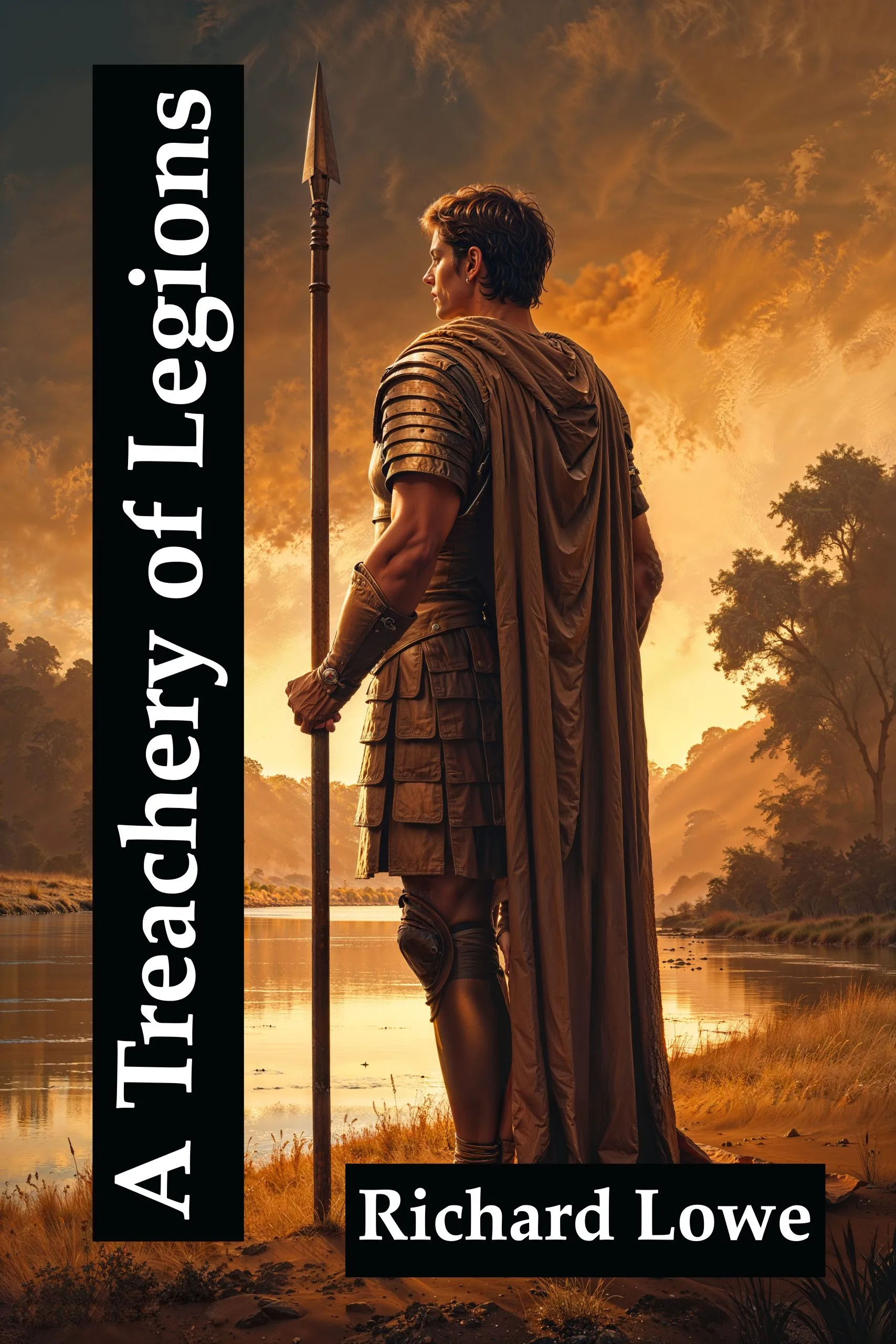
My novel A Treachery of Legions is set in Rome in 69 AD, the year of four emperors, told by Marcus Antonius Primus, the man who won at Cremona for the Flavians.
