
A Treachery of Legions
Rome, 69 AD, told at sixty-three by the man who marched
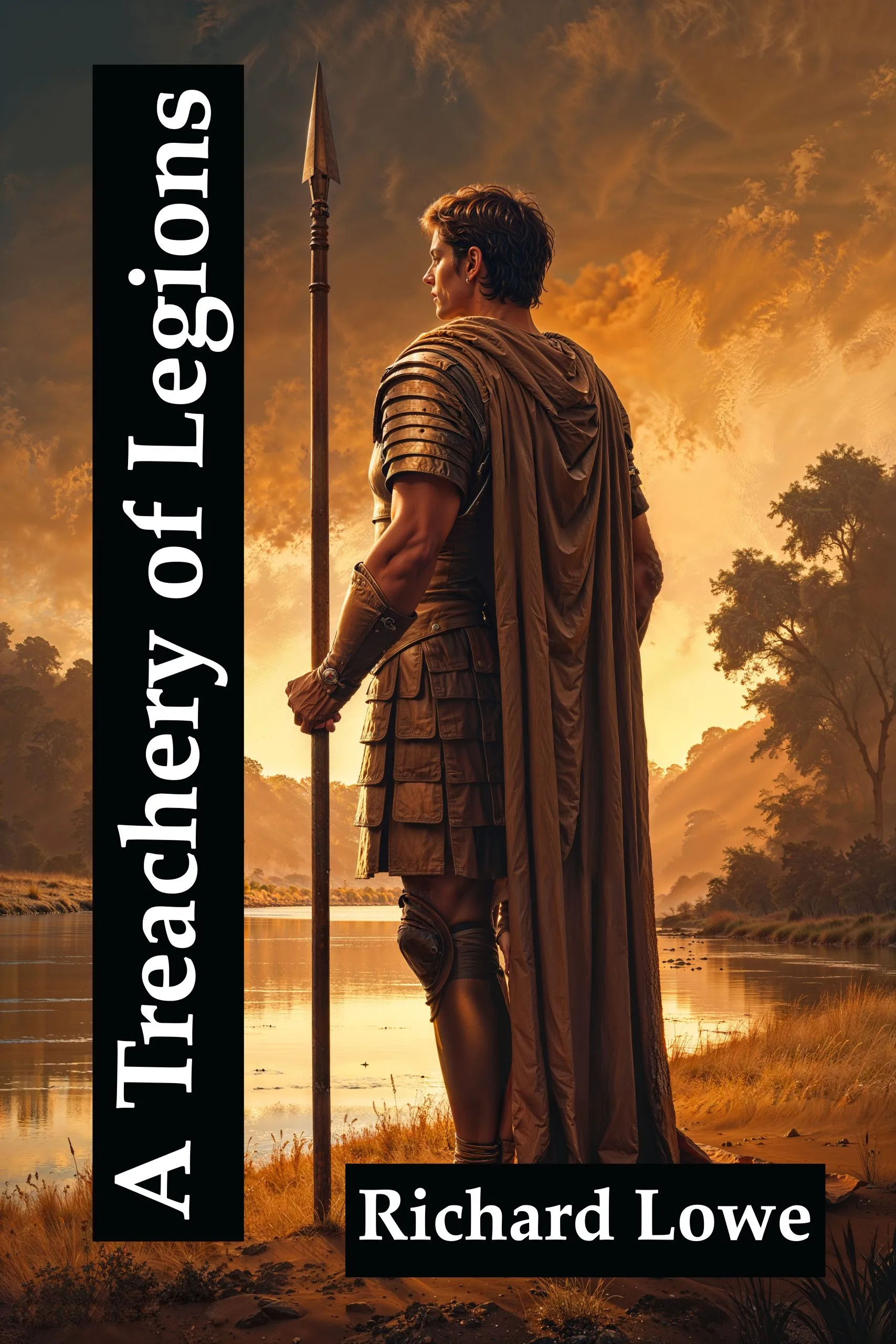 |
Four men will claim the throne before the year is out, and three of them will die for it Standalone · 340 pages · First person, Primus at sixty-three BUY FROM INGRAMSPARKAMAZONKOBOREAD A CHAPTERTABLE OF CONTENTS Paperback ISBN 978-1-972810-22-4 · ebook ISBN 978-1-972810-23-1 |
| 340Pages | 69AD | 4Emperors in twelve months | 63His age, telling it |
Otho died because of what I did.
Marcus Antonius Primus, from the novel
Marcus Antonius Primus spent twenty years earning everything Rome gives a man who started with nothing. In 69 AD he marched without orders, won at Cremona, and let a city burn, and the empire he handed to the Flavians had no further use for him afterward.
He tells it himself at sixty-three, with decades to have settled on a version he can live with. The major events are documented: the Year of the Four Emperors, the Flavian march, the second battle of Cremona, the sack. The interior life is invented, and so is the marriage, and so is the woman across the Danube.
More on the real subject behind this book: AD 69, the year Rome had four emperors, the battles, the sources, and what the legions discovered about power. The eyewitness side of those years is in Reading Josephus, on the historian who watched Rome crush Judea and how to pick a translation.
For readers of Robert Harris and Steven Saylor, and of Damion Hunter’s Centurion novels.
How does A Treachery of Legions open?
Prologue, and Toulouse, 49 AD
The room smelled of lamp oil and cold stone and silence.
He wasn’t a tall man. I’d expected tall. The dispatches from the east described him in the language men use for generals they respect, steady, capable, a soldier’s soldier, and I’d built a picture from those words that didn’t match the compact, unremarkable figure standing three feet from me with a sword leveled at my throat.
The blade was plain iron, no decoration, the grip wrapped in plain leather worn to the shape of his hand. The kind of sword a man carries because he intends to use it, not because he wants anyone to look at it. It needed sharpening.
He hadn’t sharpened it. That was also information.
He hadn’t raised his voice. He hadn’t called guards. He’d waited until the last of his attendants cleared the threshold, and then he’d drawn the sword with the economy of a man performing a task he’d thought about well in advance.
The point was close enough that I could feel the cold coming off the iron.
I didn’t step back.
Not because it was brave. I didn’t step back because stepping back would have told him something about me that I didn’t want him to know, and in that room, in that moment, there was little I still controlled. What I did with my feet was one of the things I could still choose.
He looked at me the way a man looks at a contract before he signs it. Checking the terms. Making certain he’d read them correctly the first time.
Outside, Rome moved through its morning. Carts on the stones. Someone shouting at a slave in the street below.
The ordinary machinery of a city that had spent the last year watching men kill each other over who got to stand in this room.
The man holding the sword had won. I’d helped him win. These were facts we both held, and they didn’t explain the sword, except that they explained it completely.
I’d come to this room believing I understood my position. Standing inside it, three feet from that blade, I began to revise.
His face told me nothing. That was itself a kind of information. Angry men show their anger.
Frightened men show something behind the eyes. This man showed me the same face he probably showed a river he was deciding whether to cross: assessment, patience, the willingness to wait for the right moment and no feeling about the waiting.
He had been a soldier longer than I had. I’d forgotten that. Or chosen to forget it, which amounts to the same thing.
The lamp on the table between us guttered once in a draft from somewhere and the light shifted and for a moment the shadows under his eyes deepened and he looked like what he was: a man past sixty who had spent forty years in the field and was now standing in a palace in Rome with a sword in his hand and a question he hadn’t yet asked.
He drew a breath.
He opened his mouth.
And I thought: here it is. The thing I’ve been walking toward since that morning on a road in Toulouse when I was eleven years old and a legion came down out of the north and a cavalryman laughed at me, not unkindly, and I felt for the first time the weight of being the thing other men look past.
I waited for the question.
* * *
I was eleven years old the first time I saw a Roman legion on the march and I have never entirely recovered from it. I say this from the vantage of sixty-three, which gives it more dignity than it deserves. What happened was that a small boy in a road forgot to fill the water jars because he was looking at soldiers, and a large and complicated set of consequences followed from that forgetting, and I’ve spent fifty years pretending the large and complicated consequences were the result of deliberate decision, not distraction.
They were mostly distraction. The deliberate decisions came later, once the distraction had already committed me to a direction.
They came down the road from the north in the early morning, before the heat, the way soldiers learn to move when they’ve been doing it long enough to know the morning is the only part of the day that belongs to them. I’d gone out to fill the water jars from the well at the edge of our land. I stood in the road with the empty jars and watched them come and I forgot entirely about the water.
My father’s employer owned the land. We worked it. That was the arrangement, stated plainly, with no parts left out.
The senator had a name I won’t bother with because he mattered to my life only as the reason we lived where we lived and ate what we ate. He was in Rome. He was always in Rome.
His land manager came twice a year to collect what was owed and inspect the fields with the bored attention of a man whose mind is always somewhere more important, and the rest of the time we were left to the work, which was sufficient to fill every hour a man had and several he didn’t.
My father was a good farmer. He understood soil and water and the timing of things. My mother had borne six children.
Four of us had lived past the second year. This wasn’t considered unusual. The two who didn’t, a girl the winter I was four, a boy who came after me and left before I was old enough to understand what leaving meant, were mourned and buried and then the work continued, because the work continued regardless.
The chapter keeps going.
Who should read A Treachery of Legions?
|
Read it if
|
Not for you if
|
► Behind the Book: A Treachery of Legions
How this one got written, what went wrong, and what got cut.
How did A Treachery of Legions come about?
Richard Lowe, the Writing King
I read the Centurion books in my twenties, found in a secondhand shop and read over a long weekend the way you read things when a book catches you exactly right. What stayed with me wasn’t the battles. It was the texture around them. The cold of a British morning. The weight of equipment worn long enough that the body has stopped noticing it. Men in close quarters for years without any of the machinery civilian life provides for managing that.
I was sixty-three when I started this one. I had been thinking about that weekend for forty years.
The year wasn’t an accident. In 69 AD four men held the throne inside twelve months, and the machinery that holds an empire together is briefly visible because it’s briefly breaking down. You can see what the legions were and what military competence was worth politically. That seemed like the right place to put a man who has spent his life learning how things really work.
What do people ask about A Treachery of Legions?
Also in The Deep Past
|
Seventy-four thousand years ago, the sky closed |
Three of them will die for it
He was there for most of the reasons why.
BUY FROM INGRAMSPARKAMAZONKOBOREAD A CHAPTERTABLE OF CONTENTS
Paperback and ebook.
First March
A Treachery of Legions
The centurion who first had charge of us was named Calvus, and he was the best soldier I ever knew, which I say having known a great many soldiers and having been, in the end, counted among them.
He appeared at the muster point on the morning we were to march, walked once around the assembled forty-three of us without expression, and then stood in front of us with his vine staff tucked under his arm and looked at us the way a man looks at a field he’s been given to work that’s in worse condition than he was told to expect.
He wasn’t a large man. He was perhaps forty, with a broken nose that had healed sideways and the kind of face that’s been outdoors in all weathers for so long that it no longer tones what the weather is doing. He wore his equipment with the easiness of a man who has worn equipment so long he’s stopped noticing it, the way you stop noticing your own skin.
“Right,” he said. His voice wasn’t loud. It didn’t need to be. “I’m going to tell you one thing and one thing only, and I’m going to tell it to you now because I won’t have time to repeat it and because everything else you need to know follows from it.
You listening?”
Forty-three men indicated in ways that they were listening.
“From this moment you belong to Rome. Not to your families. Not to your farms.
Not to whatever gods you pray to or whatever debts you owe or whatever woman you left behind who may or may not wait for you. Rome. Rome doesn’t care what you were before this moment.
Rome cares only what you do from this moment. That’s the agreement. That’s all the agreement there is.”
He paused. The merchant’s son started to raise his hand.
“Put your hand down,” Calvus said, without looking at him.
The hand went down.
“Good. Anyone who cannot live with that agreement has until I finish speaking to say so, and I’ll note their name and send them home and they can explain to their fathers and their neighbors and whoever else cares that they declined the agreement. Anyone?”
No one said anything.
“Outstanding,” Calvus said, with no more warmth than he’d said everything else. “Then we march.”
The first day wasn’t difficult. The road was good and the weather was mild and most of us were strong from farm work and didn’t yet understand what we were asking of our bodies. We talked on the march, all of us, the way men talk when they don’t yet know they should save their breath.
The second day was harder. The road climbed into rougher country and the temperature dropped and several men developed blisters bad enough to change their stride, which changes everything else over a long march. The merchant’s son, whose name was Flaccus, developed a persistent cough that he tried to suppress and couldn’t.
He was a soft-featured young man who had clearly never intended to be here and was discovering this wasn’t an adequate reason to leave. He suppressed the cough with the focused determination of someone who has decided that not coughing is a matter of personal character. He was wrong about this but I respected the effort.
He was discharged in the second year, the cough having become something the army surgeon wouldn’t certify as serviceable, and I heard he walked home from the Danubian posting. I don’t know if that’s true. I heard it from Ambiorix. That means it may have been a story Ambiorix liked instead of a fact.
On the second evening Calvus sat with a group of us around the fire and talked about the frontier. Not this frontier, the Rhine. He’d served there for eleven years before his Danubian posting.
“The forest is still wrong up there,” he said. He meant the Teutoburg, where Varus had lost three legions to Arminius sixty years before. Not a battle.
A slaughter. Seventeen thousand men gone in three days. “You can feel it when you march through that country. The Germans know it too.
They’ve been living on that memory ever since.”
Table of contents
A Treachery of Legions
- Prologue
- Toulouse, 49 AD
- First March
- The Vine Staff
- The Decade
- Rome, 58 AD
- Julia, 58 AD
- The Letters Begin
- Nero’s Rome, 62 AD
- Exile
- Galba, 68 AD
- The Danube
- First Contact
- The Hall
- Julia in Rome
- The Legion
- Brunhild Again
- 69 AD, January
- The Betrayal
- Bedriacum One
- Vitellius
- The Switch
- The Riverside
- Julia Moves
- Brunhild
- The March Begins
- Verona
- October 24th
- Cremona
- The Road to Rome
- Rome, December 69 AD
- Julia
- The Insignia
- Cremona’s Ghost
- The Summons
- The Sword
- What Remains