Latest
The Money Appeared the Week After the DisasterHow a Stranger Decides You Are Credible in Nine SecondsWhat You Have to Decide Before Anybody WritesWriting It Before You Need ItCross Training Covered Everything Except the Role That Mattered MostBehind the Book: The Woke VirusBehind the Book: Galactic InvasionBehind the Book: You Don’t Own Anything AnymoreWhat’s New at The Writing King: Week of November 8, 2026Alexander Zhidkov: Decision MakingJessi Szurek: Expand Your RangeYou Don’t Own Anything AnymoreThe Budget Decided How My Department Was ShapedWhy Your Competitor’s Book Is Working and Yours Would NotWhy Are These Guys Smiling? A Business Book That Became a Wrestling MemoirPangram Wants to Decide Who Gets PublishedWhat You Have Enough Material For Right NowWhen a Book Is the Wrong ToolThe Woke VirusGalactic InvasionChatGPT Turns Four: From a Free Research Preview to GPT-6What’s New at The Writing King: Week of November 1, 2026Diwali: The Festival of Lights and the Story Behind the LampsHow Much Water and Power Does Heavy AI Use Take? I Ran My Own NumbersBad Boys: Ride or Die (2024)Vesuvius Day: The Teenager Who Wrote Down Pompeii’s Last DayAnti-Communism Week: Remembering the Writers Communism SilencedVoyager 1 One Light-Day: Fifty Years to Travel One Day of LightVellum Added an Optional AI Feature. A Pile-On Killed It in a Day.Are AI Subscriptions Losing Money? The Gym Membership Math Says NoAI Terms Every Writer Should Know, and Why Each One MattersWorking While Sick: What 24/7 On Call Cost MeHe Banned AI From His Writing Group. His Own Cover Got Called AI Slop.Who Writes the Fake Fan Mail Authors Get? Inside the Scam CompoundsSMS Appointment RemindersFree BooksDarrell Stern: Stop Being Invisible, Become UnmissableJoe Rockey: Ghostwriting His BookHow to Turn Your Expertise Into a Book People Want to Read | The Expert MethodWhat’s New at The Writing King: Week of October 25, 2026Challenger Remembrance Day: The Engineer Who Wouldn’t SignJoel Salomon: The Truth About MoneyReddit Is Putting Up a Login Wall. Wikipedia Won’t Be Far Behind.Victoria Chemko: The Body Is the First TechnologySir Patrick Stewart: A TributeA Year in the Bank: ADHD, Face Blindness and the Freedom to Walk Out | The Impossible Puzzles Show, Episode 326A Yale Economist Says We Won’t Be Missed. He Forgot the Bread Line.Walter Koenig: A TributeI Don’t Post Bad ARC Reviews. I Send the Author a Note.AI Has Paid Off Outside Tech. Apollo Is Reading the Wrong Scoreboard.
The Writing King Your Ethical Ghostwriter. Your Story, Done Right.

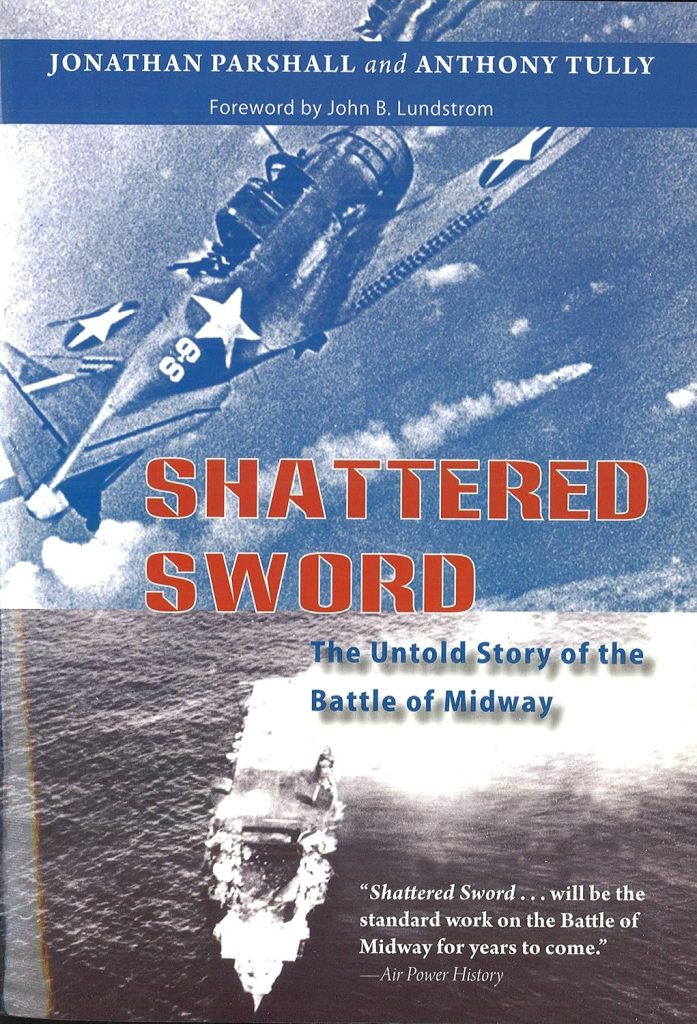
Shattered Sword: The Untold Story of the Battle of Midway

Shattered Sword: The Untold Story of the Battle of Midway

The Untold Story of the Battle of Midway

Category:History
Publisher:Potomac Books
ISBN:1574889230
Pages:640
ISBN:9781574889239
Language:English
Share:

Buy Now

Description:

TL;DR

Jonathan Parshall and Anthony Tully retell the Battle of Midway from the Japanese side, using Japanese records to overturn decades of accepted history. It’s one of the two nonfiction books I keep rereading.

Most Americans learned the Battle of Midway as a miracle. American dive bombers arrive at the perfect moment, just as the Japanese carriers are about to launch their planes, and three carriers burn within minutes.

Shattered Sword argues that the story everybody repeats is wrong in important ways, and it shows why.

What is Shattered Sword about?

The June 1942 Battle of Midway, told largely from the Japanese side. Jonathan Parshall and Anthony Tully went back to Japanese primary and secondary sources and rebuilt the battle from them. What went wrong for Japan, and why they lost, is the subject.

Their central argument is about the sources.

Western histories leaned heavily on Admiral Nagumo’s after-action report, on postwar American interrogations and above all on the memoir of Mitsuo Fuchida, a Japanese participant whose account was self-serving and, the authors show, wrong in places. Strip those away and work from the operational records, and the familiar picture changes.

The Japanese carriers weren’t seconds from launching a counterstrike. The odds weren’t as lopsided as legend says. The authors explain how Japanese carrier doctrine shaped the choices Nagumo had in front of him, and why decisions that look foolish in the old story made sense at the time.

Then there’s the back matter. Eleven appendices cover everything from flight operations to carrier casualties, including an essay arguing that a Japanese landing on Midway itself would probably have failed.

Why did I find Shattered Sword hard going?

It’s dense. Back in 2024 I was trying to read a book a week, and this was one of the tougher ones. It runs 640 pages and assumes you’re willing to follow carrier deck cycles in detail.

I found what went wrong interesting enough to keep going, and it’s become one of the books I return to.

Why a battle turned out the way it did is endlessly interesting to me.

How was Shattered Sword received?

Very well among naval historians. It won the North American Society for Oceanic History’s John Lyman Book Award in 2005 and was reviewed in the Naval War College Review and other journals. Potomac Books published the first edition, and the University of Nebraska Press later reissued it. Neither author was an academic historian. Parshall had founded combinedfleet.com, a website devoted to research on the Imperial Japanese Navy, and Tully was one of its leading researchers. Two independent researchers rewrote the standard account of a heavily studied battle, and the professionals agreed.

What should writers take from Shattered Sword?

Check the source behind the source.

A whole generation of histories repeated one participant’s memory because it was available and dramatic. Writers of military fiction, and of memoir, fall into the same trap when they trust one account. Parshall and Tully went to the records, and the records told a different story.

For a novelist, the lesson is practical. The famous version of an event is usually the one somebody had a reason to tell, and the details that make a scene feel true, the time it took to spot a deck, arm the planes and get them aloft, live in the dull operational paperwork nobody quotes.

Keep reading

Writing military fiction: research that matters, and why primary sources beat the version everybody repeats.

Sources

Frequently Asked Questions

Which battle does Shattered Sword cover?
The Battle of Midway in June 1942, retold mainly from the Japanese side using Japanese sources. It challenges several long-accepted parts of the American version of the battle.
Who are the authors of Shattered Sword?
Jonathan Parshall and Anthony Tully wrote it, and Potomac Books published it in 2005.
Was Mitsuo Fuchida’s account of Midway accurate?
No. Shattered Sword argues that Fuchida’s memoir, a source Western historians relied on for decades, was self-serving and wrong on key points. One of them was the claim that Japanese carriers were moments from launching when they were hit.
Did Shattered Sword win an award?
Yes. It won the John Lyman Book Award from the North American Society for Oceanic History in 2005.
How long is Shattered Sword?
About 640 pages, with 24 chapters and 11 appendices.
Is Shattered Sword good for writers of military fiction?
Yes. It shows how operational detail and doctrine shaped real decisions, and how a widely repeated account can be wrong.
Categories and tags

About the author

Jonathan Parshall and Anthony Tully

Anthony Tully

Anthony Tully is an independent naval historian and one of the leading researchers behind combinedfleet.com. He co-wrote Shattered Sword with Jonathan Parshall, rebuilding the Battle of Midway from Japanese records.

More about Anthony Tully

Jonathan Parshall

Jonathan Parshall is an independent naval historian who founded combinedfleet.com, a website devoted to research on the Imperial Japanese Navy. With Anthony Tully he wrote Shattered Sword, a retelling of the Battle of Midway from Japanese sources that won the John Lyman Book Award.

More about Jonathan Parshall

Back