
Nero died in June of 68, abandoned in a villa four miles outside Rome with four attendants left. The Julio-Claudian line ended with him, and for the first time in almost a century nobody knew who was supposed to rule. What followed was the first civil war the empire had seen since the last days of the Republic. It ran roughly eighteen months and produced four emperors, three of whom died violently.
I think AD 69 is the most frightening year in Roman history. A working state came apart in about eighteen months once the people holding it together stopped pretending, and men who’d stood side by side in April were killing each other outside Cremona by October. I can’t read Tacitus on it without feeling sorry for the ordinary legionary, who paid for every one of those ambitions and got nothing back.
What was the Year of the Four Emperors?
The sequence is worth having straight, because the speed is the point.
Galba. Governor of Nearer Spain, in his seventies, marched on Rome and was recognized after Nero’s suicide. He arrived with a reputation for severity and immediately confirmed it. He refused to pay the bonus the Praetorian Guard believed it had been promised, and told them he levied his soldiers and didn’t buy them. It was principled and it killed him. On 15 January 69 the Praetorians murdered him in the Forum. His body lay in the street until a common soldier took the head and carried it to Otho.
Otho. He’d come to Rome as Galba’s supporter and turned on him when Galba named someone else as heir. The Senate declared him emperor the same day Galba died. He held it for about three months.
Vitellius. The legions on the Rhine had already acclaimed him on the first days of January, before Galba was even dead. His armies came south, met Otho’s at Bedriacum near Cremona on 14 April, and won. Roughly fifty thousand men on Otho’s side, seventy thousand on Vitellius’s, and about forty thousand dead. Otho killed himself two days later, and the ancient writers admired him for it more than for anything he did alive.
Vespasian. He was in Judaea putting down a revolt. In July the legions of Egypt, Judaea, and Syria declared for him. His forces beat Vitellius’s army at Bedriacum again in October, on the same ground. In December Vitellius was dragged through Rome and killed, and on 22 December the Senate confirmed Vespasian, who went on to found the Flavian dynasty and rule for ten years.
Why did the empire come apart so fast?
Because a secret got out, and Tacitus is the one who names it. The empire had learned that an emperor could be made somewhere other than Rome.
Augustus and his heirs had ruled through a legal fiction: the princeps was first among citizens, confirmed by the Senate, legitimate because the arrangement was old. Nero’s death removed the family the fiction was attached to, and what was left underneath was arithmetic. Whoever the legions supported was emperor. Galba proved it by taking the throne from Spain. Vitellius proved it from the Rhine. Vespasian proved it from Judaea. Once three men in one year had done it, the demonstration was complete, and every later century of Roman history is downstream of that lesson.
What was Bedriacum like on the ground?
Two battles were fought on nearly the same ground, six months apart, and the first is where the year stops being politics.
Around a hundred and twenty thousand men in the field. Legions that had served together, in some cases men who had transferred between the units now opposite them. That’s what separates a civil war from a foreign one: the enemy formation uses your drill, equipment and signals, and you may know its centurions by name.
Forty thousand dead in an afternoon. To put that in a frame, it’s comparable to the worst single days of the American Civil War, achieved with edged weapons at arm’s length. Every one of those deaths required a Roman soldier to close with another Roman soldier and finish it by hand.
The second battle took Cremona itself, and the winning army sacked the city for four days. That army fought for the man history would remember as the emperor who restored order. I find that hard to accept. Four days of plunder against a Roman city, and the textbooks call it restoration.
How do we know what happened in AD 69?
Three sources, and they don’t agree.
Tacitus wrote the Histories around forty years later, and his account of 69 is the best narrative history to survive from the ancient world. He’s also writing under later emperors, with a senatorial view of events and a settled opinion about what the year proved.
Suetonius wrote biographies, not history. He collected anecdote, gossip, and physical detail. That makes him essential and unreliable in the same paragraph.
Cassius Dio wrote more than a century later, and survives partly in later summaries of his work instead of in his own words.
All three treat Vitellius as a glutton and a monster, and modern historians have questioned it. Greenhalgh argued the cruelty is exaggerated, that Vitellius showed real respect for the Senate, and that he tried to appeal across Roman society. The picture we have is the one written by people whose side won. That’s the standing problem with this year. Vespasian’s dynasty ruled for twenty-seven years. Men who knew how the story ended, and who benefited from it ending that way, wrote every surviving account.
What did the year feel like from the ranks?
The sources are written from the top. That’s where they’re least useful and where the novel goes.
The picture we have is the one written by people whose side won.
A legionary in 69 changed emperors up to four times without moving. He swore an oath to Galba. Then to Otho. Then, if he was on the wrong side at Bedriacum, he was pardoned and folded into Vitellius’s army, and swore again. Then in October he was on a field near Cremona against men he’d stood beside in April.
The oath wasn’t a formality. The sacramentum was religious, sworn to a person, and breaking it was sacrilege. Four in a year isn’t cynicism, it’s a system asking men to do something the system itself had made meaningless.
Four in a year isn’t cynicism, it’s a system asking men to do something the system itself had made meaningless.Share on X
Add the practical detail. Marching from the Rhine to Italy took weeks. Vitellius’s army looted its way down the peninsula because armies on the move fed themselves. Winter crossings of the Alps. Rations, boots, and the constant question of whether the man beside you’d still be on your side next month.
None of that is in Tacitus, because Tacitus is writing about the Senate, and I think that’s the biggest hole in the whole record. The men who did the killing and the dying are a backdrop in every surviving account. They swore the oaths, crossed the Alps in winter and buried their friends at Bedriacum, and the historians treated them like weather.
What happened outside Italy while Rome changed hands?
The year is usually told as a Roman story. That understates it. An empire distracted by its own succession is an empire not watching its edges.
In Judaea the revolt Vespasian had been suppressing since 67 didn’t pause because he left for Rome. His son Titus finished it, and Jerusalem fell in 70 with the destruction of the Second Temple, an event that reshaped Judaism permanently and that happens in the immediate aftermath of the civil war and not separately from it.
On the Rhine, the Batavians revolted in 69 under Julius Civilis, who had served Rome and knew exactly how thin the frontier had become once the legions marched south. The revolt ran into 70 and at one point looked capable of detaching the whole northwest.
Both of those are consequences of the same fact. Legions used for a succession fight are legions not standing on a border, and the empire spent the following two years paying for the year it spent on itself.
Was Vitellius really the monster the sources describe?
Probably not, and the question is a useful lesson in reading any ancient account.
Tacitus and Suetonius give him gluttony on a comic scale and cruelty toward suspected enemies. Both were writing after the Flavians had won and had every reason to establish that the man Vespasian removed deserved removing.
The counter-case is circumstantial but real. He kept the Senate involved, tried to build support across classes, and when he was cornered at the end he sent envoys and even Vestal Virgins to sue for peace. That isn’t the behavior the caricature predicts.
None of that makes him a good emperor. It makes him a man whose eight months were written up by the people who killed him, and there’s no independent account to check them against. That’s the ordinary condition of ancient history and it’s worth holding in mind every time a source is unusually confident about a loser’s character.
Why write about the Year of the Four Emperors as a novel?
A Treachery of Legions is about Marcus Antonius Primus, and he’s the reason the book exists.
Primus is the man who, more than anyone, won the civil war for Vespasian. He commanded the Danubian legions, moved them, marched on Rome, and delivered the victory. Without him Vespasian probably doesn’t take the throne, and I suspect Vespasian knew it. For doing the decisive thing he got no triumph. He retired and disappeared from history. His early life is undocumented and his later life is undocumented, so the man who made the emperor was set aside once he’d served his purpose and the record goes silent at both ends.
That treatment was a disgrace. Primus did the one thing Vespasian couldn’t do for himself and was paid in silence, and powerful men have always been glad to keep the victory and lose the name of whoever delivered it. Giving him his name back was the part of the book I cared about most.
That silence is what a novelist wants. A real man at the hinge of the whole war, with the before and after missing, and a set of events in the middle that are documented in detail.
The appetite for it came from a long way back. I read Damian Hunter’s Centurion books in my twenties, found them in a secondhand shop and went through the lot over a weekend. What stayed wasn’t the battles but the detail around them: the cold of a frontier morning, equipment worn so long the body stops noticing it, and the way men in close quarters manage each other without any of the machinery civilian life provides.
Then forty years of everything else. The BBC I, Claudius a dozen times, HBO’s Rome, an architecture book I traced through to learn how the physical empire was assembled, Josephus for the Judean revolt, and Masada. I was sixty-three when I started writing it, carrying that weekend around for forty years.
What does historical fiction owe the historical record?
The rule I work by is that the record constrains what happened and says almost nothing about what it was like, and the second is the novel’s job. What’s fixed: the dates, the battles, the outcomes, the named men and their ends. Galba dies on 15 January. Otho kills himself after Bedriacum. Vitellius is dragged through the streets in December. A novel that moves any of that is writing fantasy with Roman names.
What’s open: everything a person felt, said in private, believed about the men they served, and did in the hours the sources skip. Nobody wrote down what a legionary thought about his fourth oath, so that part was never in the record to begin with, and filling it is the novelist’s whole job. I get impatient with critics who call that invention, because the alternative is writing as though those men had no inner lives at all.
The trap in Roman fiction is the modern conscience. Giving a first-century soldier a twenty-first-century view of slavery, empire, or violence makes him legible and makes him false. He can be decent within his own frame, and the frame isn’t ours. That gap is the most interesting thing available to a writer working in this period, and most books close it because leaving it open is uncomfortable.
My take
Historical fiction does its best work when it gives a forgotten man his name back. Primus did the work Vespasian couldn’t do for himself, and the record barely mentions him afterward. That gap in the record is a gift to a novelist. Read the year for what it taught the empire, that legions could make emperors outside Rome. And watch who gets the credit after any victory. It’s rarely the person who delivered it.
What 69 established
Vespasian restored order, and the phrase deserves examination, because what he restored was a system that had just shown everyone how it could be seized.
The Flavians lasted twenty-seven years and ended with Domitian assassinated. The pattern of 69 recurs across the next four centuries, most spectacularly in 193 with five emperors in a year, and again through the third century when emperors came and went in months.
The empire never solved succession. It had no mechanism for choosing a ruler that didn’t rest on which army was closest and best paid. Everything after 69 is a series of attempts to paper over a fact that year made impossible to unsee.
That’s the subject underneath the novel: the moment a system learned it was held together by an agreement everyone had stopped believing. I think it’s the most honest lesson Rome ever taught, and it’s unjust that the men who learned it at Bedriacum got buried in a field while the ones at the top got written into history as the saviors.
The book is A Treachery of Legions. The rest of the research behind the fiction is collected in the writing hub. The writing side of it is in how the book came together.
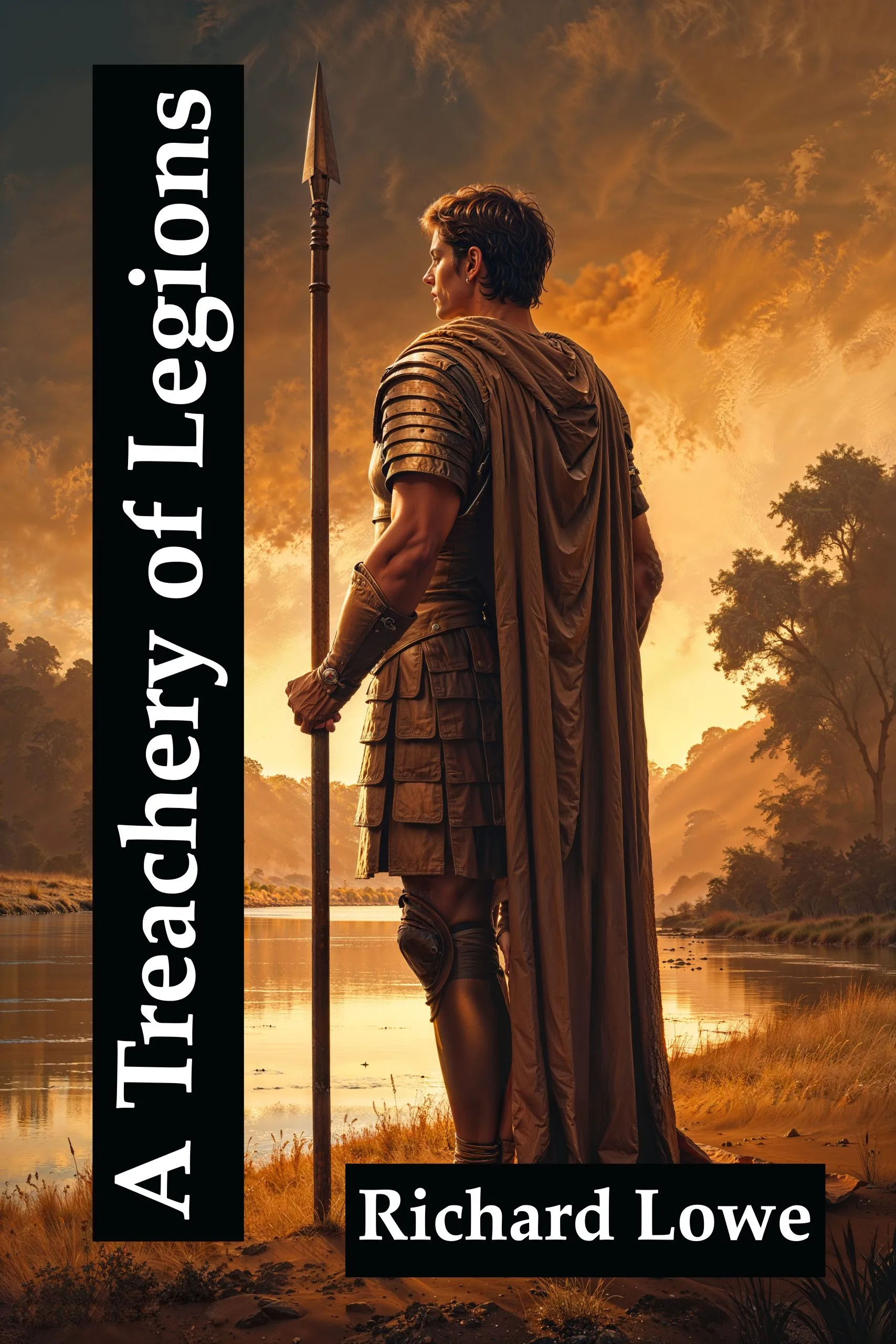
Marcus Antonius Primus marched without orders, won at Cremona, and let a city burn. A Treachery of Legions is that year told by him at sixty-three.
