
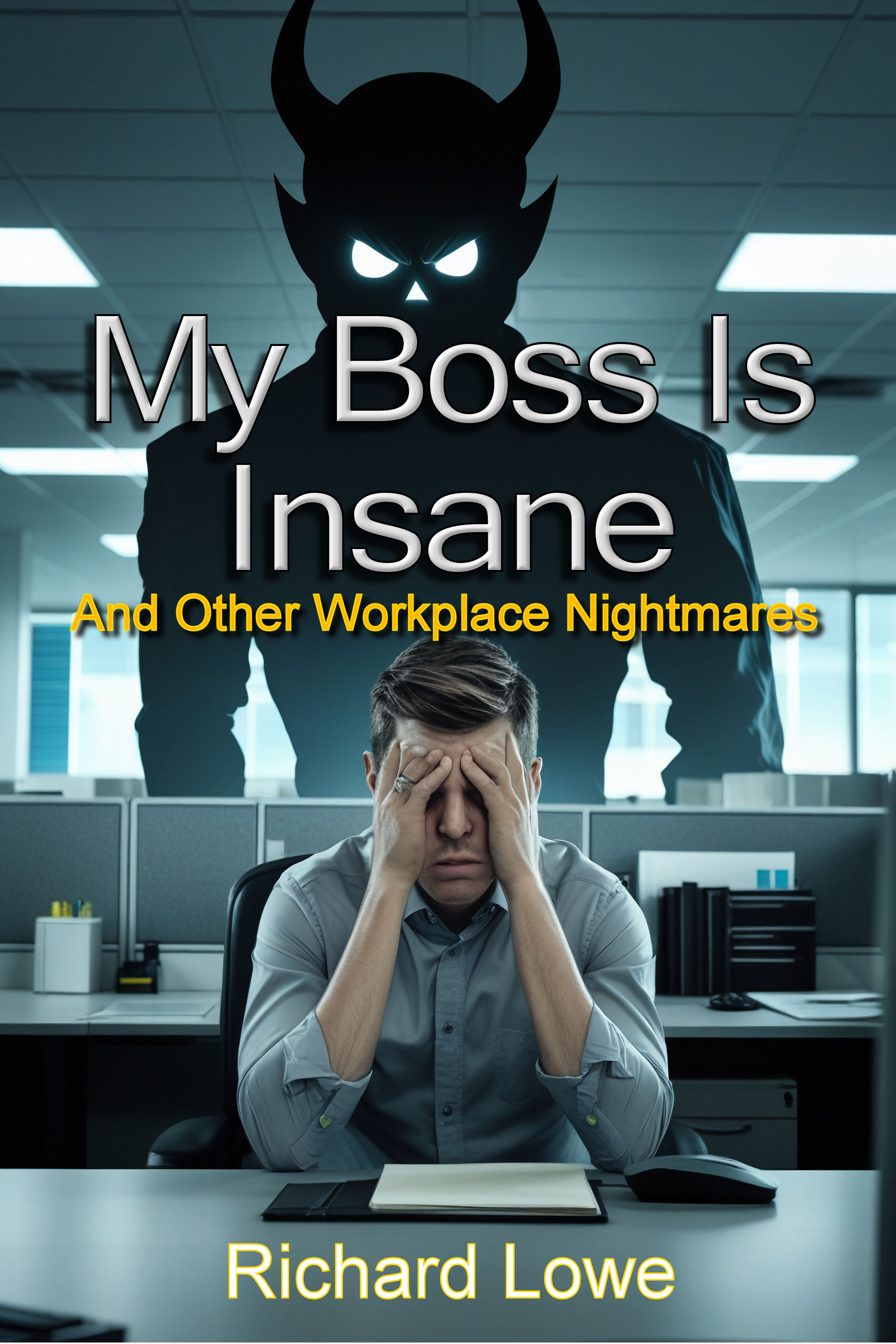
My Boss is Insane
And Other Workplace Nightmares
 |
They all think they’re the only one BUY FROM INGRAMSPARKAMAZONKOBOREAD A CHAPTERTABLE OF CONTENTS 120 pages · Paperback ISBN 978-1-972810-28-6 · ebook ISBN 978-1-946458-65-0 |
| 120Pages | 19Chapters | 9Kinds of bad boss | 0Stories invented |
They all think they are the only one
Every week somebody tells me about their boss. The micromanager who tracks bathroom breaks. The liar who takes credit and reassigns blame. The one who makes jokes in meetings that nobody laughs at and everybody remembers. The screamer.
The stories are depressingly similar to the ones I lived through across thirty-three years in corporate America. The names change and the logos change. The pattern never does. Bad managers get promoted, good people quit, and the whole thing runs again with a fresh set of victims.
The isolation is the cruelest part. People believe they’re uniquely unlucky. They blame themselves for failing to handle treatment that would break anyone. They stay because they have no idea how ordinary their situation is.
This book exists to break that. Every story in it happened, with the names and details changed. You’re not the only one. You’re not imagining it. You’re not stuck, though it’ll feel that way until somebody says otherwise.
What is inside My Boss is Insane?
|
The catalog
|
The serious ones
|
|
Protecting yourself
|
Getting out
|
Who should read My Boss is Insane?
|
Read it if
|
Not for you if
|
Why did I write My Boss is Insane?
Richard Lowe, the Writing King
Thirty-three years in corporate America. I’ve reported to several of the people in this book and I’ve had to manage a couple of them out. Every story here happened to somebody real, with the names and details changed to protect them. None of it is a composite invented to make a point.
► Behind the Book: My Boss is Insane
How this one got written, what went wrong, and what got cut.
► My Boss Was Incompetent and Untouchable. I’d Eighteen Months Left.
One story from behind this book.
What do people ask about My Boss is Insane?
Also in The Working Life
|
Taking Back Control of Your Working Life |
The Honest Guide to Job Searching |
|
A Survival Guide for Modern Professionals |
Street-Smart Management Wisdom Management Without BS |
|
Cutting Through the BS |
You have more power than you think
Your career is too important to leave in the hands of someone like that.
BUY FROM INGRAMSPARKAMAZONKOBOREAD A CHAPTERTABLE OF CONTENTS
Paperback and ebook.
A chapter
My Boss is Insane
After dealing with toxic bosses for over three decades, I’ve learned one fundamental truth: your memory means nothing, your word means nothing, and witness testimony means nothing. The only thing that matters in workplace disputes is what you can prove with documentation.
I learned this lesson the hard way when I tried to challenge a manager’s behavior without proper evidence. My boss, Frank, had a pattern of making promises in verbal conversations and then denying he’d ever made them. He’d agree to budget increases in meetings, then claim he never approved the spending. He’d promise promotions and raises to team members, then act surprised when they brought up his commitments.
The breaking point came when Frank promised our entire team bonuses for completing a critical project ahead of schedule and under budget. We busted our asses for three months, working nights and weekends to meet his aggressive timeline. When we delivered the project two weeks early and 15% under budget, we were proud of what we’d accomplished.
“Great work, everyone,” Frank announced at our team meeting. “I’ll make sure those bonuses we discussed are in your next paychecks.”
Two weeks later, no bonuses appeared. When I approached Frank about it, he looked at me like I was crazy. “Bonuses? I never promised any bonuses. You must have misunderstood.”
I was furious but powerless. It was my word against his, and he was two levels above me in the organization. When I brought it up with other team members, they all remembered the promise but were afraid to speak up against a manager who controlled their careers.
That’s when I realized that verbal agreements and promises are worthless when dealing with dishonest managers. From that day forward, I documented everything. After every meeting or phone call where decisions are made or commitments given, I send a summary email: “Hi Frank, just wanted to confirm what we discussed. You agreed to approve the $50,000 equipment purchase and said the bonuses for early project completion would be processed by month-end. Please let me know if I misunderstood anything.”
Most of the time, managers don’t respond to these emails, which creates a paper trail showing they didn’t dispute your version of events. This approach saved me twice. In one case, a boss tried to claim I’d never completed a project he’d canceled midway through. My email trail showed his original approval, my progress updates, and his cancellation order. In another situation, a manager tried to give me a negative performance review based on missed deadlines caused by his constantly changing priorities. My documentation showed the timeline of his changing instructions. The review was withdrawn.
Table of contents
My Boss is Insane
- Preface
- Introduction
- Chapter 1: What a Good Boss Actually Looks Like
- Chapter 2: The Boss Is Racist
- Chapter 3: The Boss Is Harassing Religion
- Chapter 4: The Boss Is a Liar
- Chapter 5: The Boss Is Retiring
- Chapter 6: The Boss Is Unethical
- Chapter 7: The Boss Is Micromanaging
- Chapter 8: The Boss Is Psychotic
- Chapter 9: The Boss Is Hostile
- Chapter 10: The Boss Is Sexually Harassing
- Chapter 11: The HR Reality Check
- Chapter 12: Documentation, Your Only Real Protection
- Chapter 13: Managing Up When Your Boss is Broken
- Chapter 14: Exit Strategy Planning
- Chapter 15: Building Boss-Proof Skills
- Chapter 16: Mental Health and Recovery
- Chapter 17: Leading Differently
- Chapter 18: Toxic Bosses in the Remote/Hybrid World
- Chapter 19: The Freelancing Alternative
- Conclusion