
My Job Sucks
Taking Back Control of Your Working Life
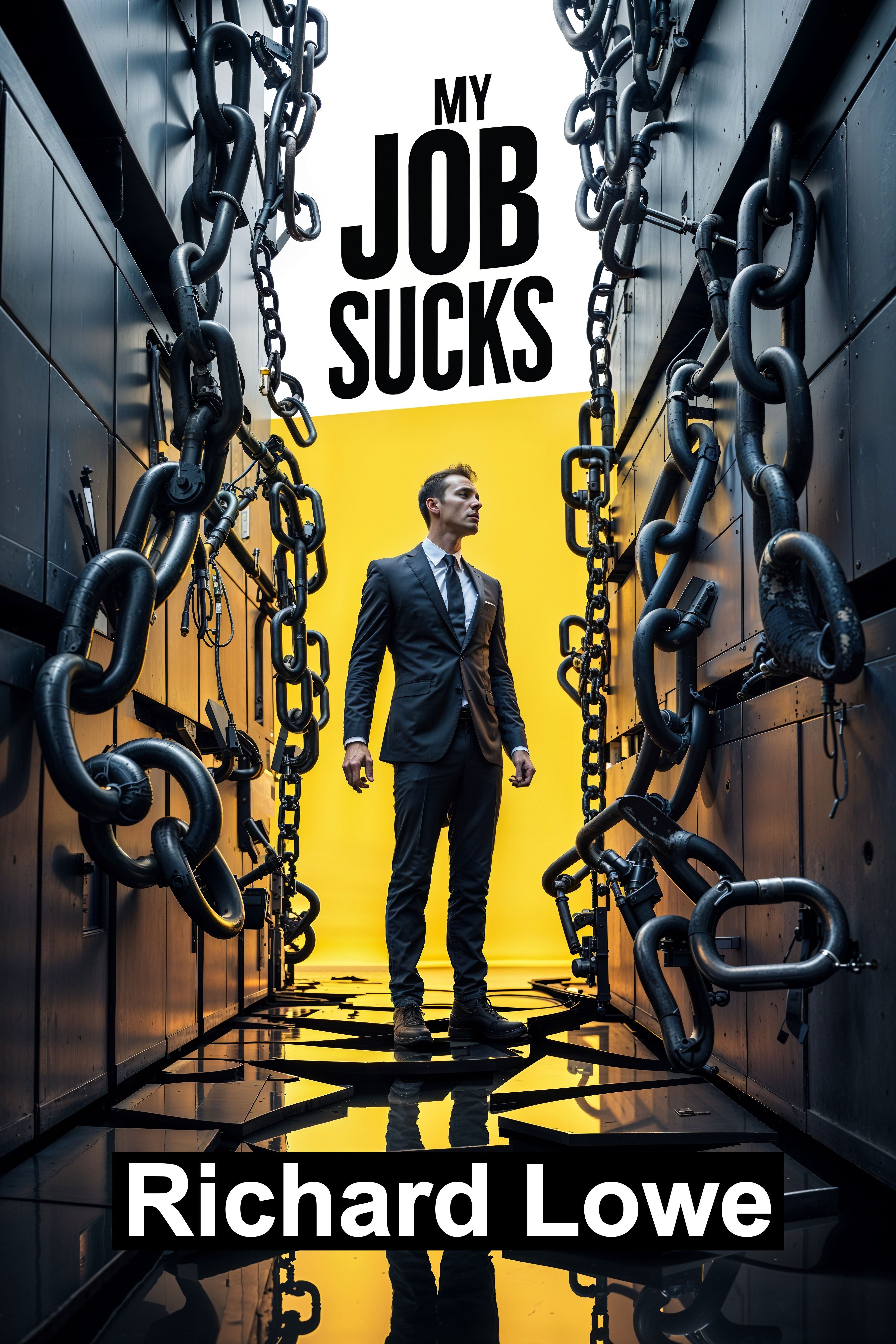 |
You’ve been lied to your entire working life BUY FROM INGRAMSPARKAMAZONKOBOREAD A CHAPTERTABLE OF CONTENTS 158 pages · Paperback ISBN 978-1-946458-39-1 · ebook ISBN 978-1-946458-66-7 |
| 158Pages | 22Chapters | 33Years inside it | $16BCompany he ran ops for |
You have been lied to your entire working life
Every piece of career advice you’ve been handed, every motivational poster, every HR presentation about company values, was built to keep you compliant and grateful and, above all, afraid.
None of that fear is an accident. Companies worked out a long time ago that frightened employees are productive employees. Frightened people don’t ask for raises. They don’t push back. They say thank you when they’re asked to give up a third weekend in a row, and then they apologize for looking tired.
So you carry a knot in your stomach about a quarterly report. You feel sick when a meeting appears on the calendar with no agenda. You check email at eleven at night in case something urgent happened while you were living your life.
Here’s the part they’d rather you didn’t work out. Every morning you decide to hand them eight hours of a finite life. That’s a transaction, not a favor they’re doing you, and the moment you see it that way you have leverage you didn’t know you had.
What is inside My Job Sucks?
|
Seeing it clearly
|
Building leverage
|
|
The long game
|
What comes next
|
Who should read My Job Sucks?
|
Read it if
|
Not for you if
|
Why did I write My Job Sucks?
Richard Lowe, the Writing King
I ran computer operations at Trader Joe’s for twenty years, inside a $16 billion company with 400+ stores and 38,000 employees. I sat in the meetings where headcount got decided and watched the language that came out of them afterward. Nothing here’s a guess about what management is thinking. I was in the room while they thought it.
► Behind the Book: My Job Sucks
How this one got written, what went wrong, and what got cut.
► I Asked for a Weekend Off. My Boss Said Fifteen Minutes or You’re Fired.
One story from behind this book.
What do people ask about My Job Sucks?
Also in The Working Life
|
And Other Workplace Nightmares |
The Honest Guide to Job Searching |
|
A Survival Guide for Modern Professionals |
Street-Smart Management Wisdom Management Without BS |
|
Cutting Through the BS |
You already have the leverage
You just haven’t been counting it.
BUY FROM INGRAMSPARKAMAZONKOBOREAD A CHAPTERTABLE OF CONTENTS
Paperback and ebook.
A chapter
My Job Sucks
HR has successfully rebranded itself as the employee advocate, the workplace counselor, and the guardian of company culture. They’ve convinced people that they exist to solve employee problems, mediate conflicts, and ensure fair treatment. This is perhaps the most dangerous lie in corporate America because it leads employees to trust the very department designed to protect the company from them.
HR’s primary function is legal and financial risk mitigation. Every policy they create, every procedure they implement, and every interaction they have with employees is designed to minimize the company’s liability and maximize their legal defensibility. When HR says they want to help you with a problem, what they really mean is they want to assess whether your problem poses a threat to the company and, if so, eliminate that threat as efficiently as possible.
The “people first” marketing is brilliant because it makes employees voluntarily provide the information HR needs to protect the company against them. You walk into their office thinking you’re getting help, and you walk out having created a documented record of your complaints that can be used to justify whatever action the company wants to take against you.
The open-door policy is a trap disguised as accessibility. They want you to come to them with problems because it creates a documented record of your complaints and gives them the opportunity to control the narrative. When you report harassment, discrimination, or illegal behavior, the first thing HR does is assess whether addressing your complaint serves the company’s interests. If it does, they’ll act. If it doesn’t, they’ll find reasons why your complaint isn’t valid or practical.
The performance improvement plan is HR’s favorite weapon because it creates a documented path to termination that appears fair and objective. PIPs are rarely designed to help employees improve, they’re designed to create evidence that the employee was given opportunities to improve and failed to meet clearly defined expectations. The metrics are often impossible to achieve or subjectively measured, giving managers the flexibility to justify whatever outcome they want.
The exit interview is HR’s final intelligence-gathering operation. They want to know why you’re leaving, what problems you encountered, and whether you might pose any legal threats after departure. The information you provide helps them assess legal risks and prepare defenses against potential claims. Your honest feedback about toxic managers or illegal practices gets filed away to protect the company, not to fix the problems.
To deal with HR, understand their true function and act accordingly. You’re not talking to a counselor or advocate, you’re talking to the company’s legal defense team. Everything you say can and will be used to protect the company’s interests, not yours.
Never go to HR with a problem unless you’re prepared for the consequences of creating a documented record of that problem. If you complain about harassment, be prepared for retaliation disguised as performance management. If you report illegal behavior, be prepared to become the problem employee who creates drama. If you express dissatisfaction with company policies, be prepared to be labeled as not a culture fit.
Table of contents
My Job Sucks
- Introduction: Welcome to the New Reality
- The Perfect Job (From Your Perspective)
- The Perfect Employee (From Corporate’s Perspective)
- The Gig Economy (And How to Use It)
- Red Flags – How to Spot a Toxic Workplace
- Surviving the Disposable Workforce Mentality
- Gaming the Work-Life Balance Illusion
- Navigating the Hierarchy of Exploitation
- Dealing with Sociopathic Leadership
- Your Coworkers Aren’t Your Friends
- Toxic Colleague Countermeasures
- Remote and Hybrid Work Optimization
- Why We Stay in Jobs We Hate
- HR Isn’t Your Friend (Critical Intel)
- Skills and Career Development – AI-Proof Your Future
- Compensation Warfare – Getting Paid What You’re Worth
- Exit Strategy Development
- Playing the Corporate Game – Strategic Excellence
- Alternative Career Paths – Escape Routes That Work
- Psychological Warfare Defense – Protecting Your Mind
- Life Design – Building Around Work, Not Through It
- Future-Proofing Your Career – Adaptation Strategies
- Your Career in the Age of Corporate Brutality