
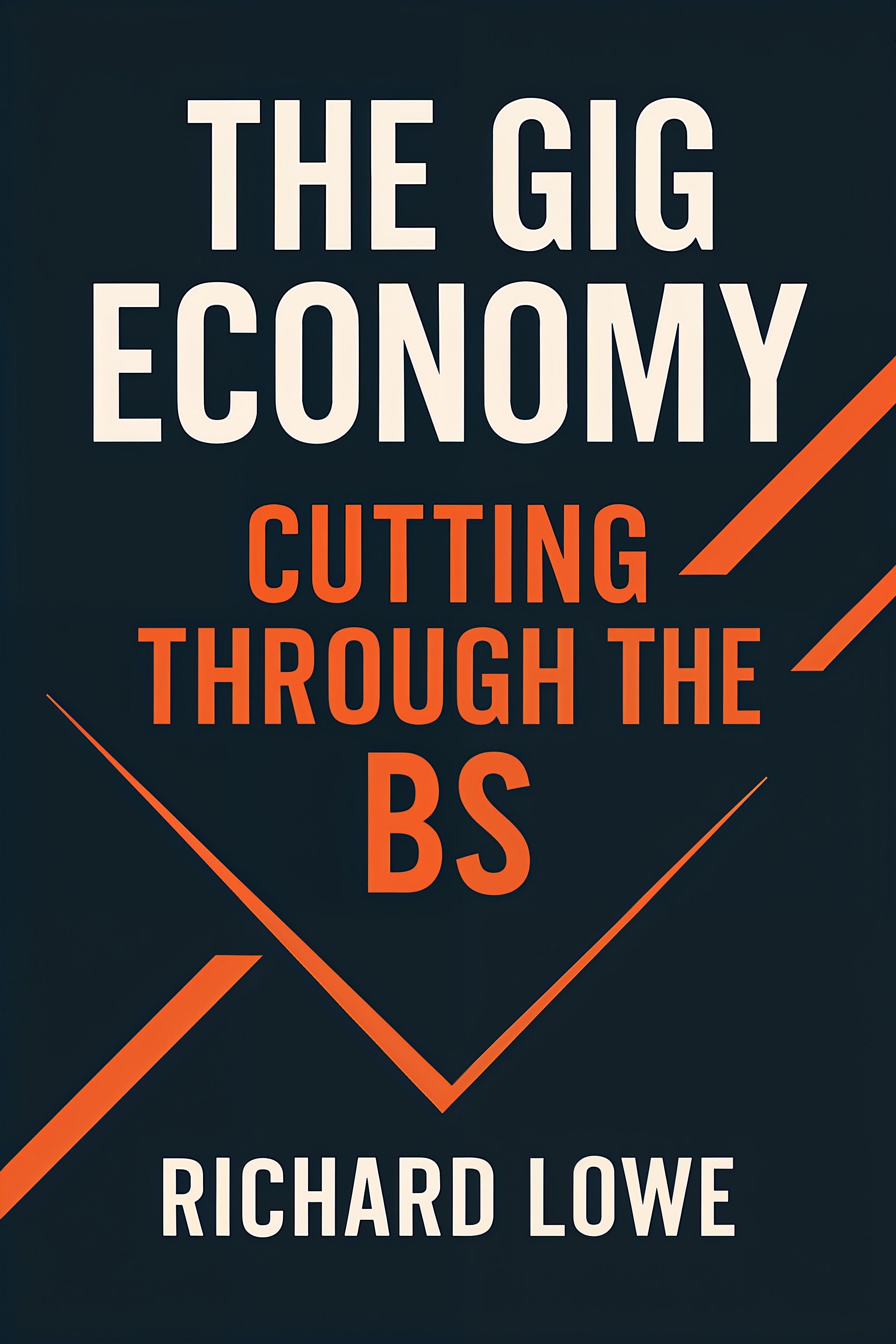
The Gig Economy
Cutting Through the BS
 |
This book started as a money problem BUY FROM INGRAMSPARKAMAZONKOBOREAD THE INTRODUCTIONTABLE OF CONTENTS 274 pages · Paperback ISBN 978-1-946458-50-6 · ebook ISBN 978-1-946458-81-0 |
| 274Pages | 3Parts | 9Reader paths in | 12Years doing this |
This book started as a money problem
I was trying to earn enough to leave a soul-crushing office job without going broke on the way out. So I did what everybody does. I watched the passive income videos, bought the dropshipping course, and followed step-by-step blueprints that promised a guaranteed result.
I wasted months and several hundred dollars chasing strategies that had worked for somebody else, under conditions I didn’t have, in a market that had already moved.
The turning point was giving up on copying and starting to experiment. I treated income generation as a series of small tests instead of a religion. Test small, measure, scale what works, abandon what doesn’t.
That led to ghostwriting, which became my income and eventually let me leave employment entirely. The valuable part was never ghostwriting. It was the method for finding what other people had missed.
What is inside The Gig Economy?
|
Part I, the bullshit
|
Part II, what works
|
|
Part III, implementation
|
Throughout
|
Who should read The Gig Economy?
|
Read it if
|
Not for you if
|
Why did I write The Gig Economy?
Richard Lowe, the Writing King
I did this. Twelve years ago I was in the office job running the numbers on how to get out, and I wasted months and several hundred dollars on courses first. Ghostwriting turned out to be the answer, and I have since written 113+ books under my own name and ghostwritten 54+ for other people. I’m not a guru who studied this. I’m someone who got it wrong repeatedly and wrote down what finally worked.
► Behind the Book: The Gig Economy
How this one got written, what went wrong, and what got cut.
► I Won a Contest for $15. It Took Me Two Hours.
One story from behind this book.
What do people ask about The Gig Economy?
Also in The Working Life
|
Taking Back Control of Your Working Life |
And Other Workplace Nightmares |
|
The Honest Guide to Job Searching |
A Survival Guide for Modern Professionals |
|
Street-Smart Management Wisdom Management Without BS |
Nobody is coming to hand you a blueprint
Which is good news, because the blueprints don’t work anyway.
BUY FROM INGRAMSPARKAMAZONKOBOREAD THE INTRODUCTIONTABLE OF CONTENTS
Paperback and ebook.
Introduction
The Gig Economy
You’ve probably read a dozen books about making money online. Maybe you’ve tried a few of the “proven systems.” Maybe you’re wondering why you’re still broke despite following all the expert advice.
I should know. I’ve tried almost everything. Contest sites that pay pennies for hours of work. “Read for pay” schemes that amount to intellectual slavery. Games that promise rewards but deliver nothing. Fiverr gigs that had me competing with people willing to work for less than minimum wage. Dropshipping before automation ruined it. eBay arbitrage until fees killed the margins. Affiliate marketing until I couldn’t sleep at night promoting garbage to make a buck.
I made $10,000 in affiliate marketing and walked away because the industry is filled with scammers and predators. I made $35,000 on eBay before shipping costs and platform fees made it unsustainable. I tested Etsy when it was still about handmade goods, before dropshipped junk from China buried every legitimate seller.
What worked was a ghostwriting business that generates $150,000 a year. Books that bring in a few hundred dollars monthly in passive income. Not get-rich-quick schemes. Sustainable income streams that get better with time instead of falling apart when the next algorithm change hits.
This book isn’t going to teach you to copy what I did. Ghostwriting is my path, not the path. I’m going to teach you the methodology I used to find what works: how to experiment with minimal risk, how to spot opportunities others miss, how to build multiple income streams so you’re not dependent on any single platform or market.
I’m going to tell you what not to waste your time on. The micro-income traps. The platforms designed to exploit your labor. The scams disguised as opportunities. I’ve tested this stuff so you don’t have to.
The job landscape is changing faster than most people are prepared for. Not a collapse, just a shift. The gap between people who handle transitions well and people who get caught unprepared is usually a few months of low-stakes experimentation started before anything went wrong. That’s what this book is about.
This book started as a money problem. I was trying to make enough to quit my soul-crushing office job without going broke in the process.
Table of contents
The Gig Economy
- Preface
- Introduction: Why I’m Qualified to Call BS
- How to Use This Book
- You just lost your job and need income within 30 days
- You’re thinking about leaving your job but haven’t yet
- You’re employed and want a second income stream
- You’ve tried gig work and it hasn’t worked
- You’ve limited time and want the core argument
- You’re ADHD or neurodivergent
- You’re retired or semi-retired and want supplemental income
- You’re a creative: writer, artist, designer, photographer, musician
- You’re skeptical and not sure this is for you
- Part I: The Bullshit (What Doesn’t Work)
- Why Traditional Jobs Don’t Cut It Anymore
- The Micro-Income Trap
- The Race to the Bottom
- What Used to Work But Doesn’t Anymore
- The Affiliate Marketing Scam
- The Mental Traps That Keep You Broke
- If You Just Lost Your Job
- Part II: What Works
- What the Gig Economy Is (and Isn’t)
- The Real Advantages and Disadvantages of Freelancing and the Gig Economy
- The Experimentation Method
- Examples, Not Blueprints
- Risk Management and Scam Detection
- Part III: Implementation
- Running It Like a Real Business
- Getting Your First Paying Customer
- Getting Paid: Payment Platforms and How to Protect Yourself
- Insurance for Freelancers
- Making It Work with ADHD and Neurodivergence
- Outsourcing: When to Delegate and When You’re Just Being Lazy