
Star Trek gave business a useful piece of vocabulary, and most people who use it have the point backwards.
The Kobayashi Maru is a training simulation designed to be unwinnable. The simulation puts cadets in a situation where every available action leads to failure. The exercise is about how somebody behaves when there’s no good move. Kirk beat it by reprogramming the simulation. That reads as cheating, and it’s usually the main lesson: he refused the premise.
Michael Santore brought this up on my podcast as a way of describing real decisions, and he’s the standing to use it. He raised two million dollars building a daily fantasy sports company against FanDuel and DraftKings, and ran out of runway on a ten percent margin.
What makes a decision hard?
Not complexity, and not stakes. Most decisions with both are still easy. In most business decisions one option is better, and the work is gathering enough information to see which. They can be large, expensive, and slow, and they’re still not hard in kind. Somebody with the facts and a spreadsheet gets there.
A hard decision is one where every option is bad and you have to choose anyway. Keep funding the thing that’s not working, or kill it and waste what you’ve spent. Fire the person who’s loyal and no longer capable, or keep them and let the team pay for it. Take the deal that saves the company and gives away the part you built it for.
Those feel like no-win scenarios because within the rules as stated, they are. The useful question is whether the rules as stated are the real rules.
How do you change the rules of the game?
Attack the premise instead of the options. Every no-win scenario contains an assumption that generated it. Somebody says they must either cut the team or miss the deadline, and the assumption is a fixed scope. Somebody says they must either take the bad offer or lose the client, and the assumption is that those are the only two responses available.
Santore’s own case is the clearest example I have. He built a company in a market dominated by two giants with vastly deeper pockets, competing on their terms, and the margin was ten percent. Competing head-on with an incumbent on price is a scenario you can’t win by playing well.
His later work changes the game instead of replaying it.
He took blockchain, a technology most people met as a speculative asset, and positioned it as compliance infrastructure. The grounds were that new AI regulations are effectively asking for immutable audit logs. That’s the same asset in a different game, and the second game has less competition and a buyer with a legal obligation.
That’s the move. When the options are all bad, stop choosing among them and ask which assumption produced the list.
What do you do when you cannot change the rules?
Sometimes the constraint is real and you lose, and the Kirk story misleads people about that. Reprogramming the simulation is available in fiction more often than in business. In that case, two things count for more than the choice itself.
Decide quickly. The cost of a hard decision is rarely in picking wrong. It’s in the months of not deciding, while the situation degrades and the options narrow. Almost everyone I’ve worked with who regrets a hard call regrets the delay more than the direction.
Face the sunk cost. Santore’s account is unsentimental: persistence matters, and so does being realistic. Those two pull against each other and both are true. The money already spent is gone whatever you choose next, and the only question that matters is what the next dollar buys. Everybody knows this and almost nobody applies it, because the sunk cost is usually years of somebody’s life instead of money.
What three questions help with a no-win decision?
Keep funding the thing that’s not working, or kill it and waste what you’ve spent.
Somebody brings me a decision that feels impossible. That happens often in the middle of a book project. Three questions do most of the work. What happens if you do nothing. People frame decisions as a choice between actions and forget that inaction is on the list and has consequences of its own. Half the time the answer clarifies everything, because doing nothing turns out to be the worst option and the paralysis lifts.
Who told you those were the only options. Usually nobody did. The list assembled itself out of habit and other people’s expectations, and the assumption hides in them.
What would you tell somebody else in this position. People give better advice than they take. The gap between the advice you’d give and the choice you’re making is the size of whatever is distorting your judgment.
What is the deadline rule for hard decisions?
One practical thing from that conversation, which I’ve started using.
Estimate how long something will take, then double it and add ten percent. He came to that through years in product and project management, and it’s a better rule than it sounds.
It works because people estimate the work and forget everything around it. The waiting. The revisions. The person who’s on holiday.
The thing that turns out to depend on another thing. Doubling covers the ordinary overrun. The extra ten percent covers the event nobody predicted. That happens on every project and is different every time.
For books this is close to exact. Somebody tells me they’ll have a manuscript in three months. Six months and change is the real number, and a plan built on the real number gets finished. Somebody abandons a plan built on the optimistic one around month four when it’s visibly failing.
Why this belongs in a book
This is why I push the point with clients who have run something.
The decisions that define a career are exactly the ones nobody writes down. People tell the successes at conferences in a cleaned-up version. The hard calls, the ones where every option was bad and you picked one and lived with it, get a sentence and a skip, because they’re uncomfortable and because you’re not sure you were right.
Those are the parts a reader needs. Anybody can find out what a good strategy looks like. What’s scarce is an account of somebody deciding under real pressure with incomplete information, including the times it went badly. A business book without a real failure in it reads as marketing, and readers have learned to discount it.
Santore’s two million and the ten percent margin is a better credential than a clean win, because it’s checkable and it cost something. It makes the rest of what he says worth hearing, and it’s what I look for when working out whether somebody has a book. That’s the question the Discovery Intensive exists to answer.
My take
Hard decisions belong in your book, and the failures belong there most. A business book with only clean wins reads like marketing, and readers discount it. When every option is bad, look for a way to change the rules first. If you can’t, set a deadline, decide, and live with it. Then put that decision in the book with the outcome, including what went wrong and what it cost you, because readers trust those pages more than any clean win.
The short version
When every option is bad, check the assumption that produced the options before choosing among them. If the constraint is real, decide fast and ignore what you’ve already spent. Double your estimate and add ten percent. And write down the hard calls, because nobody else can supply that part of your experience.
Michael’s full conversation is in his episode of Leaders and Their Stories, and there are more of these in the Leaders and Their Stories hub. If the book you’ve been meaning to write is about the decisions instead of the results, that’s the one I most want to work on, and thought leadership books covers how to build that kind of book.
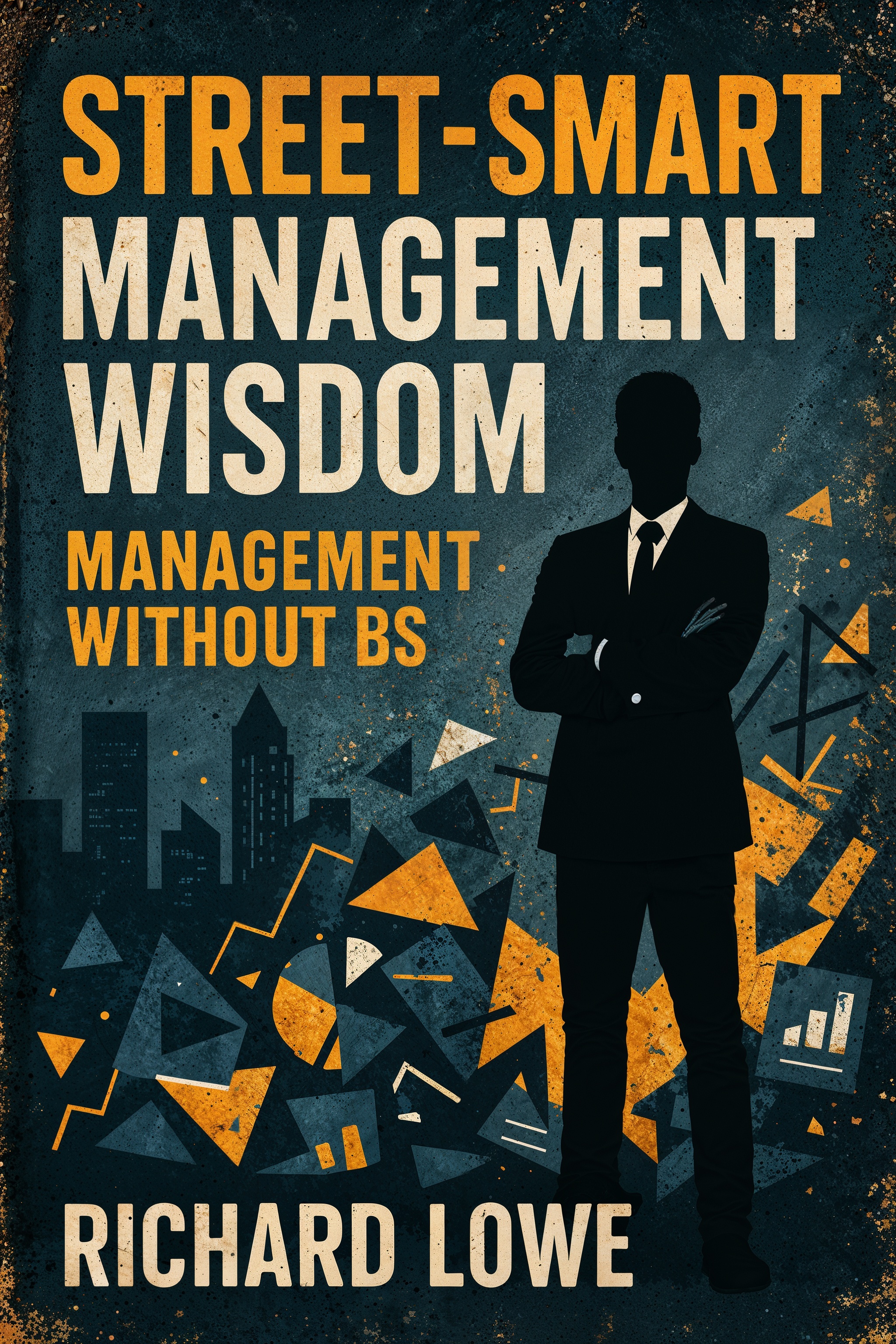
Street-Smart Management Wisdom puts you in the hero’s seat with three managers who have already faced the hard calls. You watch them fail and recover across fourteen chapters.
