
I record a lot of conversations with people who run things. The useful signal is when unrelated guests say the same thing without having heard each other.
That happened this summer. Joe Rockey, who works with small business owners, said AI is a function and never a relationship, and that the line between those decides who wins with it. Craig Leonard, on personal branding, said use AI as an advisor and never as the writer. Noah Landow, thirty years into running an IT firm, said the interesting use inside a company is removing drudgery instead of removing people. Susan Evangeline Bagh, who advises on transformation, said most of the current wave is hype and infrastructure built ahead of proven need.
Four people, four industries, one boundary, and it maps onto what I do for a living.
People outside publishing are saying it too, and it’s what I believe. AI is a tool. Treat it like one and you’ll do fine. Let it do your work for you and you’ll have problems, and in a book those problems carry your name on the cover.
What can AI do in book work?
A great deal. I use it daily, so this isn’t a purist argument. Transcription and organization. A book project generates twenty or thirty hours of recorded interviews. Turning that into searchable, sorted text used to be weeks of somebody’s life and is now a background task, and that change is good.
Research triage. Give it forty sources and ask which five address a specific question. It’ll be wrong sometimes and it’ll save hours anyway, provided you check.
Structural interrogation. Paste an outline and ask what’s missing, what repeats, what a reader would ask that goes unanswered. It’s a competent reader, as I said in my piece on AI-written profiles, and reading is a real skill to have on tap. Mechanical passes. Consistency checks, chronology, whether the name of a company is spelled the same way in chapters two and nineteen. Machines are good at this and humans are terrible at it.
All four are drudgery. Noah’s formulation is the right one: ask your team what they hate doing, then hand that part over. My writing handbooks use AI prompts the same way, to help a writer build a better protagonist or a tighter plot, and the writer still writes the book. I’d hate to see anyone use those tools to skip the part that makes the book theirs.
What can AI not do for a writer?
Be you, and that’s the product. A memoir or an authority book sells because one person with their own history is saying this. Strip that and you have a competent article on a subject, available free everywhere, with no reason to be a book.
A model can’t supply three things, and no prompting changes that.
It wasn’t there. It doesn’t know what the floor smelled like, what your boss said in the parking lot, or which of the two versions of that story is the true one. Those specifics are the difference between a book people finish and one they abandon at page forty.
It doesn’t know what matters. Given a career, it can’t tell which decision was the hinge. It’ll weight by how much text you gave it. That correlates with what you find easy to talk about. That’s usually the opposite of what the book needs.
It smooths. Output moves toward the familiar, because that’s what a probability model does. Your material is valuable where it’s unfamiliar, and the machine sands that off first.
That sanding is what worries me most when an author hands the whole job to a machine. The odd detail, the unpopular opinion, the year that went wrong are what a reader remembers, and they’re the first things to disappear.
Joe Rockey’s version of this, about business generally, applies without modification. Anyone buying something important to them wants a human. An AI sales bot only sells to people who don’t care. A book somebody puts their name on for the rest of their life is something important to them.
Where is the line between AI assistance and ghostwriting?
I draw it at the sentence.
I’d hate to see anyone use those tools to skip the part that makes the book theirs.
Everything up to the sentence is fair game: recordings, transcripts, sorting, checking, questioning the structure, catching inconsistencies. A person who has spoken to the author for hours writes the sentences themselves, and knows which of their phrases are theirs. That line is where the value sits. A client is paying for their voice on a page, and a voice consists of sentence rhythm, word choice, and what the writer leaves out. Those are the three things a model normalizes.
It also has a practical edge now. Readers have developed an ear for the tone, quickly, and so have search and answer systems.
Publish text under your own name that reads like the average of the internet, and you trade a durable reputational cost for a short-term saving. I argued that in what AI does to writing when nobody is watching.
Why offer an AI-assisted writing service at all?
Because done properly it’s good, and hiding from the word helps nobody.
My AI-assisted books service exists for people who want a shorter authority book at a lower price, and it lowers the price by using machines for the drudgery. That cuts hours. The interviews still happen. The structure is still decided by a person. The final pass is still mine. It runs at roughly half the per-word rate because the mechanical part got cheaper, and I set out the details in the AI-assisted book at half the cost.
What I won’t sell is a book a machine wrote. There’s principle in that, and it also wouldn’t work. The client would get a fluent, agreeable, forgettable document with their name on it, and the result defeats the reason to publish.
Should authors disclose AI use in their books?
People ask whether an author should disclose AI involvement, and my answer has hardened over the last two years.
Tell the client everything, in writing, before the contract. Which parts of the process use machines, which don’t, and what they’re paying a person to do. Any ghostwriter who gets vague when asked that question is telling you something. Craig Leonard applies the same test to profile writing.
Public disclosure on the book itself is a different question and depends on the platform, since retailers and audiobook distributors have their own rules and those rules keep changing. Check the current terms wherever you’re publishing, because a policy violation discovered later is a far worse outcome than a line in the front matter.
I don’t think an author should ever be surprised by how their own book was made. If a writer won’t put the process in writing before the contract, walk away, because you’re the one who’ll be explaining it to a retailer or a reader later. My own position is simple enough to say in one sentence: the client knows exactly what we did, and no machine wrote a sentence in a finished book.
What do AI transformation projects teach about writing books?
Susan Bagh made a point about organizations that applies to a single author. Transformation has to be business-led and top-down, or it fails, and roughly three quarters of them do fail. Translated: decide what you’re trying to achieve, then choose tools. The failure mode is the reverse, adopting a tool and looking for a use. That’s most of what is happening with AI right now and most of why so little of it sticks.
For a book that means the same sequence I use for every project. Decide what the book is, who it’s for, and what it has to do. Then decide which parts of making it are drudgery and hand those over. Anybody who starts with the tool ends up with a book shaped by the tool’s preferences, meaning the average of everything. Thirty years of someone’s experience flattened into that is a sad trade.
My take
Give AI the drudgery and keep the author. Decide what the book is, who it’s for and what it has to do before you touch a tool. Then hand over the mechanical parts. Start with the tool and you get a book shaped by its preferences. Its preferences are the average of everything. Thirty years of someone’s experience deserves better than that.
Where does AI belong in making a book?
Use it for what nobody would miss doing, and keep every part that’s you. AI sold to authors as a way to skip the book is a bad pitch, because the part it skips is the part anybody was going to read the book for.
Four people with nothing in common arrived at that boundary independently. A rule of thumb rarely gets more confirmation than that. Their full conversations are on the podcast: Joe Rockey on AI as a function, Noah Landow on machines that stopped being predictable, and Susan Evangeline Bagh on seeing the whole chessboard, with more in the Leaders and Their Stories hub.
If you’re weighing how to get a book made and where the machine belongs in it, the Discovery Intensive settles what the book is first. That’s the order that works.
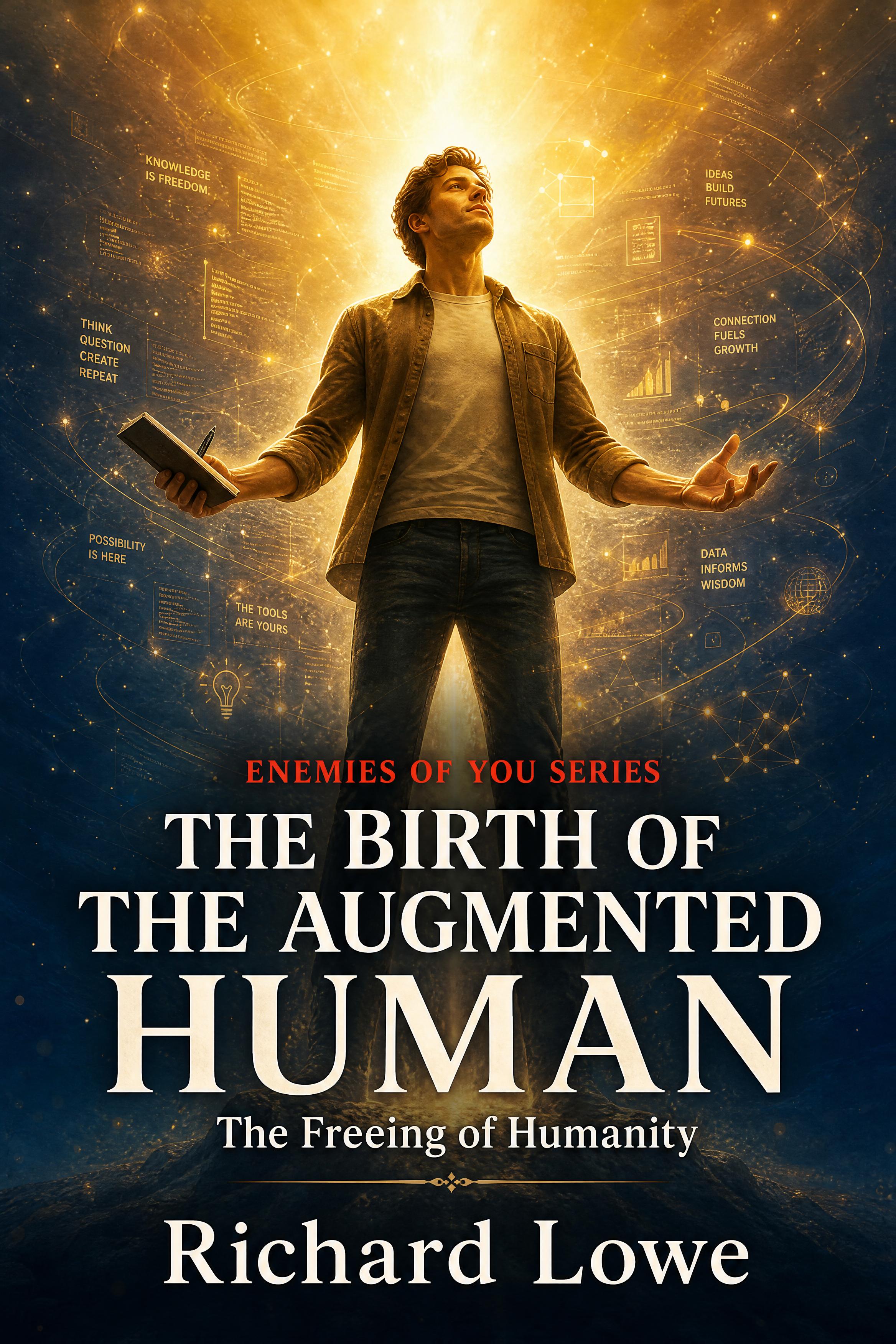
Used properly, AI amplifies thinking instead of replacing it. The Birth of the Augmented Human shows what goes right when people keep the thinking and hand off the drudgery.
Frequently Asked Questions
The book on this: The Ghostwriting Advantage is 254 pages on what a ghostwriter is for once the machine handles the drudgery, and where the line sits between a function and a writer.
