
“I can’t write. I mean it. You’ll see.”
Clients say that to me all the time, or they apologize for their writing, or tell me they don’t have time to write.
I tell them I understand, because that’s why people hire a ghostwriter. Lately there’s a new version: people arrive with a draft they tried to write with AI that came out badly, and they hire me to do it properly. AI is bringing me clients, and I find that very amusing.
Underneath the apology is usually a real fear. If a professional writer finds your writing bad, will they replace your voice with theirs?
Does my ghostwriter have to like my writing style?
No. A ghostwriter’s job is to write the book you would write if you had the time and the training, in the voice you’d use. Their personal taste doesn’t come into it.
A good ghostwriter treats your voice as the assignment.
If you’re blunt, the book should be blunt. If you swear, tell long stories, or use the same odd phrase every other sentence, those are raw material. Some of it gets trimmed for the page, because speech and writing work differently, but the character stays. A ghostwriter who needs to enjoy your style to write it well is the wrong ghostwriter.
What your ghostwriter should care about is whether readers will understand you and keep turning pages. That can mean tightening a rambling story, moving your best point up front, or cutting a tangent. None of it means turning you into someone else.
Can I hire a ghostwriter if I don’t write well at all?
A ghostwriter who needs to enjoy your style to write it well is the wrong ghostwriter.
Yes, and plenty of the most successful authors I’ve worked with couldn’t write a clean paragraph if their lives depended on it. Writing well and having something to say are different skills. You bring the knowledge, the stories and the opinions. The ghostwriter brings the craft that turns them into a book. What qualifies you is knowing your subject and being willing to talk about it. Clean sentences are my job, and I’ve never thought less of a client because theirs weren’t. Your spelling, grammar and punctuation don’t matter. Neither does whether you’ve ever written anything longer than an email. You need to be able to talk about your subject, answer questions truthfully, and react when something on the page doesn’t sound right. If you can hold a conversation about the thing you know best, you can do this.
How does a ghostwriter capture the way I talk?
Mostly by listening, and by recording what you say. A few emails and a LinkedIn post won’t give anybody your voice. I need to hear you talk, for hours, about the work you care about and the things that make you angry.
The interviews do most of the work. Over hours of conversation, a ghostwriter hears how you tell a story, the words you reach for, how long your sentences run, where you get angry, where you get quiet, and what you find funny. The recordings let them go back and catch the exact phrasing instead of relying on memory.
Good ghostwriters also study:
- ► Your emails, texts and memos, typos and all, for rhythm and word choice.
- ► Talks, podcasts or videos where you speak without a script.
- ► Phrases you repeat, the ones your team would recognize as yours.
- ► Words you’d never use. Those matter as much as the ones you would.
My article on capturing the client’s voice goes into the method in more detail.
Will a ghostwriter make my book sound like them?
A weak one will. It’s among the most common complaints clients have about bad ghostwriters. Writing in your own voice is easy, and writing in someone else’s is hard work, so a ghostwriter who cuts corners slides back into their own. The worst of them fall back on generic polished prose that sounds like nobody at all.
You’ll recognize it when it happens. The draft reads well, and you’d never say any of it. Words appear that you’ve never used. Your blunt opinions come back softened into careful suggestions. Your jokes vanish. Your stories lose the details that made them yours.
People who come to me after a bad experience with another ghostwriter tell me the same things over and over: the writer blew the schedule, wanted more money halfway through, or never got their voice. That last one is the worst, because they paid for their own book and got somebody else’s.
AI-generated drafts make this worse, because AI writes in the same smooth, forgettable voice for everyone. I’ve written about why AI never writes in your voice, and it’s one of the reasons a human who listens closely matters more now than ever.
What if my ghostwriter keeps changing my voice?
Say so early, with details. The first chapter is the best time, because fixing voice then shapes everything that follows.
Vague feedback doesn’t help. “It doesn’t sound like me” gives a ghostwriter nothing to work with. Mark the exact sentences that feel wrong and say what you’d say instead. “I’d never call it a ‘workforce.’ It’s my crew.” “This is too polite. I’d tell them flat out it was a stupid decision.” “Put the story about the flooded basement back in. That’s how I explain this to every new hire.” Specific notes like that teach a ghostwriter your voice faster than anything else.
If the voice still isn’t there after a couple of rounds of specific feedback, have a direct conversation about it. Sometimes the ghostwriter needs more interview time with you. Or they’ve been smoothing you on purpose because they think it sounds more professional, and you need to tell them you’d rather sound like yourself. If it never improves, you’ve got the wrong match, and my article on ending a ghostwriting project mid-stream covers what to do.
Can a ghostwriter write in a plain, simple style?
Yes, and for most business books a plain style is the right one. Plain means short sentences, ordinary words and ideas stated directly. Most people prefer to read exactly that way, and plain writing can still be vivid and funny.
Business readers in particular have no use for decoration. They want the lesson, the story that proves it, and what to do on Monday. A book that sounds like a straight-talking owner explaining how he fixed a problem will beat a book full of elegant phrasing almost every time.
If your natural voice is plain, don’t let anyone talk you out of it. Some writers treat plain prose as a flaw to fix, and I think that’s vanity on their part, because the book is supposed to sound like you. Tell your ghostwriter at the start that you want it to sound like you talking.
How can I test a ghostwriter’s voice match before hiring?
Ask them how they do it, and then make them show you.
On the first call, ask how they capture a client’s voice, how many hours of interviews they plan, whether they record, and how they handle feedback on voice.
A ghostwriter with a real process will describe it in detail. Someone who says “don’t worry, I’m very versatile” hasn’t thought about it. My list of questions to ask a ghostwriter about voice covers what to listen for.
Then ask for a sample written in your voice. Past books show that a ghostwriter can write.
A sample chapter built from your own interviews shows whether they can write like you. The Book Discovery Intensive exists partly for this reason: it ends with a 2,000-word sample chapter in your voice, so you can judge the match before you commit to a full book.
My take
Plain is fine. Business readers like a blunt voice better than a fancy one. Your ghostwriter’s taste doesn’t matter, because their job is to sound like you. Any writer who treats plain prose as a flaw to fix is putting vanity ahead of your book. Ask how they capture voice, then make them prove it with a sample built from your own interviews before you commit.
What should you send a ghostwriter so they can hear your voice?
Send anything with your natural voice in it: emails you wrote quickly, texts, a talk you gave, a podcast appearance.
Skip the polished pieces someone else edited. Then plan on a lot of interviews, because the more you talk, the more of your rhythm and phrasing ends up on the page. Get a sample chapter before you commit to a full book. Your voice is the one part of the book nobody else can supply, and a writer who won’t prove they can capture it hasn’t earned your money.
The Book Discovery Intensive ends with exactly that: a sample chapter in your voice, written from your own interviews. My ghostwriting services take it from there.
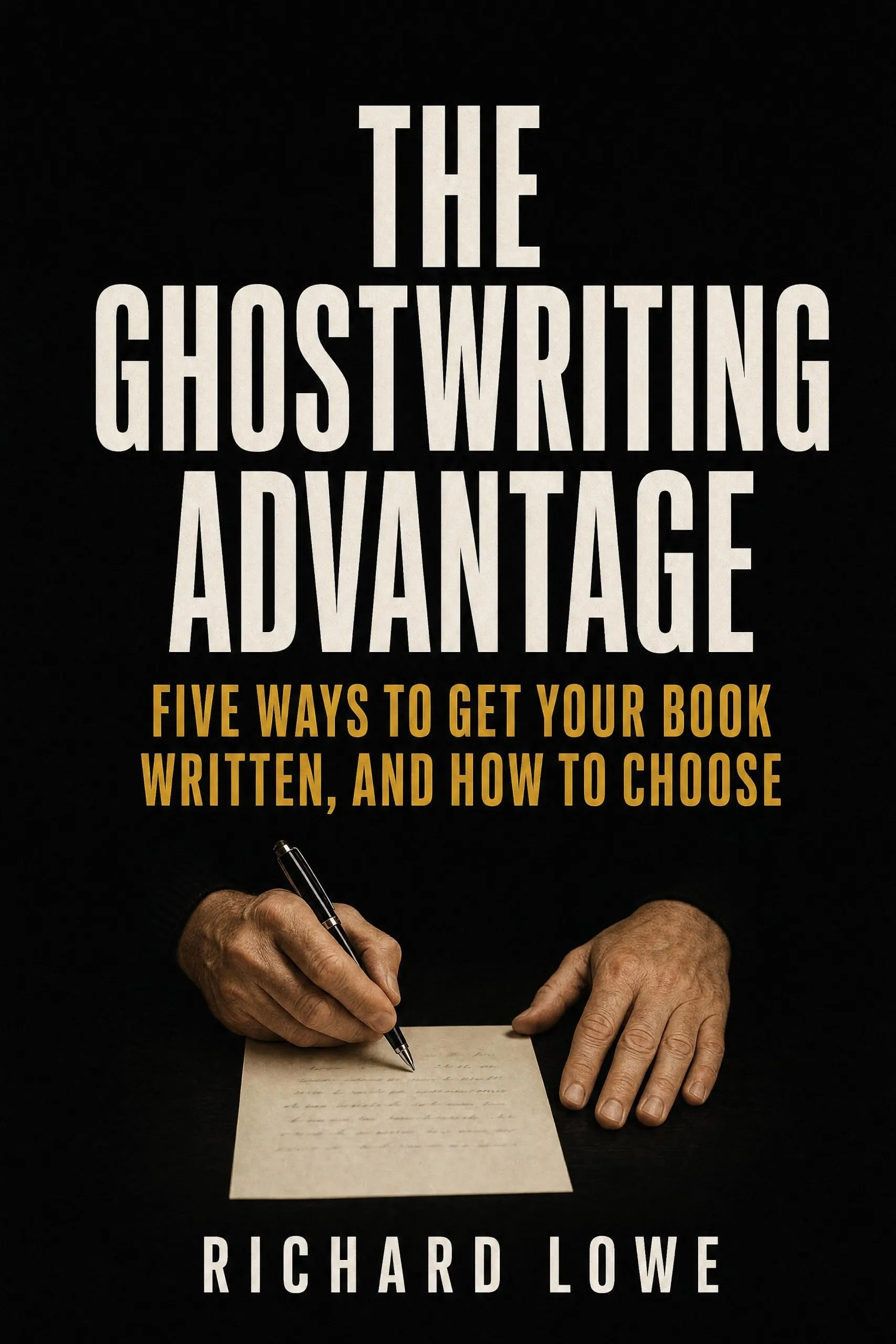
A ghostwritten book should sound like you. The Ghostwriting Advantage explains how a ghostwriter captures your voice and gets your book written for you without turning it into someone else’s.
