TL;DR
6/10. A twenty-minute read that traces a chain of consequence backward, from Norman Borlaug’s crop research through the people who put him in a position to do it, and from Joshua Chamberlain’s decision at Gettysburg outward. Slight as a book and effective as an argument.
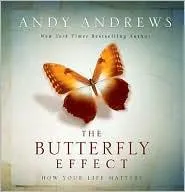
This is a gift book and it should be judged as one. Large type, heavy stock, illustrations, and perhaps twenty minutes of reading. Judged by weight it’s nothing, and it’s sold enormously because the argument inside is one people want to hand to somebody else. Andrews built a speaking career on this material before it was a book, and the structure shows that origin. It’s a talk with pictures, and it works the way a good talk works. That’s by arriving at one idea and stopping.
I’ve got mixed feelings about books like this. Part of me objects to something this slight being sold as a book at all, and part of me admits the idea inside is one people need to hear. Andrews knew exactly what he was making, and I’d prefer to judge it on those terms than pretend it’s a history.
What is the argument of The Butterfly Effect?
That a person’s effects continue past their ability to observe them, and that the arithmetic of those effects isn’t calculable in advance.
The device is a chain traced backward. Norman Borlaug’s wheat research is widely credited with preventing famine on an enormous scale. Andrews works back: who created the conditions for Borlaug’s work, and who created the conditions for that person, and so on, until the chain reaches somebody who had no idea what they were setting in motion.
The Chamberlain material at Gettysburg is the strongest example. A colonel on the far left of the Union line, out of ammunition, ordered a bayonet charge down a hill because he couldn’t hold and wouldn’t retreat. He couldn’t see past the next hour. The argument is that a great deal of what followed rests on that few seconds.
The Chamberlain story is the best thing on these pages, and it’s also where I get nervous, because it’s so satisfying. A story that tidy should make you suspicious. Andrews doesn’t supply that suspicion, so you’ll have to bring your own.
Watch: The Butterfly Effect by Andy Andrews, Michelle Carey
Why does the device in The Butterfly Effect work?
Because consequence is normally invisible in the direction that matters.
You can see what caused you. Parents, teachers, the accident of where you were born, the person who gave you a job. The causal chain running backward is at least partly legible. You can’t see what you’ve caused. The chain runs forward past your death, through people you’ll never meet, and there’s no mechanism by which you could observe it. So the natural assumption is that your effects are small, because the ones you can see are small. That asymmetry affected me more than anything else in the book. I think most people underrate their effect on others, and it makes them careless in small moments they’d treat with real care if they could see where the consequences went.
The book’s whole function is to make that asymmetry vivid, and a chain traced backward from an enormous outcome does it in a way an abstract statement cannot.
Is the history in Andy Andrews’ The Butterfly Effect reliable?
Chains like this always simplify, and it’s worth being clear about how. Every link in a causal chain had thousands of other inputs. Borlaug’s work depended on institutions, funding, prior research, and the labor of many people, and selecting one antecedent and calling it the cause is a narrative choice and not a historical finding.
Historians would object to most of these attributions and they’d be right to. Historians have argued about the Chamberlain claim in particular for a century, with serious historians holding that exactly this kind of retelling has inflated the significance of Little Round Top.
This is my real complaint. Andrews is a good enough speaker that he didn’t need to lean on contested history, and the shortcut costs him credibility with any reader who knows the period. A single paragraph admitting that Little Round Top is disputed would have bought him a great deal of trust.
Andrews is doing rhetoric with historical furniture, and a reader should know that’s what they’re getting.
Does the objection ruin The Butterfly Effect?
No, and this is the thing worth understanding about the book.
The underlying claim doesn’t depend on any particular chain. Your effects continue past your ability to see them, and that arithmetic isn’t calculable in advance. That’s true whether or not the specific Borlaug sequence is the right one, and it would still be true if every link in it were wrong. The chains are illustrations of a claim instead of evidence for it, and the claim is closer to a way of seeing, and the book is trying to install it.
Verdict
Not a book so much as an argument in a nice binding, and it knows that. Buy it for somebody who needs it instead of for yourself. That’s what it was designed for. The idea is sound and the history is a story about the idea. If you want the history, read about Chamberlain and Borlaug properly, and you’ll find both are more complicated and more interesting than the version here.
So it’s a split verdict from me. The idea deserves a place in anyone’s head, and the history deserves a better telling. I’d give it to a graduate or a discouraged friend without hesitation, and I’d never recommend it to someone who wants to understand Gettysburg.
Explore further
The Writing Hub: craft, technique, and the books worth learning from.
Frequently Asked Questions
Other Books From – Self-Help