TL;DR
Former Seattle Police Chief Norm Stamper’s insider critique of American police culture, drawn from 34 years in San Diego and Seattle. It’s confessional, combative and still argued over.
In 1972, a young San Diego officer named Norm Stamper shot and killed a man who appeared to be holding a gun to his two-year-old son’s head. The man turned out to be unarmed. The shooting was ruled justified. Twenty-one years later, that little boy, now a grown man threatening to jump from a bridge, blamed the officer who had killed his father for much of what had gone wrong in his life.
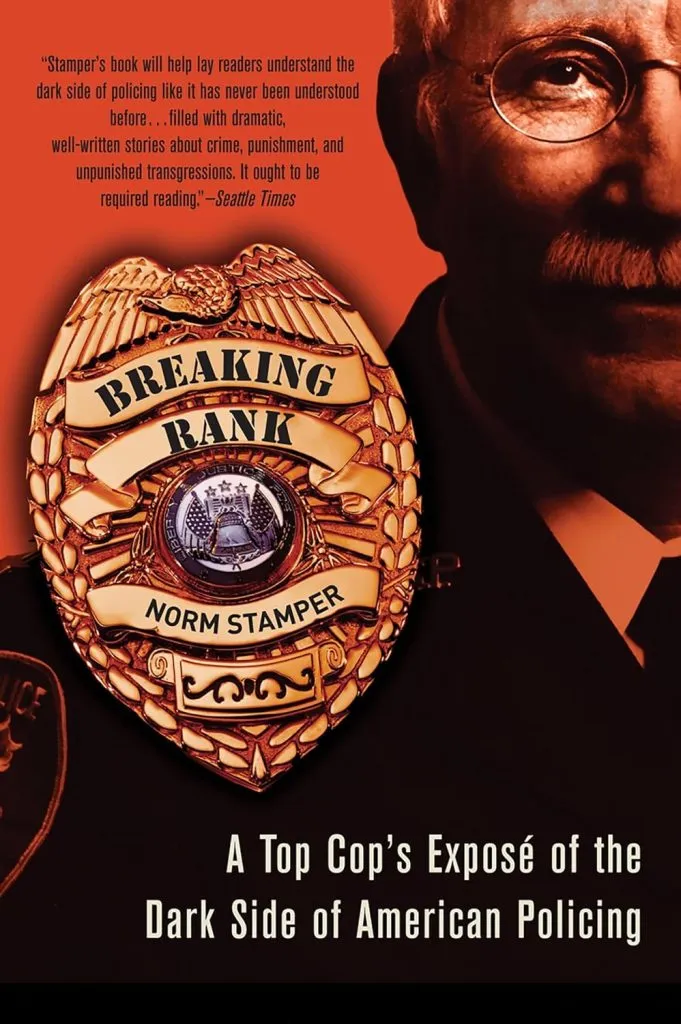
Stamper tells that story in Breaking Rank: A Top Cop’s Exposé of the Dark Side of American Policing. It sets the tone for the book. Nation Books published it in 2005.
What is Breaking Rank about?
It’s a critique of police culture from someone who spent 34 years inside it. The book opens with a letter to a Washington police chief who shot his estranged wife and then himself, and uses that case to examine domestic abuse inside police departments. From there it takes on racism, sexism and homophobia in the ranks, the code of silence, undercover work, police unions and what it means to take a life.
Stamper includes his own failings. He writes about his early racism and homophobia, undercover work he did against activists and gay men, and his own past as a verbally abusive husband. He also recounts a 1976 investigation he ran into a San Diego graveyard squad, where nearly every officer admitted to using racial slurs on duty.
Some of the chapter titles alone tell you what kind of book it is: “Why White Cops Kill Black Men,” “Sexual Predators in Uniform” and “Snookered in Seattle,” his account of the 1999 World Trade Organization protests that turned violent while he was chief.
What does Stamper argue for?
A great deal, and readers will disagree with much of it. He argues for demilitarized community policing and against the code of silence. He also takes positions on drug policy, prostitution law, guns and the death penalty that put him well outside the mainstream of his profession. He later said publicly that his decision to authorize tear gas in Seattle in 1999 was a mistake.
Who is Norm Stamper?
Stamper joined the San Diego Police Department in 1966 and rose into the department’s top command over 28 years. He was Seattle’s police chief from 1994 to 2000 and resigned after the WTO protests. He later wrote a second book on policing and retired to the San Juan Islands.
How was Breaking Rank received?
With praise from reviewers and anger from some officers. The Seattle Times, the Boston Globe and the San Diego Union-Tribune all gave it strong notices, and true crime writer Ann Rule endorsed it. Seattle Weekly called it blunt and surprisingly well written, while noting that a former aide disputed some of Stamper’s claims. Officers in both his old cities sent angry letters.
What happened in Stamper’s 1976 San Diego investigation?
It’s one of the book’s most uncomfortable chapters, and one of its most important. In 1976, San Diego’s police chief assigned Stamper to look into a graveyard-shift squad. Nearly every officer on it admitted using racial slurs on duty, and the squad had its own radio shorthand for calls involving Black residents that treated the victims as less than human.
Stamper uses the investigation to make a point he returns to throughout the book: the problems he describes weren’t a few bad officers. They were habits a whole squad shared and a department tolerated. He also writes about policing San Diego’s Logan Heights and Barrio Logan neighborhoods in the 1970s, where he saw firsthand how those habits shaped the way residents saw the police.
What Breaking Rank shows a leader planning a book
Because it’s a different kind of law enforcement book, one written to argue with the profession. A retired leader can use a book to say what he couldn’t say in uniform, and Stamper did. Whether a reader agrees with him or not, the book shows how far a police memoir can go when the author holds nothing back, starting with himself.
Another Seattle chief, Carmen Best, wrote her own account two decades later in Black in Blue.
Keep reading
Hiring a ghostwriter for a sheriff’s or police chief’s book: how law enforcement leaders turn a career into a book, and what has to stay out.
Frequently Asked Questions
Other Books From – Biography and Memoir