TL;DR
6/10. Fifty creatures sorted into six groups, each with an illustration, an origin, and a note on what popular culture did to it. Basic, well made, and more useful to a writer as an index of leads than as a reference.
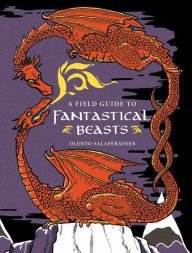
The categories are Fairies and Little People, Demons and the Undead, Water Creatures, Hybrid Beasts, Humanoid Creatures, and The Sacred and the Divine, with seven to ten entries in each. One to two pages per beast, a full-page illustration every other page, plus a glossary, a bibliography, and an index. The illustrations are the reason the book exists and they’re good, rendered as though a naturalist had gone out and drawn the specimens in their habitats.
My feelings about this one are mixed. The art is lovely and the premise charms me, and I still closed it wishing the text had half the ambition of the illustrations. As a starting point for a writer it has real value. As a reference it’ll let you down.
The author name is a pen name, and the biography, which places him alone on the Shetland Islands studying legendary beasts, is part of the conceit. Olento Salaperainen is Finnish for something close to mysterious creature. That’s the joke.
What does A Field Guide to Fantastical Beasts do that similar books do not?
It tracks the pop culture layer, and that’s more useful than it sounds.
Each entry notes where a creature came from and also what film, novel, or franchise reshaped the version most readers now carry. Those are frequently different things and the gap is where a writer finds material.
The gremlin is the example I remember. They feel ancient and they’re not. They appeared among pilots in the early twentieth century, blamed for engine failures and mechanical problems that had no other explanation, and Roald Dahl wrote about them before anybody put them in a film. A creature with a documented origin inside living memory is a useful thing to know about.
Most people’s mental image of a gremlin comes from a 1984 film. Most people’s mental vampire comes from Stoker and then from cinema, and has very little to do with the folkloric revenant that preceded both.
The pop culture notes are the reason I’d recommend it at all. Fantasy writers who reuse the movie version of a creature without knowing where it came from are throwing away the best material they’ve got, and this book at least shows them there’s something older to find.
How is A Field Guide to Fantastical Beasts organized?
By type instead of by geography or alphabet. That’s the right choice for browsing and the wrong one for looking something up.
The six groupings put creatures next to each other that share a function instead of an origin, so a Japanese kappa sits near a Scottish kelpie because both are water creatures that drown people. That juxtaposition is interesting and it’s where the book is at its best. That pairing delighted me. Two drowning creatures from opposite ends of the world, set side by side, say more about what people fear near water than an alphabetical listing ever could. Each entry gives an appearance, a habitat, a note on behavior, and field notes drawing on myth, recorded incident, and popular culture. The field-guide framing is maintained throughout without becoming tiresome.
What are the limits of A Field Guide to Fantastical Beasts?
It’s basic and it’s Western-weighted, and reviewers consistently say so. The entries are short, the creatures mostly familiar, and the sourcing drawn largely from Greek, British, and Norse material. Non-Western creatures appear, including the Chinese qilin, the Egyptian sphinx, the Tibetan yeti, and the Rainbow Serpent, and they’re a minority and are handled more briefly. A specialist will find nothing new. Someone who has read Borges or the standard folklore encyclopedias will find this thin by comparison, and it’s aimed at a younger or more general reader. That reviewers put at roughly high school level.
It also doesn’t distinguish carefully between folklore, literary invention, and modern cryptid claims. The Loch Ness monster sits alongside creatures with two thousand years of textual history, and the book doesn’t flag that these are different categories of thing.
That blurring bothers me more than the thinness. When the Loch Ness monster sits beside a creature with two thousand years of texts behind it, the book flattens the difference between old folklore and a modern cryptid claim, and a young reader deserves to know which is which.
Is A Field Guide to Fantastical Beasts useful for a fantasy writer?
As a starting index, yes, and that’s how I use it. The value is having fifty creatures with their origins summarized and a bibliography attached, so that when one catches your attention you know where to go next. The book won’t give you enough to write from. It’ll tell you what to read. The illustrations are also worth having beside you while drafting. A written description of a creature is easy to make generic. Looking at somebody’s specific rendering of one forces a decision about what yours looks like. That’s frequently how a scene starts.
The pop culture notes are the part I wouldn’t get elsewhere in this compressed a form, and knowing which version of a creature a reader will arrive with is directly useful, because you’re either meeting that expectation or breaking it deliberately.
Verdict
A gift book that’s more useful than most gift books, and a reasonable first shelf for anyone writing fantasy who wants to know where a creature came from before reusing the film version.
Don’t mistake it for a reference. Use the bibliography, and be aware that it doesn’t distinguish between folklore, literary invention, and modern cryptid claims.
I’d buy it for a young fantasy fan without a second thought. I wouldn’t let a serious writer stop there, and I’d want any novelist to treat it as a map to the real research.
Explore further
The Writing Hub: craft, technique, and the books worth learning from.
Frequently Asked Questions
Other Books From – Writing Reference