
I don’t trust nostalgia, and I think most of it’s a lie.
People remember their youth as a golden age because they were young, and the world itself had little to do with it. Most of what they miss is a working back and a full head of hair, and I won’t argue that old things were better for being old. This is a list of things we traded away, often for good reasons, while pretending we lost nothing in the deal. We lost plenty. Some of it was worth losing.
Some of it wasn’t. The point is to notice the bill, because nobody read it to us at the time.
You used to own things
Start with the big one, because it sits under most of the others. Before the year 2000, when you bought a thing, you owned it.
You bought a DVD and it was yours. It sat on a shelf.
No company could reach into your living room and delete it, change it, or charge you again to watch it. You could lend it to a friend. Sell it at a yard sale. Leave it to your kid. Watch it in thirty years on whatever machine still spun a disc. The movie didn’t depend on a subscription, a login, or a company’s decision to keep a server running.
It was a physical object, and physical objects don’t disappear when a business model changes.
Now you rent everything and own nothing. The movie you paid for lives on a service, and the service can pull it whenever a licensing deal expires. People have bought films and shows on streaming platforms, then opened their library to find them gone, with a refund at best and a shrug at worst. What you bought was permission to watch it until somebody revoked the permission. I think putting that arrangement behind a button labeled “Buy” is a con, and the companies doing it know exactly what they’re doing.
This is the quiet revolution of the last twenty-five years, and it reaches far past movies.
Your music is a subscription. Your books can be deleted from your reader. Your software is a monthly fee that stops working the day you stop paying. The whole economy shifted from selling you things to renting you access, and access can always be taken away. We gained convenience, an enormous amount of it, and we gave up ownership. That turns out to have been the thing that made all those objects ours.
The DVD and the weight of a collection
Stay on the DVD a moment, because it stands in for a whole lost category.
A shelf of DVDs, or records, or books, was a kind of map of a person.
The whole economy shifted from selling you things to renting you access, and access can always be taken away.
You could walk into someone’s home, look at what they kept, and learn who they were. The collection took up space, cost money, and required choices. You couldn’t own everything, so what you owned meant something. A person’s shelf was a self-portrait made of objects.
A streaming library is the opposite. Everyone has access to everything, so having a thing tells you nothing about anyone. The choices are gone, and with them the meaning the choices carried. Nobody walks into your home and learns who you are from your Netflix account, because your Netflix account is the same as everyone else’s, a doorway to the same enormous pile.
There was also a thing about the friction. To watch a movie on DVD you had to want it enough to get up, find the disc, and put it in. That small effort was a filter. It made watching a decision instead of a default. Now the default is endless, frictionless, autoplaying. The larger act of scrolling has replaced the small act of choosing. That’s a different thing, and worse for you.
Phone numbers in your head
Here’s one nobody mourns, and they should. People used to know phone numbers.
You knew your own number. Your home number. Your best friend’s. Your mother’s. Maybe twenty or thirty in total, held in your head and available at any moment. If you were stranded with a stranger’s phone, you could still reach the people who mattered. The numbers lived in you.
Now they live in the phone, and only in the phone. Lose the device and you lose the means to contact almost everyone you know. We outsourced a piece of memory to a machine, and the piece didn’t come back. This is a small thing until the moment you need it, and then it’s not small at all. More than that, it points at a habit we’ve repeated a hundred times since.
Every time a device offered to remember something so we wouldn’t have to, we said yes. A little more of what we used to carry in our own heads moved into the glass. The convenience is real. So is the dependence.
I think this is the loss people will regret most, and they won’t notice it until a battery dies at the worst possible moment. Somebody stranded on the side of a road with a dead phone and no way to reach his own family is a real person on a real night. The companies that built these devices had every reason to make us dependent on them, and we handed that dependence over without a fight.
Getting lost, and the maps that let you
Before everyone had a navigation app, getting somewhere new meant looking at a map. Planning a route. Paying attention to where you were. You built a model of the place in your head. You knew your town sat in a particular shape. That the river ran a particular way. That to get downtown you went toward the water and turned at the big church. You had a map inside you, because you had to.
The navigation app took the map out of your head and put it on the screen.
Now you follow a blue line and arrive without ever knowing where you went. Ask most people to draw their own city from memory and they cannot, because they’ve never had to hold it. We trade the knowing for the arriving, and most days the arriving is all we want.
There’s a difference between a person who knows where he is and a person being guided. We’ve become the second kind without noticing.
What did we lose when we stopped being unreachable?
There used to be a thing called being out.
You left the house, and for the duration, no one could reach you. Your boss couldn’t call. The world couldn’t interrupt. If something happened, it waited until you got home and the answering machine blinked. The gap between leaving and returning was a private country with no roads in.
That country is gone. The phone made everyone reachable everywhere, always, and the expectation followed fast behind. Now an unanswered message is a small failure. Now work follows you to the dinner table and the vacation and the bathroom. We gained the ability to reach anyone at any time. The price was that anyone can now reach us at any time. And the off switch carries a social cost that didn’t exist before. Being unreachable used to be the normal condition of a person away from home.
Now it’s a thing you have to fight for.
Boredom, and what it was for
This one sounds soft and isn’t. People used to be bored, and boredom did something.
Think of waiting in a line, riding a bus, sitting in a waiting room or lying awake at night. There were long stretches of empty time with nothing to fill them, and the mind, left alone, wandered, made connections and turned up ideas nobody asked for.
A great deal of human thinking happened in those gaps without anyone planning it. I’d rather stand in a line with my own thoughts than scroll through a feed built to keep me from having any.
The phone ended boredom. There’s no empty moment anymore, because every empty moment can be filled instantly with a screen, and so every empty moment is. We’re never bored now, and we should miss it, because the boredom was doing work we didn’t notice until it stopped. The wandering mind, the daydream, the idea that arrives while you stare out a bus window. All of it needed empty time. We’ve paved over the empty time with an endless supply of small distractions that feel like rest and aren’t.
The shared event
There used to be moments when a whole country watched the same thing at the same time.
A finale, a broadcast, a game, a moon landing. You watched it when it aired or you missed it, and so everyone watched it together, and the next day everyone had seen the same thing and could talk about it. Television, for all its faults, gave a culture a shared clock.
On-demand everything ended the shared clock. Now everyone watches everything whenever they want. That sounds like freedom and mostly is, but the side effect is that we no longer watch anything together. The common event, the thing everyone saw, has nearly vanished, and with it a certain glue. We used to have a small stock of shared references, things you could assume any stranger had seen. That stock is thinner every year, because the audience has shattered into a million private schedules, each watching its own thing at its own time.
Photographs you could hold
Before digital cameras and phones, taking a picture cost something. Film came in rolls of twenty-four or thirty-six exposures, and every press of the shutter used one up, and then you paid to develop them. So you didn’t photograph everything. You photographed the things that mattered, and you waited a week to see whether they came out, and when the prints came back from the drugstore there was a small ceremony in opening the envelope and seeing what you’d caught.
Those prints were objects. They went in albums and shoeboxes and wallets. They survived in attics for generations. A family’s history sat in a box you could carry out of a burning house, and the photographs in it were finite, chosen, and real. You could hold your grandmother’s wedding in your hand.
Now everyone takes thousands of pictures and looks at almost none of them. The phone makes photography free, so we photograph everything, and the everything piles up in a digital heap nobody ever opens, scattered across phones and clouds and accounts that won’t outlive us.
We have more images of our lives than any humans in history, and we’ll pass down fewer, because a shoebox survives and a dead account doesn’t. The cost of film was a filter that made each picture matter.
We removed the cost, and with it the meaning, and we got infinite forgettable images in exchange for a small number of treasured ones.
What was worth losing after 2000?
Be fair about it. Plenty of what we left behind deserved to go.
Getting lost was often just frustrating. Not knowing a fact meant not knowing it, sometimes for years, because there was no quick way to look it up. Being unreachable meant a real emergency couldn’t find you. The friction we’re tempted to romanticize was, much of the time, just friction, and friction is mostly a tax on getting things done. Anyone old enough to remember refilling a paper map at a gas station, or missing a show forever because the VCR failed to record, knows the old world charged its own fees.
Nobody should pretend the past was better. It was slower, harder, and more limited, and most of what replaced it is an improvement. My complaint is that the improvements weren’t free, and we have a bad habit of pretending they were. Every convenience took something in trade, and because the taking was gradual and the convenience was immediate, we never noticed the trade happening.
My take
Plenty of what we lost after 2000 deserved to go. Paper maps and missed shows were friction, and nobody should pretend the past was better. My complaint is that the convenience came with a bill we never read. Every improvement took something in trade, and the taking was slow enough that nobody noticed. Keep the conveniences. Count what they cost, and hold on to a photograph you can hold in your hand.
Reading the bill
So here’s the bill, finally itemized. We gave up owning things for the convenience of renting access to everything. We gave up holding numbers and maps in our heads for the convenience of holding them in a device. We gave up being unreachable for the convenience of reaching anyone. We gave up boredom for the convenience of endless distraction. We gave up the shared event for the convenience of watching what we want when we want.
In almost every case the convenience won, and in almost every case it should have.
But a person who knows what they traded is in a better position than a person who thinks they got everything for nothing. You can’t get the old world back, and mostly you shouldn’t want to. What you can do is notice. Buy the disc once in a while so you own one thing. Learn three phone numbers by heart.
Drive somewhere without the blue line and see if you can find your way. Let yourself be bored on purpose and see what your mind does with the silence.
Call it paying attention. I hate how the trade slipped past us, with every company involved counting on us to skip the fine print, and the least we can do now is refuse to forget that the things we gave up were worth something. The trade was mostly a good one. It was still a trade, and somebody should have told us the price before we paid it.
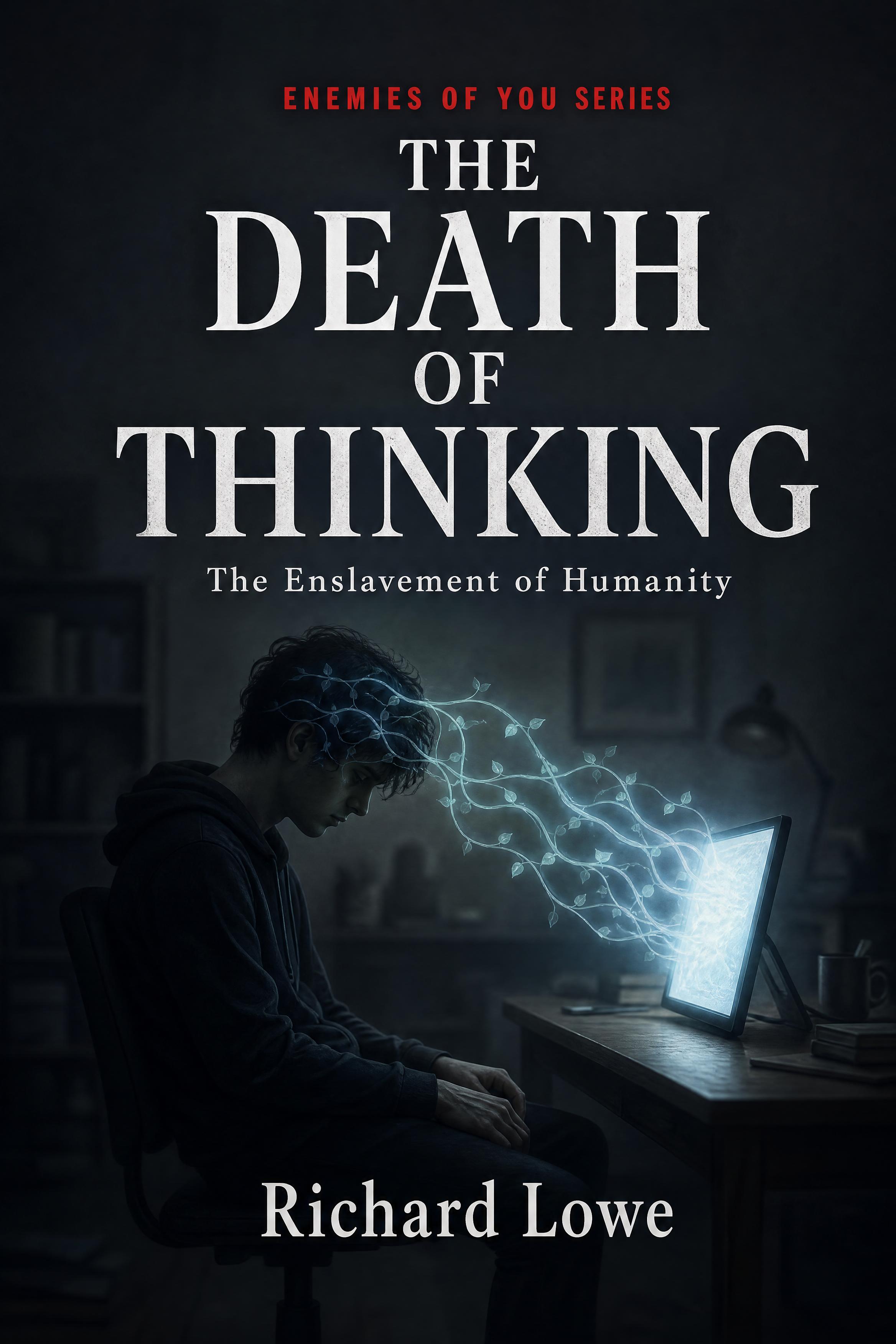
Phone numbers and maps were the first things we handed off. In The Death of Thinking I look at how small conveniences pile up into losses you feel only when the skill is gone.
