
Jake and the Bullies
One dodgeball video, and an engine that runs on what happens next
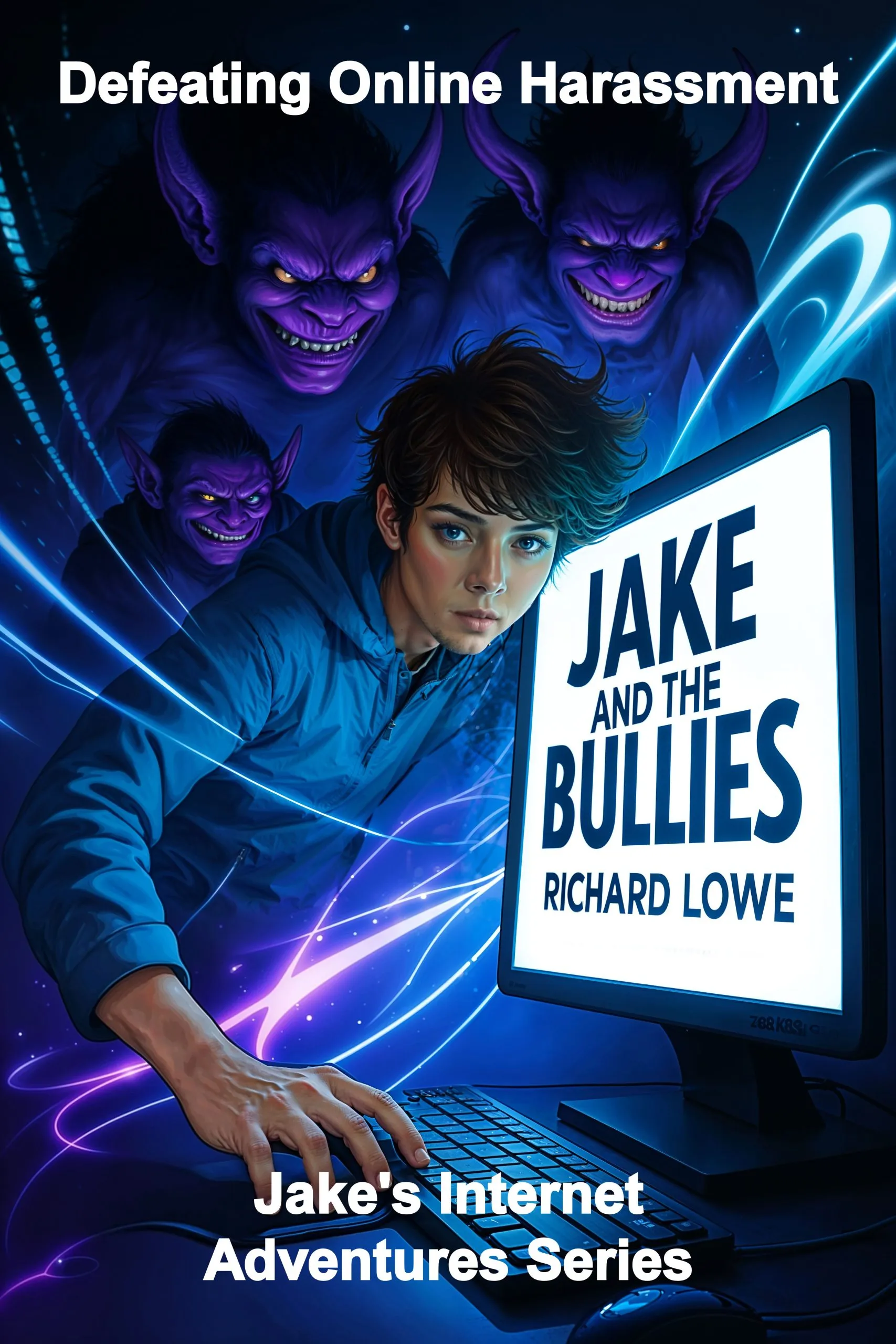 |
Jake never wanted to be internet famous, and definitely not for taking a dodgeball to the face Jake’s Internet Adventures, Book One · 160 pages · Reading age 7 to 14 BUY FROM INGRAMSPARKAMAZONKOBOREAD A CHAPTERTABLE OF CONTENTS Paperback ISBN 978-1-946458-34-6 · ebook ISBN 978-1-946458-84-1 |
| 160Pages | 1Dodgeball video | 7-14Reading age | 1Hate Engine |
I never had anyone show me there was another way.
from the novel
The video goes up and the comments start, and within a day Jake Martinez has a problem much bigger than being embarrassed at school. Then something happens with his computer and he’s inside the internet itself, in Social Media City, where the trolls have caves and the algorithms have addresses.
At the center of it is a Hate Engine that runs on what kids feel when the comments arrive. Jake has to work out how it feeds before he can do anything about it, and the answer isn’t to fight harder.
In what order should you read Jake and the Bullies?
| 1. Jake, Book OneJake and the BulliesYou are here | 2. Wild Tiger, Book OneThe Wild Tiger and the Answer Bot | 3. Wild Tiger, Book TwoThe Wrong Answer |
How does Jake and the Bullies open?
The Video
Jake Martinez stared at his lunch tray.
He wasn’t looking at his food. He listened.
Giggling. Whispers. Someone saying his name.
Something was wrong.
The cafeteria was packed like always. Hundreds of kids, trays clattering, chairs scraping. The smell of mystery meat and chocolate milk. Jake had eaten in this cafeteria a hundred times.
At the table nearest the door, a kid Jake had never seen before was reading an actual paper book. Jake noticed it and immediately forgot about it.
But today felt different.
He picked up his turkey sandwich and took a bite. It tasted like cardboard. Everything tasted like cardboard when you were nervous.
“Did you see it?” someone whispered at the table behind him.
“Oh my gosh, yes! It’s so funny!”
More giggling. More whispers.
Jake’s stomach twisted into a knot.
He looked around the cafeteria. Half the kids had their phones out. They’d look at their screens. Then they’d look at him. Then they’d look back at their screens.
Then they’d start giggling.
Something on those phones was about him.
He knew it.
His best friend Marcus slid into the seat across from him. Marcus wore his basketball jersey. He’d had a huge smile when he sat down. But the smile was gone now.
“Dude,” Marcus said quietly. “You need to see this.”
“See what?” Jake asked.
But he already knew. Whatever it was, it was going to be bad. Really bad.
Marcus hesitated. He looked like he didn’t want to show Jake.
That was even worse.
Marcus held out his phone.
Jake looked at the screen.
His stomach didn’t just drop. It fell all the way to the floor and kept going.
There he was. In a video. Getting smashed by three dodgeballs at once. Spinning around like a tornado. Then falling flat on his face with a sound like a wet slap. His gym shorts had twisted up in the fall. You could see his Spider-Man underwear.
The whole thing lasted about fifteen seconds.
It felt like fifteen years.
The video had 847 likes.
And the number was still going up.
But the worst part wasn’t the spin. It wasn’t even the underwear.
The worst part was the caption someone had added.
“When you think you’re athletic but you’re really just pathetic! #EpicFail #DodgeballDisaster #SpiderPants”
Jake watched it play once. Then again. Then a third time, as if he was hoping the ending would change.
It didn’t.
“Who posted this?” Jake whispered.
“Account called FailCompilation247,” Marcus said. “Nobody knows who runs it.”
Jake put the phone down.
He looked around the cafeteria again.
Kids recorded him now. Not watching the video. Recording HIM. Recording his reaction to his own humiliation. He could see the little red recording lights on their phones.
“It’s not that bad,” Marcus said.
But even Marcus didn’t sound like he believed it.
Jake pushed his lunch tray away. He couldn’t eat. He couldn’t think straight.
His phone buzzed.
Then again.
Then again and again and again.
“Maybe don’t check that right now,” Marcus said.
Jake checked it anyway.
Hundreds of notifications. Hundreds. Text messages, Instagram tags, Snapchat mentions. Kids from school shared the video and piled on with their own laughing emojis and mean comments.
He scrolled through them until his eyes burned.
Then one new notification popped up. Not from any app he recognized. The text seemed to float right on his screen, like it hovered above everything else.
Just four words.
“Welcome to the Club…”
Jake’s blood went cold.
What club?
He had no idea.
But then the bathroom door down the hall burst open. Heavy footsteps echoed against the tiles. The cafeteria went weirdly quiet.
A voice Jake recognized with dread said:
“I know you’re in here, Martinez.”
Kyle Brennan.
The biggest bully in eighth grade.
He was tall for his age, built like a football player, the kind that made teachers nervous. He stood in the cafeteria doorway, phone already out.
“Come out, come out, Spider-pants.”
He said it just loud enough for everyone to hear.
And everyone did.
The chapter keeps going.
Who should read Jake and the Bullies?
|
Read it if
|
Not for you if
|
► Behind the Book: Jake and the Bullies
How this one got written, what went wrong, and what got cut.
How did Jake and the Bullies come about?
Richard Lowe, the Writing King
Kids get told to ignore it, and ignoring it does nothing, because the thing on the other side isn’t a person having a bad day. It’s a system that runs on reaction.
So I made that literal. Jake goes inside the internet and finds the engine, and the tactics he learns down there are the tactics that work up here: how harassment spreads, what feeds it, and which responses make it worse.
The lesson sits inside the adventure instead of on top of it. A kid who wanted a story gets a story. What they take away is a working model of how the thing they’re dealing with works.
What do people ask about Jake and the Bullies?
Also in Young Adult
|
The Wild Tiger and the Answer Bot Slow down describes a direction. It doesn’t give you a mechanism. |
The tool worked, mostly, and forty kids had already built on the part that didn’t |
The video was the small problem
Something on the other side was already using it.
BUY FROM INGRAMSPARKAMAZONKOBOREAD A CHAPTERTABLE OF CONTENTS
Paperback and ebook.
Social Media City
Jake and the Bullies
They crashed through a dozen spider webs made of fiber-optic cables.
They bounced off a cloud of Instagram stories. Tumbled past a waterfall of TikTok videos. And landed in a pile of something soft and pink.
“Ugh,” Jake groaned. “What’s this stuff?”
Tyler sat up, pulling pink fluff out of his hair. “I think we landed in a pile of heart-eye emojis.”
Jake looked around.
A city of giant smartphones. The streets were rivers of blue light. Floating screens showed people’s posts and photos everywhere he looked.
“Welcome to Social Media City,” Tyler said. “Population: everyone who’s ever posted a selfie.”
A walking smartphone strutted over to them. Its screen showed someone’s Instagram profile.
“OMG, you’re the dodgeball boy!” it squealed. “Can I get a selfie?”
Before Jake could answer, a dozen more phone-people surrounded them.
“Make the face!” one shouted.
“Do the spin!” another yelled.
Jake’s cheeks burned.
Even HERE. Even inside the internet. He couldn’t escape.
Tyler grabbed his arm and pulled him away from the crowd.
They ran until they found a run-down building squeezed between a giant Facebook tower and a huge Instagram camera. A flickering neon sign said: HELPER’S HUB.
Tyler knocked three times. Paused. Knocked twice more.
The door opened.
A small blue cube floated at eye level. About the size of a baseball. It had a simple smiley face on one side.
“Password?” the cube asked.
Tyler looked embarrassed. “We don’t know the password.”
The cube’s face switched to a frowning emoji.
Jake stepped forward. “We’re being chased by trolls and security bots. We really need help.”
The cube studied Jake.
“You’re the dodgeball boy, aren’t you? I’ve been tracking that video’s spread across seventeen platforms. You went viral in under three hours!” The cube seemed to realize it was being rude. “Oh. Sorry. I’m Helper.exe. Call me Helper. Come in. Quickly.”
Inside the shop, walls were covered with monitors showing different parts of the internet. The chairs were made of old keyboards. Surprisingly comfortable.
“Tea?” Helper asked.
Jake took a sip. It tasted like nothing. But it made him feel calmer.
“Now,” Helper said, his face turning serious. “There’s something you should know. There’s a new presence in the network. Something that calls itself DigitalGuardian. It’s been contacting kids who are being bullied, promising to help them.”
Jake and Tyler exchanged glances.
“Everyone who accepted its help,” Helper continued, “has ended up trapped here.”
“That’s exactly what happened to us,” Tyler said.
“I was afraid of that. And I found something else.” Helper floated to a monitor and typed quickly. “Both of you’ve been marked as ‘special users’ by something called the Hate Engine. I’ve never seen that designation before.”
The room got darker.
Outside, Jake heard something.
Marching feet. Getting closer.
Helper quickly switched off all the monitors.
“Oh dear,” he said. “They’ve found us.”
Through the window, Jake could see a parade of digital monsters. Trolls with delete keys. Creatures made of flashing ads. And something new: giant spiders made entirely of error messages.
“Is there a back way out?” Jake asked.
“Yes. But it leads to the source code district. Very dangerous. One wrong step and you could crash an entire website.”
The marching sounds got closer.
“COME OUT, DODGEBALL BOY!” a troll bellowed.
“WE HAVE CAKE!” another yelled. Then horrible mechanical laughter.
“This way,” Helper said. “Don’t touch the code streams.”
They hurried through a door marked AUTHORIZED PERSONNEL ONLY.
And stepped onto a narrow bridge made of pure light.
Below them, rivers of computer code flowed like glowing waterfalls.
They were halfway across when a voice echoed through the digital air.
“Hello, Jake.”
Jake froze.
A tall figure stood at the other end of the bridge. It wore a dark hood made of flowing computer code. Where its eyes should have been: two glowing red dots.
“DigitalGuardian,” Tyler whispered.
“I’ve been waiting for you, Jake,” the figure said. “Here, in my world, I can give you power. The power to make them all pay.”
“Don’t listen,” Helper said. “It’s not what it seems!”
DigitalGuardian raised one hand.
Helper froze. Mid-air. His face flickering with error messages.
“Your little friend can’t help you now,” DigitalGuardian said. “Join me willingly, and I’ll give you the power to destroy everyone who’s ever laughed at you. Or resist, and I’ll take that power anyway.”
Table of contents
Jake and the Bullies
- The Video
- Going Viral
- Marcus
- No Escape
- Going Under
- Welcome to the Web
- Social Media City
- The Troll Caves
- First Battle
- The Virus
- Game World
- Boss Battle
- The Core
- Shutdown Sequence
- Upload Complete
- Cheat Code
- Lights Out
- Final Level
- After
- New Code
- Hero Protocol
- Reboot
- Digital Army
- Coming Next: Jake and the Chaos Collective