
The Wrong Answer
The tool worked, mostly, and forty kids had already built on the part that didn’t
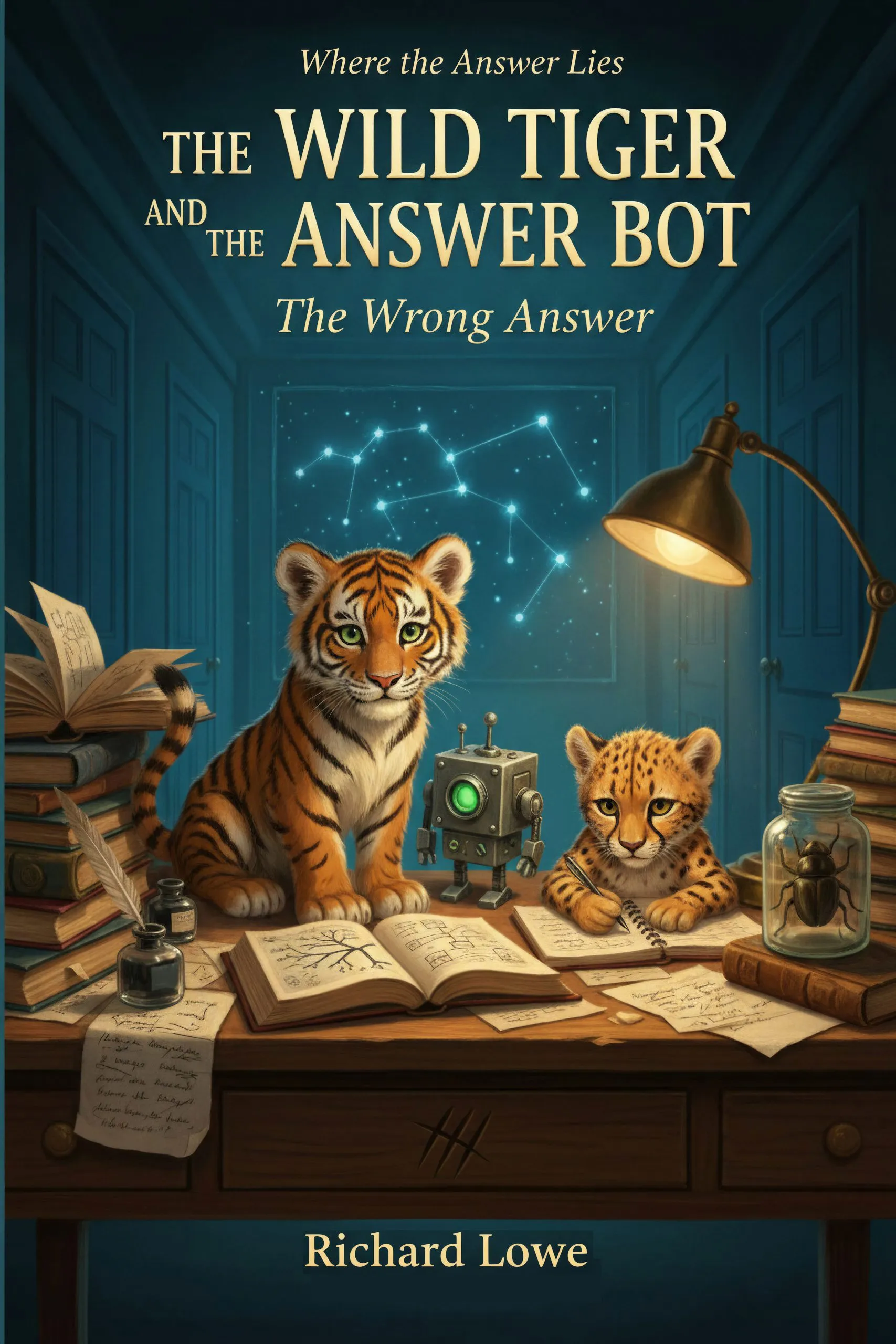 |
She stands up in front of the class and says: I was wrong about this specific thing in this specific way Wild Tiger Series, Book Two · 189 pages · Reading age 6 to 12 BUY FROM INGRAMSPARKAMAZONKOBOREAD A CHAPTERTABLE OF CONTENTS Paperback ISBN 978-1-972810-69-9 · ebook ISBN 978-1-972810-70-5 |
| 189Pages | 40Kids already using it | 6Tests, zero through five | 1Flaw |
We’re fixing the flaw and showing our work.
Blaze, from the novel
Blaze brought the valve back and gave it to her class, and forty kids started using it. Then she found the flaw. It worked, mostly, and there was one specific thing it got wrong in one specific way, and by the time she understood the error everybody had already built on top of it.
So she doesn’t fix it quietly. She stands up and names the error, then shows the class how to recheck anything they verified with the broken version. Devon is the kid who felt something was wrong for months before he had the words, and his question is the one the whole book is answering.
In what order should you read The Wild Tiger and the Answer Bot?
| 1. Jake, Book OneJake and the Bullies | 2. Wild Tiger, Book OneThe Wild Tiger and the Answer Bot | 3. Wild Tiger, Book TwoThe Wrong AnswerYou are here |
How does The Wild Tiger and the Answer Bot open?
Stanley Goes Through
I told him not to look at the wall when it opened.
It opened at eleven. Same as always. The thin line of gold light running from floor to ceiling. The zipper. Then the portal, large and round and lit from inside, settling onto the rug.
Stanley had been sitting on the edge of my bed with his second notebook. He’d filled the first notebook three weeks ago and bought the second one immediately. It was already half full.
He looked at the wall when it opened.
“I told you not to—”
“I know.”
“I told you not to—”
“I know,” Stanley said. “I couldn’t help it.”
He stood at the edge of the portal with his spiral notebook pressed against his chest. His cheetah spots had gone still. That happens to him when he’s trying not to show anything on his face. The spots stop moving. I’d noticed it over months of lunch conversations. I’d never told him I noticed.
“It’s not going to hurt you,” I said.
“I know,” he said again.
“The portal talks,” I said. “Don’t be weird about it.”
“I won’t be weird about it.”
“The first time I heard it talk, I fell off my bed,” I said.
Stanley looked at me.
“You could have mentioned that earlier,” he said.
“First-timers,” the portal said.
Stanley made a sound I’d never heard from him before. High. Brief. Gone almost before it existed.
He pressed the notebook harder against his chest.
“Hello,” he said to the portal. The way you say hello to something when you’re not sure what rules apply.
“Hello,” the portal said. “I’ve been looking forward to this.”
Stanley turned to me. His spots had started moving again. That meant he was okay.
“It’s been looking forward to this,” he said.
“I know,” I said.
“For how long?”
“Since I first mentioned you,” I said. “Can we go? It’s a schedule.”
* * *
The data stream outside the portal walls was the same as the first time. Buildings in every direction. Library blues and database silvers and the warm amber of old archives. The networks pulsing green. The encyclopedia building with its steady light, someone adding something to it right now, in this exact second, the same as always.
Stanley had his face against the portal wall.
“You’re leaving a mark,” the portal said.
“Sorry,” Stanley said. He didn’t move.
“It’s all right,” the portal said. “First-timers always do. It’s something about the scale.”
“It’s everything,” Stanley said. “The scale is everything.”
He was right. From the inside, the internet looks like the biggest thing that’s ever existed. It looks like a city made of other cities, all of them stacked on top of each other and running sideways and going in directions you don’t have names for.
Stanley looked at it for a long time. His pen was out. He wasn’t writing. He was just looking.
Then he turned from the wall.
He opened the notebook.
He started writing.
I waited.
“How do you describe it?” I said.
“I don’t know yet,” he said. “I’m trying to find a shape for it first.”
He kept writing. Three pages. I watched the buildings move past outside. The encyclopedia building slid by and I waved at it. The portal made the sound it always makes when it finds that amusing.
Stanley looked up.
“You waved at a building,” he said.
“The encyclopedia building,” I said. “Someone’s always adding to it.”
He thought about that for a moment.
Then he turned back to his notebook and wrote something else.
I didn’t read it. But I wanted to.
* * *
The corridor of blue doors looked exactly the same as the last time and the time before that.
Hundreds of them. Identical. Same shade of medium blue, same size, same handle, same shadow at the bottom. No numbers. No markings. Nothing to tell them apart.
Stanley stood still and looked at both ends of the corridor.
Then he walked to the nearest row. He looked at the handles. The hinges. He crouched down and checked the shadows underneath each door, moving along the row at a slow, steady pace.
I waited.
The chapter keeps going.
Who should read The Wild Tiger and the Answer Bot?
|
Read it if
|
Not for you if
|
► Behind the Book: The Wild Tiger, The Wrong Answer
How this one got written, what went wrong, and what got cut.
How did The Wild Tiger and the Answer Bot come about?
Richard Lowe, the Writing King
Book One gave Blaze the valve. Book Two is about something harder: what happens when you hand somebody a tool, the tool has a flaw, and forty people have already used it.
She doesn’t find the error and fix it in private. She stands up in front of the class and says she was wrong about one thing in one way, here’s the correction, and here’s how to recheck anything you verified with the broken version. That’s the lesson. Corrections aren’t failures, they’re part of the method.
Devon’s question drives the book: what if the thing doing the checking is also wrong. The answer isn’t that checking is futile. Check from more than one direction, document what you can’t confirm, and make the method visible so other people can improve it. Test zero is for every kid who was told they didn’t understand something well enough to question it. They understood it fine. They needed a structure.
What do people ask about The Wild Tiger and the Answer Bot?
Also in Young Adult
|
One dodgeball video, and an engine that runs on what happens next |
The Wild Tiger and the Answer Bot Slow down describes a direction. It doesn’t give you a mechanism. |
Corrections are part of the method
Not the failure of one.
BUY FROM INGRAMSPARKAMAZONKOBOREAD A CHAPTERTABLE OF CONTENTS
Paperback and ebook.
The Corridor of Doors
The Wrong Answer
He went back to the beginning of the row. He started again, this time looking at the base of each door where it met the floor.
Three minutes.
Five.
He stopped at the third door from the left in the second row.
He got down on one knee. He looked at the bottom left corner.
The scratch. Thin. Old. Slightly deeper at one end.
“This one,” he said.
Not a question. He just knew.
I’d found it the first time in eleven minutes. Stanley did it in eight.
“How?” I said.
“The scratches on all the other doors are from feet,” he said. “Scuff marks. People walking past and catching the wood with the edge of a shoe. This one’s different. The angle is wrong for foot traffic. It’s from something carried past this corner at about mid-height.”
He stood up.
He opened the notebook. He wrote: scratch analysis: carried object at mid-height, not foot traffic. Different wear pattern than surrounding doors.
“Stanley,” I said.
“Yeah.”
“You’ve been here less than fifteen minutes.”
“I know,” he said. He sounded like himself again. Quiet. Pleased without showing it. “Can we go in?”
I pushed the door.
The smell reached him before anything else. Old ink and wood smoke and the sweet chemical underneath that I still hadn’t identified after two visits.
Stanley stopped walking.
His eyes went to the drawings on the walls.
He walked to the water spirals first. Not the wings, not the flying machine, not the human eye diagrammed like a clockwork. The water spirals.
He stood in front of them for a long time without writing anything. His pen was in his hand but not moving. He went close to one page, then stepped back to see three at once, then went close again.
“The scale doesn’t change the mathematics,” he said.
“No,” I said.
“The same spiral. Every size.”
“Yes.”
“The drain in a sink and the hurricane and the galaxy.”
“Yes.”
He stepped back further. He looked at all of them at once.
“He’s been looking for why,” Stanley said.
“Yes,” I said.
“Has he found it?”
I looked at the cloth-covered shelf in the corner. The forty-year drawing underneath it that Leonardo had shown us last time.
“He’s getting closer,” I said.
“Good,” Stanley said. He wrote something in the notebook.
Then Leonardo turned around.
The most awake eyes I’d ever seen in my life. I’d thought that the first time and it was still true three visits later. Eyes that found everything interesting, all the time, as a baseline condition of existing. They moved to me first, then to Stanley.
Then they stayed on Stanley.
The pen on the table had been writing by itself since we walked in. It kept writing.
Stanley saw it. He watched it for three full seconds. He opened the notebook, wrote something down, and didn’t say another word about it.
I liked him so much in that moment.
He’d accepted the pen. He’d accepted the smell and the drawings and the screens and the forty years of work on the walls. He’d walked in and gone straight to the water spirals and understood what they meant before Leonardo said a word.
That was the difference between Stanley and almost every other person I’d met.
He didn’t need to be told what was interesting. He found it himself.
Leonardo was still watching him with those awake eyes.
“You didn’t start at the wings,” Leonardo said.
“No,” Stanley said.
“Most visitors start at the wings,” Leonardo said. “They’re the most dramatic.”
“The wings show anatomy,” Stanley said. “The spirals show something else.”
“What do they show?” Leonardo said.
“That the same pattern appears at scales that have nothing else in common,” Stanley said. “Which means the pattern is more fundamental than the medium.”
Leonardo was quiet for a moment.
The pen wrote something fast in the margin.
Stanley noticed the pen writing. He glanced at it, then back at Leonardo. He opened his own notebook and wrote something too.
I liked him so much in that moment.
“You came from the water spirals,” Leonardo said.
“The scale doesn’t change the mathematics,” Stanley said.
“No,” Leonardo said. “It doesn’t.”
He sat down.
“Sit,” he said. “Both of you.”
He looked at Stanley the way he’d looked at me the first time. Not evaluating. The opposite of evaluating. Like he was watching something he’d been waiting to see and was making sure he didn’t miss any of it. I recognized the look from my own first visit.
Table of contents
The Wrong Answer
- Stanley Goes Through
- The Corridor of Doors
- The Second Workshop
- Something Wrong
- Current Discoveries
- The Crack
- The Red District Learns
- What Changed
- The Door
- The Troll Returns
- Stanley’s Framework
- Blaze Gets It Wrong Again
- The Parent Meeting
- The Worst Part
- Back to Leonardo
- What Failure Looks Like
- The Red District Studied Them
- Stanley’s Notebook Page Forty
- The Test
- Devon
- The Correction
- Devon’s Question Answered
- The Red District Tries One More Time
- What Leonardo Knows Now