
The Wild Tiger and the Answer Bot
Slow down describes a direction. It doesn’t give you a mechanism.
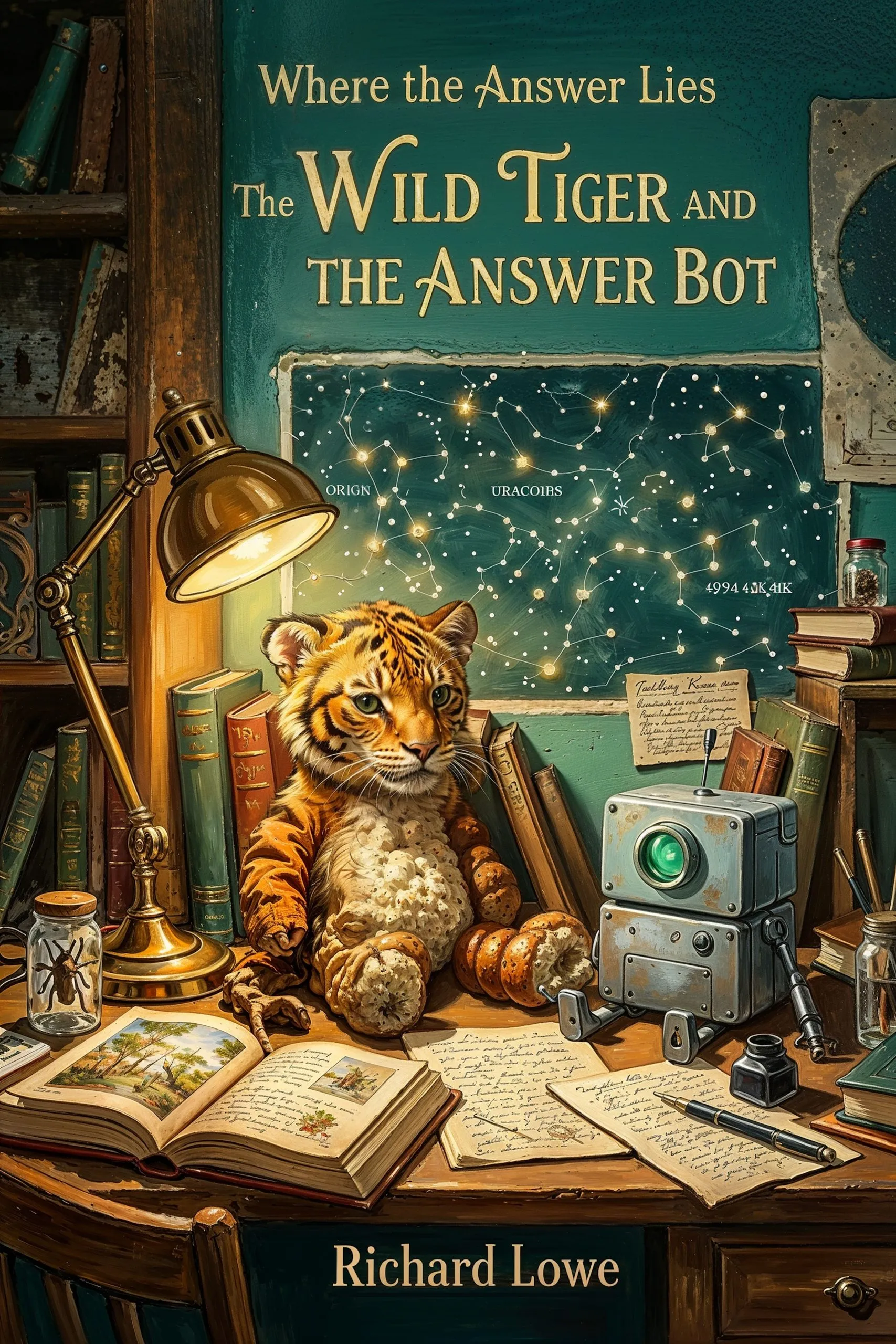 |
Blaze knows a lot. What she cannot do is stop herself from saying it out loud. Wild Tiger Series, Book One · 94 pages · Reading age 6 to 12 BUY FROM INGRAMSPARKAMAZONKOBOREAD A CHAPTERTABLE OF CONTENTS Paperback ISBN 978-1-972810-59-0 · ebook ISBN 978-1-972810-60-6 |
| 94Pages | 6-12Reading age | 9Blaze’s age | 1Valve |
Tools don’t work just because you have them.
Blaze, from the novel
Blaze is a nine-year-old Bengal tiger who knows that petrichor is the smell of rain on dry earth and that obsidian is technically a glass. The moment anyone asks a question, any question, the answer arrives and leaves before she’s decided anything about it.
Adults keep telling her to slow down. Slow down names a direction without handing over a mechanism, and a kid who’s answering before deciding to answer cannot simply decide to stop, because the decision happens too late. Then she and Chip find a portal into the internet, and a workshop where Leonardo da Vinci is the answer bot.
In what order should you read The Wild Tiger and the Answer Bot?
| 1. Jake, Book OneJake and the Bullies | 2. Wild Tiger, Book OneThe Wild Tiger and the Answer BotYou are here | 3. Wild Tiger, Book TwoThe Wrong Answer |
How does The Wild Tiger and the Answer Bot open?
The Answer I Couldn’t Stop
My name is Blaze.
I’m a Bengal tiger.
And I have a problem.
I have about fifty problems. But the biggest one started on a Tuesday morning in Ms. Burrows’s class, when I ruined everything.
Again.
Here’s what happened.
Ms. Burrows drew a diagram on the board. Water cycle. Evaporation. Precipitation. Arrows going up and down. Simple. I’d known this stuff since second grade.
She turned around and said, “Can anyone tell me what causes water to evaporate?”
I told myself: wait. Paw up. Wait to be called on. You can do this.
I put my paws flat on my desk.
I pressed them down. HARD.
And then…
“Heat energy from the sun excites the water molecules at the surface so they break free from surface tension and escape into the air as vapor, and at high altitude they need particles to condense around, which is called nucleation and without nucleation particles like dust or pollen there’d be no clouds at all, just invisible water going nowhere!”
The classroom went silent.
I was halfway out of my chair.
I had no memory of standing up.
My tail was doing a full rotation behind me. My paw wasn’t raised. It had never been raised.
The answer had just come OUT. Before I decided to let it out. Before I even knew I was thinking it. One second I was pressing my paws down. The next second I was standing and talking and there was nothing I could do to stop it.
It’s like sneezing.
You know how you can’t stop a sneeze once it starts? You can press your tongue to the roof of your mouth. You can stare at a light. You can pinch your nose. But the sneeze comes anyway.
That’s exactly what the answers are like.
I looked at Ms. Burrows.
Ms. Burrows is a red panda. Small. Precise. She runs her classroom like a machine she designed herself. Paws up before you answer. Wait to be called on. Every rule exists for a reason. Every rule gets followed.
She was looking at me.
Not the angry look. I know the angry look. Raised eyebrows. Tight jaw.
This was the other look. The look that had stopped being surprised a long time ago.
“The answer was correct,” she said quietly. “Please sit down, Blaze.”
I sat.
I put my paws in my lap.
Around me I heard the very careful sounds of twenty students looking anywhere except at me.
I knew those sounds.
I’d been hearing them for years.
* * *
After class, Ms. Burrows asked me to stay.
I knew what was coming.
She sat at her desk. She picked up a pen. She wrote something on a piece of paper, folded it twice into a small white rectangle, and held it out.
“Please give this to your parents tonight,” she said.
I took it.
In four years of school, I’d never gotten a note to take home. Not once.
The paper felt like it weighed ten pounds.
I walked out into the hallway.
And Devon was waiting.
Devon is a large green iguana. Heavy-lidded eyes. Permanent smirk. He spends most of his time leaning against walls in poses he seems to think look cool.
He looked at me walking out after everyone else. He looked at my backpack.
His smirk got bigger.
“Blaze got kept after class,” he said.
I kept walking.
“BLAZE GOT A NOTE HOME,” he announced to the hallway. “BLAZE GOT A NOOOOOTE—”
I turned the corner.
But his voice followed me all the way down the hall.
I was so busy thinking about Devon and the note and Ms. Burrows’s face that I almost didn’t notice the thing leaning against my locker.
It was small. Silver. Round green eye in the center of its face, glowing at full brightness.
Chip.
My robot.
He was looking at me with an expression I’d never seen on his face before.
“I’ve been waiting for you,” he said. “We need to talk.”
The chapter keeps going.
Who should read The Wild Tiger and the Answer Bot?
|
Read it if
|
Not for you if
|
► Behind the Book: The Wild Tiger and the Answer Bot
How this one got written, what went wrong, and what got cut.
How did The Wild Tiger and the Answer Bot come about?
Richard Lowe, the Writing King
Blaze says more than once that slow down contains no useful information. She’s not wrong, and that part of the book isn’t an accusation. Most adults who say it are doing exactly what her parents do, trying to help with the tools they have.
The problem is that slow down describes a direction without providing a mechanism. A child who’s blurting answers before deciding to blurt them cannot simply decide to stop. The decision happens too late.
The valve is grounded in real self-regulation research. It’s not a cure and it won’t look the same for every kid. Some will find the finger tap works, others will need a different sensory anchor vivid enough to hold the attention. The principle is the redirect, not the specific motion. If your child recognizes themselves in Blaze, the recognition itself is worth something.
What do people ask about The Wild Tiger and the Answer Bot?
Also in Young Adult
|
One dodgeball video, and an engine that runs on what happens next |
The tool worked, mostly, and forty kids had already built on the part that didn’t |
Slow down contains no useful information
She’s not wrong, and the book isn’t blaming anyone for saying it.
BUY FROM INGRAMSPARKAMAZONKOBOREAD A CHAPTERTABLE OF CONTENTS
Paperback and ebook.
The Portal
The Wild Tiger and the Answer Bot
It wasn’t an explosion.
No bang. No flash. No dramatic sound effects.
Just a thin line of gold light, running from floor to ceiling.
Then the zipper happened.
The line pulled open. Light poured through: gold at the center, white at the edges, crackling blue where it met the air. And then, pushing through the opening, something large and round and rotating slowly like a wheel that had decided to stand on its edge.
It was the size of a car.
It was glowing from the inside.
And it was settling onto my bedroom rug.
I went backward off my bed and hit the floor with my elbow and knee at the same time.
My tail knocked the desk lamp sideways.
The specimen jars on the windowsill rattled. I lunged and grabbed them before they fell.
The large glowing thing settled onto the rug.
The floor rumbled.
Then stopped.
Then the portal spoke.
“First-timers,” it said.
Three voices, layered on top of each other. Like a chord made out of words instead of notes. Not scary, exactly. Just deeply, weird.
“You TALK?” I said.
“Of course I talk,” it said. “I’m a portal, not a piece of furniture.” A pause. “Also, your tail is three inches from my lower edge.”
I looked down. My tail was exactly three inches from the lower edge.
I tucked it in.
“Now then,” the portal said. “Are we going or aren’t we? I have a schedule. The internet doesn’t wait. And I have other passengers.”
I looked at Chip.
Chip looked at me.
“Is it safe?” I said.
“Mostly safe,” Chip said.
“MOSTLY?”
“The places we’re going are safe,” he said. “There are other places in the internet that are less safe. We’re not going to those.”
“Are you sure?”
“Mostly sure,” he said.
I looked at the portal. The portal looked back at me. Or at least it aimed itself that way. It’s hard to tell with something that doesn’t have eyes.
I thought about the note on the refrigerator. The corner seat. The window. Devon’s voice and Ms. Burrows’s face and four years of pressing my paws flat on my desk and it never, ever working.
I climbed through the portal.
It didn’t hurt at all.
I braced for electric shock. For heat. For something.
Instead it felt like stepping into the space between two heartbeats.
Not dark. Not light.
Just… potential.
Then the portal sealed behind me and I was somewhere else entirely.
Two seats inside. A lap belt that clicked into place on its own. Walls that were almost transparent, showing something moving and huge outside.
“Arriving in the stream,” the portal said. “Standard transit time. Don’t look at the edges.”
“Why not?” I said.
“Some of what passes by is designed to look interesting,” the portal said. “That’s intentional. Keep your eyes on the forward wall until I tell you it’s clear.”
Chip settled on my shoulder.
I looked at the forward wall.
A moment of nothing.
Then the forward wall disappeared and I saw the internet for the first time.
And I almost fell out of my seat.
Table of contents
The Wild Tiger and the Answer Bot
- The Answer I Couldn’t Stop
- The Walk Home
- The Note
- The Portal
- The Internet
- Twenty Eyes
- The Corridor of Doors
- Old Ink
- The Troll
- Seven Million Results
- I Was You
- The Crawler Comes Back
- The Passage
- Out
- Morning
- The First Try
- The Rock Cycle
- What Stanley Wrote
- Devon Tries Again
- The Second Day
- The Visible Tap
- The Wrong Answer
- Six Weeks Later
- What Chip Didn’t Say
- Ms. Burrows
- The Next Problem
- The Second Portal Trip
- What Leonardo Found
- The Cloth
- Stanley
- What the Valve Is For
- Before Orion