
I wrote Family on Ice about this eruption, and the science kept surprising me the deeper I went.
Toba is the event I find hardest to shake. Most catastrophes people write about take a city or a generation.
This one came close to taking the whole species, and it barely registers outside geology departments. I loved researching it, and I’m still a little angry that something this important gets a paragraph in most textbooks when it deserves a shelf.
The mountain that’s now Lake Toba stood in northern Sumatra, and on a day nobody recorded it came apart.
The number is 2,800 cubic kilometers of rock, ash, and pumice thrown into the atmosphere. That’s the largest volcanic eruption in roughly two and a half million years, and the comparisons don’t help much because there’s nothing in human memory at that scale.
Mount St. Helens in 1980 moved about a quarter of a cubic kilometer. Krakatoa in 1883, loud enough to be heard four thousand kilometers away, moved around twenty. Tambora in 1815 moved about a hundred and sixty and gave Europe and North America the year without a summer, with snow in June and failed harvests across two continents.
Toba is a different category of event, and the crater it left is now a lake a hundred kilometers long and thirty wide, with an island in the middle about the size of Singapore that’s simply the floor of the old magma chamber pushing back up.
What happened to the sky after the Toba eruption?
The rock was the smaller problem. The sulfur was the larger one.
A supereruption injects sulfur dioxide into the stratosphere, where it converts to sulfuric acid aerosols. Those aerosols are the thing that matters, because they’re highly reflective, they sit above the weather where rain can’t wash them out, and they stay for years. Sunlight arrives at the top of the atmosphere and doesn’t reach the ground.
Ash fell across continents, and it’s still findable. Archaeologists working in India, Malaysia, and the Arabian Peninsula recover Toba glass as cryptotephra, microscopic shards carrying a chemical signature unique to that eruption. It’s one of the few moments in the deep past with a precise horizon in the soil, a single day visible in the ground on two continents.
Under the ash cloud, sunlight across Eurasia was cut sharply. Some estimates put the reduction as high as ninety percent in the worst of it. Global temperatures fell several degrees, and in the account that shaped this book the cold held for up to six years.
Watch: The Biggest Eruptions That Changed Earth Forever, Kurzgesagt – In a Nutshell
What does a decade without summer do to people?
Everything downstream of sunlight fails in order, and the order is the part worth understanding.
Plants go first, because they’re the only part of the system that eats light directly. Growing seasons shorten, then fail. The plants that survive are smaller and produce less, and the ones a person could rely on being in a particular place in a particular month stop being there.
Then the herbivores. Not all at once. They move, following what’s left. That means the animals a family had hunted in the same valley for three generations are somewhere else, and nobody knows where. Then their numbers fall, because a herd that can’t feed itself doesn’t calve.
The people come next, and they get lost in the population figures. The species didn’t die of one bad winter. It died of the seventh consecutive bad winter, and of the accumulated small failures in between. Fewer calories, so fewer pregnancies carried. Colder nights, so more infants lost. Longer distances between food, so more of the old and the injured left behind. A thin year is survivable. A decade of thin years removes the margin that made everything else possible.
I think popular accounts cheat readers when they tell Toba as one bang followed by a body count. The people who died were worn down over years, by a thinner meal here and a lost infant there, and a reader who skips that has skipped the only part of the story that could happen to anyone.
Under the catastrophe hypothesis, this is what took the human population down to somewhere between three thousand and ten thousand people worldwide. Every person now alive would be descended from that remnant.
What is the genetic evidence of the Toba bottleneck?
The reason this account had such a grip is that there’s real evidence of a narrowing, and it’s in all of us. Modern humans carry very little genetic diversity. Less than chimpanzees do, and there are a few hundred thousand chimpanzees against eight billion of us. That only happens when a population passes through a gate narrow enough that most variety doesn’t make it through. Geneticists call it a bottleneck, and it’s not in dispute.
Stanley Ambrose put the two together in 1998. A near-extinction event with a date, a mechanism, and a scar you can still detect in living tissue. It’s the account this novel is built inside, and it’s the one that makes sense of why a species with our range and our brains carries so little variation.
How do we know how cold it got?
The record for an event this old comes from three places that agree with each other. That’s why the temperature figures are firmer than the population ones.
Ice cores in Greenland and Antarctica trap air and dust year by year. A sulfur spike from a large eruption shows as a distinct acid layer, and the layers around it record what happened to the atmosphere afterward. Toba appears in that record. Lake sediments preserve pollen. When the trees around a lake change species or thin out, the pollen falling into the water changes with them, and the sediment holds it in order. Cooling shows up as a shift in what was growing.
And speleothems, the mineral deposits building up in caves, grow in bands whose chemistry varies with rainfall and temperature. They give a fine-grained local record over thousands of years.
Put together, those give a global cooling on the order of three to five degrees, held for something like a decade, with regional variation that was probably severe near the eruption and milder far from it. Three degrees sounds survivable stated as a number. It’s roughly the difference between the present day and the depths of the last glacial period, arriving inside a single lifetime with no warning and no explanation.
I’ve never been able to read that three-degree figure calmly. Numbers that small get waved away, usually by people who’ve never had to ask what a family eats when the spring doesn’t come.
What a person would have seen
The eruption itself was invisible to almost everyone. Sumatra is a long way from Africa, and a family in the Rift Valley would have heard nothing.
What arrived instead was weather that made no sense.
Numbers that small get waved away, usually by people who’ve never had to ask what a family eats when the spring doesn’t come.
The sun would have gone wrong first. Dimmed, and reddened, filtered through something high up that nobody could see the edge of. Sunsets in the years after a major eruption are famously spectacular, and Toba’s would have been at a scale no one has witnessed since. A sky doing something beautiful and inexplicable every evening for years.
And the cold that didn’t lift on schedule. Not a hard winter, which people knew how to survive, but a spring that failed to arrive, and then a second one. The horror of the situation is the absence of an end date, in a world with no concept of a year without a summer, no records of previous ones, and nobody to ask.
Near Sumatra, ash fell. In places it fell in depths measured in centimeters, coating water sources, killing vegetation, and abrading the lungs of anything breathing it. Further away it was invisible, and the only sign was the sky.
What survival required, in practice
The interesting question is what the ones who lived had to do differently, and here the archaeology is more useful than the genetics. Move, and keep moving. The single most reliable human response to a failing landscape is to leave it. That requires knowing where else is. That requires hearing from someone who went. A group that had never traveled beyond its own valley had nowhere to go and no map in anyone’s head.
Widen the diet. Groups that survive climate shocks are consistently the ones that stop being specialists. Shellfish, tubers, small game, things nobody would have bothered with in a good year. The people who starved were often the ones who were very good at hunting one animal.
Keep the fire. Not for warmth alone. Fire makes marginal food edible, extends the useful hours of a short day, and is expensive enough to restart that losing it in a hard winter can end a group.
Hold the group together at exactly the size it can feed. Too few and you can’t hunt or defend. Too many and you starve faster. This calculation, made without arithmetic and under conditions where being wrong kills people, is the most brutal thing in the whole scenario, and it’s where the moral weight of the period sits.
Attention, memory, and a willingness to eat things you’d rather not carried those people through, and none of it looks heroic. The calculation about group size is what pulled me into this book. I hate survival stories where a villain makes the ugly choice so the heroes stay clean. In a failing valley, the person doing that arithmetic is a mother or a grandfather, and I wanted readers to stand beside them with nobody to blame.
Why write prehistoric fiction about a family instead of a species?
Because nobody experienced the extinction of humanity. That’s a fact assembled afterward from ice cores and genomes, and no person living through it had access to any of it.
What a person had was this valley, this winter, this count of people, and this amount of food. The global figure is a thing we know and they couldn’t. A family in Sumatra in the months after the eruption had no way to learn whether anyone in Africa was still alive, and no structure in which that question would occur.
So Family on Ice stays inside what they could perceive. The light is wrong. The count is short. The ground is bad. The animals aren’t where animals are supposed to be. That’s the whole information environment, and the book doesn’t step outside it to tell you what it meant.
It runs 254 pages in rotating close third with no quotation marks, in a style influenced by Cormac McCarthy. Leaner than Jean Auel, and without the anthropological lecture. The content warning is honest: starvation, exposure, and death in a survival setting, including children, because a book about this event that spares the children is a book about something else.
What the deep past demands of a writer
There’s no dialogue in the record. No names, no beliefs, no jokes, no arguments. What survives is stone, bone, ash, pollen, and the chemistry of teeth. That absence is a trap in two directions. The first is filling it with us. Giving Paleolithic people modern interiority, modern moral reasoning, and modern anxieties in fur. It reads as costume drama and it flatters the reader. The second is filling it with nothing. Treating people 74,000 years ago as pre-human, grunting and reactive, which the archaeology doesn’t support at all. These were anatomically modern humans with our brains, our hands, and our capacity for planning. They made tools requiring dozens of sequenced steps, and they taught those sequences to children.
Both traps come from the same laziness, and neither one deserves a pass. One turns those people into us and the other turns them into animals, and both spare the writer the hard work of imagining a mind as capable as ours facing a world with none of our tools.
The way through is to write only what a body knows.
Cold, hunger, fear, the weight of a child who has stopped complaining. Those transfer intact across seventy-four thousand years because the body hasn’t changed. Everything above that layer is invention, and it should be marked as such in your own head while you write it.
I’ve written elsewhere about what you can get wrong in historical fiction and what you cannot. The deep past is the extreme case. Almost nothing in it can be checked against a record, and almost everything in it can be written in the wrong tone.
My take
Toba is the best argument I know for writing the deep past through one family. The global numbers are something we know and they couldn’t. Stay inside what those people could perceive, the wrong light, the short count, the bad ground. Don’t hand them modern minds. And don’t spare the children if the event wouldn’t have. A book that softens this winter is about something else.
What Toba should mean to anyone reading about it now
The lesson people usually take is that we got lucky, and I think that’s the wrong one.
Whatever the final population number turns out to be, the people who came through did it with fire, feet, memory, and each other. No stored grain, no medicine, no institutions, no writing. The margin they worked on was so thin that a single bad decision about when to move could end a family line, and they made those decisions correctly often enough that we’re here.
The other lesson is about scale, and it’s uncomfortable.
A supereruption isn’t a historical curiosity. Toba-class events recur on geological schedules that are long compared to a civilization and short compared to a species. There’s no reason to think we’ve seen the last one, and a modern food system that depends on predictable growing seasons is in some ways more fragile than a hunter-gatherer band. They could walk away from a failing valley. Eight billion people can’t.
That’s why I keep writing about people who lost everything and kept going, in practical terms elsewhere and in fiction here. The details change. The problem doesn’t.
If you want the version with people in it, Family on Ice is 254 pages and the light is wrong on the first one. The rest of the work set in that period is collected in the deep past hub.
Whatever the final numbers turn out to be, somebody lived through that winter, and we’re here because they did. Most people finish school without ever hearing the name Toba. That’s a gap in the curriculum. Those families kept a species alive with fire, feet and each other, and I’ll keep writing about them as long as readers keep treating the event as trivia.
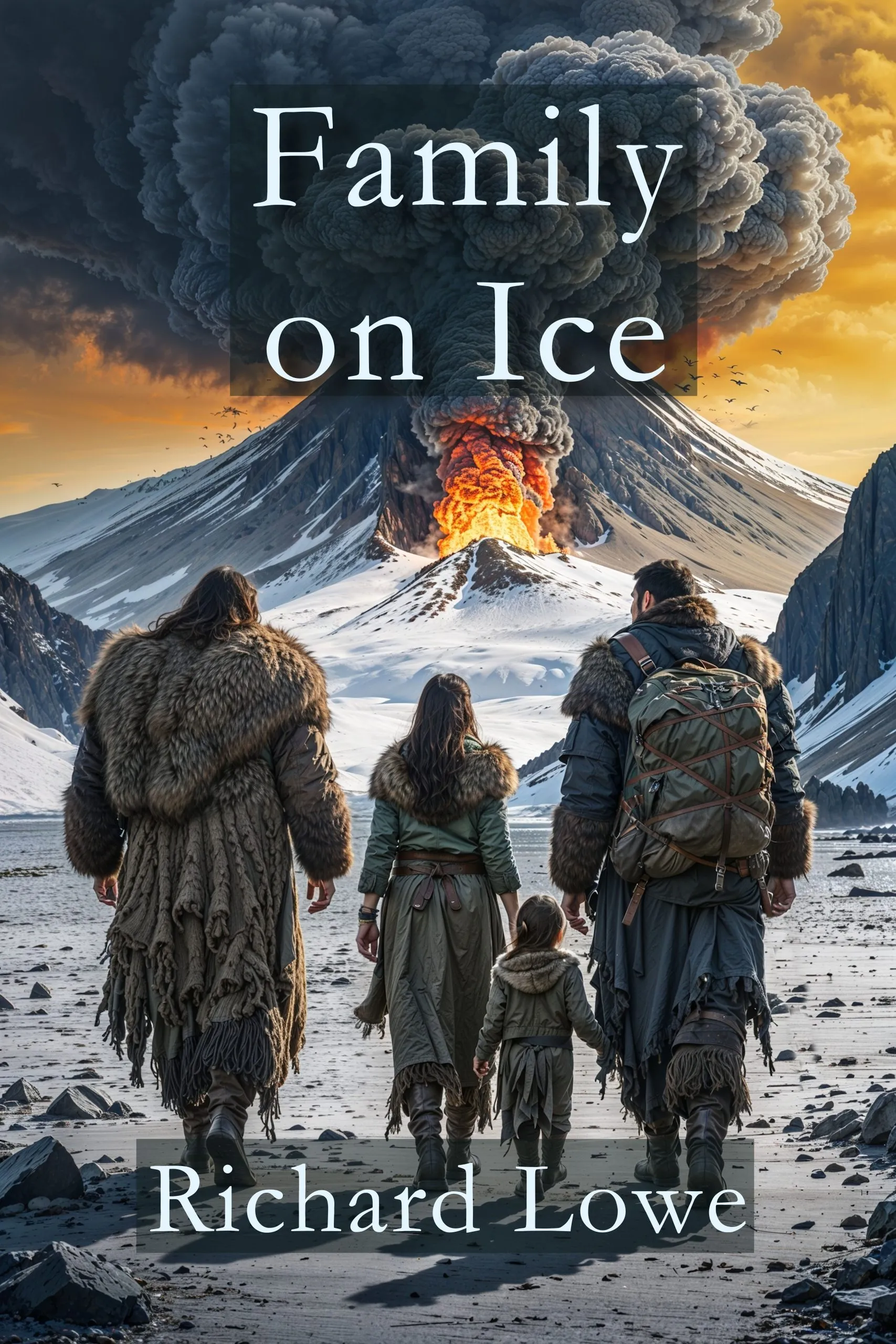
Family on Ice puts one family inside that volcanic winter, when the cold didn’t break, the game moved wrong, and the species came within a generation of ending.
