TL;DR
5/10. Fifty historical disasters from the Trojan War to Enron, arranged by the motive behind each one. Entertaining, briskly written, and not reliable enough to cite. Treat it as a list of things to go and read about properly.
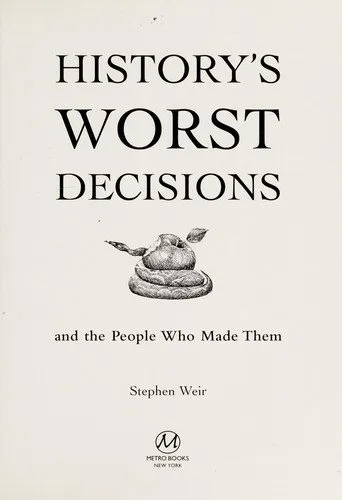
Weir runs from Adam and Eve through Hannibal crossing the Alps, Nero, Erik the Red selling Greenland on its name, Moctezuma, Lord North and the tea, the Dutch trading Manhattan for a nutmeg island, the Maginot Line, Gallipoli, thalidomide, Robert Maxwell, and Enron. Fifty entries, each a few pages, each with a named culprit and a stated motive drawn from a fixed list: anger, greed, pride, sloth, lust, false hope, faith. It was originally published as Encyclopedia Idiotica in 2005 and reissued under this title. That tells you the tone it was written in. I wanted to like this one more than I did. The premise is irresistible, and I’ll read almost anything that promises to explain why smart people walk off cliffs. What I got was a lively tour of the cliffs and very little about the walking.
What does History’s Worst Decisions get right?
The organizing device. That’s good and which I’d steal.
Sorting failures by motive instead of by period puts Moctezuma next to Enron and makes you notice that they rhyme. Pride works the same way in a palace and a boardroom. False hope produces the same behavior in a fourteenth-century pope hunting for Prester John and in a twentieth-century executive who can’t admit a division is losing money. That pairing of Moctezuma and Enron delighted me. Put two disasters five centuries apart side by side and you start seeing the same vanity in both, and that’s the book Weir should have written. That’s a real insight about human decision-making and it’s buried in a book that doesn’t develop it.
The range is also good. Military, corporate, diplomatic, engineering, and religious failures in one place, which most books on this subject don’t attempt because they’re usually written by a specialist in one of those fields.
Watch: The Real Reason the Soviet Union Collapsed and What Most Historians Still Get Completely Wrong, In-Depth Facts
How reliable is the history?
Not reliable enough to cite, and this is the problem the book can’t recover from. Readers who know the individual periods have found errors throughout, from small factual details a search would have caught to premises whole chapters rest on. That’s a serious charge and it’s the consistent finding of people qualified to check.
Sloppy history in a book about bad judgment infuriates me. If you’re going to mock the dead for their mistakes, you’d better get your own facts straight first.
Several entries are famous disasters. That’s a different thing. A tsunami isn’t a bad decision, and including it because it’s well known undermines a book whose entire premise is the decision. At least one entry presents a conspiracy theory as established. In a book about how people convince themselves of things that aren’t true, that’s more than an error, it’s a failure of the book’s own argument. The conspiracy entry is the one I can’t forgive. A book about how people fool themselves has no business fooling its readers, and Weir should have cut that chapter before it ever reached a printer.
What does History’s Worst Decisions miss?
Why the decisions were made. That was the whole opportunity. A book on this subject should be mostly about the reasoning that produced the disaster: what the person knew, what they believed, what pressure they were under, and why the wrong choice looked right from inside. That reasoning is what a reader can apply. This book is mostly about the disaster, which the reader already knows. Weir names a motive and moves on, and a motive isn’t an explanation. Saying that Gallipoli happened because of pride doesn’t tell you anything about how a competent government approved a plan that bad.
Here the shortcut is at its worst. Gallipoli deserves an account of how capable men talked themselves into a plan that bad, and a one-word motive is a shrug dressed up as an answer.
Compare it to what Gawande does with medical error or what Kahneman does with judgment, and the gap is obvious. Those books are about the mechanism. This one is about the wreckage.
Is History’s Worst Decisions worth your time?
As a source of leads, yes. Several entries sent me looking for better books on the same events, and a few of those became useful.
The Maginot Line, the Dutch and Manhattan, and the thalidomide story are all worth chasing properly, and this book is a serviceable index to them.
Nothing in it should be repeated without checking somewhere else first. That’s an awkward thing to say about a work of nonfiction and is the real position.
Verdict
Read it as a source of leads and don’t treat it as history. The motive-based structure is worth stealing, several entries will send you to better books, and nothing in it should be repeated without verification.
I’m harder on it than most readers because a book with this title had a real opportunity and didn’t take it. The interesting question was why, and the book answers what.
Five out of ten, and the structure is doing most of the work in that score. I’d steal the motive-sorting idea and go read Kahneman for the reasoning this book never gets to.
Explore further
The Writing Hub: craft, technique, and the books worth learning from.
Frequently Asked Questions
Other Books From – History