
Family on Ice
Seventy-four thousand years ago, the sky closed
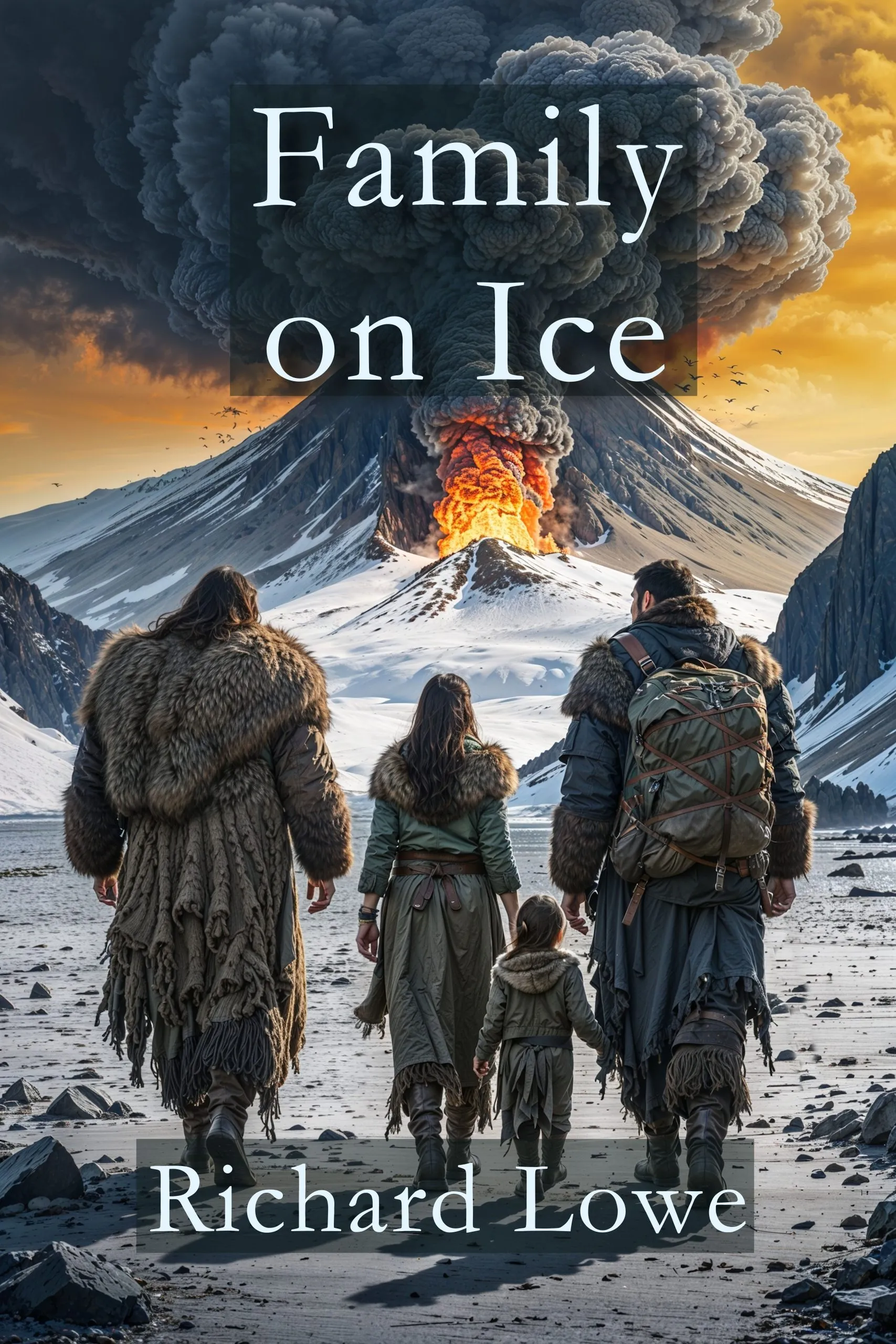 |
The cold didn’t break. The game moved wrong. The species came within a generation of ending. Standalone · 254 pages · Rotating close third, no quotation marks BUY FROM INGRAMSPARKAMAZONKOBOREAD A CHAPTERTABLE OF CONTENTS Paperback ISBN 978-1-972810-41-5 · ebook ISBN 978-1-972810-42-2 |
| 254Pages | 74KYears ago | 2,800Cubic km erupted | 90%Sunlight lost |
You didn’t enter a place a cave bear had used without saying: I see this.
from the novel
Toba erupted in what is now Sumatra and put an estimated two thousand eight hundred cubic kilometers of material into the sky. Ash fell across continents. Sulfur aerosols cut sunlight across Eurasia, in some estimates by as much as ninety percent, and the volcanic winter that followed didn’t lift on any schedule a person could plan around.
More on the eruption behind this book: Toba, the winter that almost ended us, and what that decade would have been like on the ground.
The people in this book don’t know any of that. They know the light is wrong, the count is short, the ground is bad, and the animals aren’t where animals are supposed to be. The prose is McCarthy-influenced: no quotation marks, rotating close third, declarative sentences that don’t tell you how to feel about what they just said.
For readers of Cormac McCarthy’s The Road and Jean Auel’s Clan of the Cave Bear, leaner than Auel.
How does Family on Ice open?
Before
The mountain had been speaking for three days.
Not loudly. A low grumbling that the ground carried better than the air, felt in the feet and the ankles and the back of the jaw. They’d felt this before, all of them, the mountain made noise sometimes, and they’d moved twice in living memory because of it, and both times the moving had been the right thing to do, and both times they’d come back when it quieted.
This time the man watched it and thought about moving and watched it some more.
The woman knew he watched it. She said nothing. She’d said what she had to say two days ago and he hadn’t disagreed with her and hadn’t moved and she understood this was what he was doing even though he hadn’t said it.
The children slept.
On the morning of the fourth day the man was outside before dawn, and the mountain was darker against the dark sky than it should have been, a darkness that wasn’t cloud and not shadow but the mountain itself doing something. He watched it. The ground under his feet was warm.
Not warm the way sun-warmed ground was warm. Warm from below.
He went inside and woke the woman.
She looked at his face and rose.
* * *
They moved before the sun came up, the children half-awake and carrying what they could carry, the woman with the youngest on her back. They went toward the high ground along the trail they knew, the one that ran above the river. The man went last. He kept looking back.
He saw it begin.
The top of the mountain opened. That was the only word he’d for it, and it opened, the way a wound opens, and what came out wasn’t fire, not exactly, it was light and dark at once, a column that rose faster than anything he’d ever seen move, black and white and lit from inside, climbing into the sky with a speed that had no comparison in his experience. He stopped walking.
He couldn’t have said why he stopped. The column went up and up and it was already above the clouds and still going and he understood, in the way you understood things that had no words, that this wasn’t the mountain speaking.
the mountain ending.
The sound reached him.
He’d heard thunder close enough to feel. He’d heard the cracking of ice in the spring when the river broke. He’d heard the sound a large tree made when it fell in the forest, the crack and the long crashing through the canopy and the impact. None of these were adequate. The sound wasn’t a sound so much as a cessation. The air itself compressed and then released, and in the releasing it took everything else with it, and for a moment he heard nothing at all because there was nothing left to hear with.
Then the pain in his ears and the woman screaming ahead of him on the trail and the children.
He ran.
* * *
They ran for an hour. The sky behind them was wrong in a way that grew more wrong as they ran, the column spreading at its top into a shape that flattened and darkened and began to eat the sky from where the mountain was, outward. The ash started before they reached the high ground, first as a fine grit in the air that wasn’t quite visible, then as something that was.
It tasted of rock and heat.
The youngest child coughed.
The man looked back and the sky behind them was black. Not storm-black. A black that had texture to it, that moved at its edges in ways clouds didn’t move.
He had been watching the sky his whole life and there was nothing in his experience to put this in.
He looked at the woman. She looked back too. She had the youngest against her chest and her face had the look it had when she’d finished calculating and arrived at the answer.
She said something to him. The oldest child was already holding the next one’s hand. They were good children.
He said something back.
They kept moving.
* * *
The surge came from behind them in the late afternoon.
They heard it before they saw it: a sound like the world tearing, low and vast, coming up through the ground and the air at once. The trees ahead of them moved without wind, first a trembling and then a bending, away from what was coming. Birds came over them in a mass, thousands of them, too fast, not in formation, just away.
The man put the children behind him. He knew it wasn’t useful. He did it anyway.
The woman stood beside him.
The cloud came through the valley below them first. It wasn’t like any cloud. It moved along the ground the way water moved, filling the low places, pouring over obstacles, and it was the color of ash and it moved faster than anything he’d run from in his life.
The heat reached them before the cloud did. Not the heat of a fire, which had direction and diminishment. This heat was everywhere at once, coming from behind them and from the air and from the ground, and it grew and grew and there was nowhere it wasn’t.
The youngest child had stopped coughing.
The man reached back without looking and found his children’s hands.
The cloud came up the slope.
In the last moment he looked back toward the mountain, searching for the angle, the read, the response.
The chapter keeps going.
Who should read Family on Ice?
|
Read it if
|
Not for you if
|
► Behind the Book: Family on Ice
How this one got written, what went wrong, and what got cut.
How did Family on Ice come about?
Richard Lowe, the Writing King
Toba erupted about seventy-four thousand years ago in what is now Sumatra, the largest eruption in two million years. The ash fell across South Asia in layers centimeters thick and reached East Africa as glass shards too small to see. The sulfur cut sunlight and held it down, worst across Eurasia.
The genetic bottleneck theory says the human population may have dropped to a few thousand breeding people afterward. Not everyone accepts that reading of the data and the argument is still running. Neanderthals were out there at the same time, had been for three hundred thousand years, and most people alive today outside sub-Saharan Africa carry a percent or so of their DNA.
The location is unnamed and so are the people, both deliberately. The people in this novel are invented. The situation they were in was real.
What do people ask about Family on Ice?
Also in The Deep Past
|
Rome, 69 AD, told at sixty-three by the man who marched |
The light is wrong
They have no word for what happened and no way to wait it out.
BUY FROM INGRAMSPARKAMAZONKOBOREAD A CHAPTERTABLE OF CONTENTS
Paperback and ebook.
Bad Ground
Family on Ice
He went out before the children woke.
The ash was heavier overnight. It had come down while they slept and covered everything, the firewood stack and the stretched hides and the flat rocks around the fire pit, and it lay there now in the gray early light with an evenness that snow didn’t have, no wind-drift, no variation, just a flat gray coat over everything. He stood and looked at it and then crouched and pressed his fingers into the layer near the fire. Deep. More than yesterday.
He wiped his fingers on his skins and picked up his spears and went.
The cold was in his ribs. It was always in his ribs in weather like this, an old break from a fall many winters ago that had healed well enough but left its opinion about cold air embedded in the bone. He breathed through it and adjusted his gait on the descent and it settled to its usual place.
Ptarmigan tracks at the bowl’s edge. He stopped and looked at them. Ptarmigan in the bowl was unusual, they kept to the high rocky terrain in good weather, the exposed ridges where the ground gave them their camouflage.
Down here wasn’t their country. They’d come down because up was worse, the ash heavier on the exposed ground, or the temperature wrong, or both. He moved on. When the small animals moved wrong the reason was always something the large animals hadn’t felt yet.
The trail out of the bowl toward the high ground was familiar enough that he could have walked it without sight, but the ash changed it in small ways that added up. Rocks he knew by color were the same gray as the ground around them. The footing was off, not slick, the ash had no moisture in it, but uncertain in the way that new snow was uncertain before you’d learned it.
He slowed down more than he wanted to.
The ash fell as he walked. Not hard. Steady.
The flakes. Smaller than snow, more like silt. Came down in a way that had no weather in it, no pulse. Snow came and eased and came again. This just came. He’d stopped noticing it. The ash was settling on the backs of his hands now, the coating visible after little time, and he had to stop and wipe his hands to keep the grip on the spear sure.
The smell of it was always in his nose now, that mineral thing, and he thought: *I’ve stopped noticing the smell.* He noticed it again and then it was gone again.
He didn’t like that.
The thicket was empty.
Not abandoned, there was sign, droppings and hoof marks and bark stripped from the lower birches, but old sign, a day or more back. The herd had moved toward the ash.
He crouched at the freshest marks and looked at them. Red deer, a large group, eight or ten animals at least, moving at a steady pace. Not panicked. Purposeful. A panicked animal made a different sign, the strides different, the hoof dragged differently. These animals hadn’t run. They’d gone.
He thought about what his father had told him about the red deer. His father had been a good hunter and his father had said it: “The deer always knows before you know. When the deer moves in a direction that makes no sense to you, it’s reading correctly and you’re reading wrong.” He’d watched it prove true enough times that he believed it.
The deer had moved toward the ash. Toward the heavier ash.
He thought about that for a while.
He turned toward the high ground.
Another browsing area lay farther on, a slope that caught the sun with a small ravine. He’d taken animals there before. He went toward the high ground and climbed toward it and on the upper trail he found something that stopped him completely.
Cave lion tracks.
Old, the ash-fall had softened the edges, but unmistakably lion. The size of the front pad alone told you. He crouched and looked at the direction of travel and the spacing of the stride.
A single animal, moving toward the sunrise along the ridge at a walk. Not hunting. Moving.
Table of contents
Family on Ice
- Before
- Wrong Light
- The Count
- What Ona Knew
- Bad Ground
- What She Found
- Gur
- Renn
- The Light at Midday
- The Territory
- Running Short
- The Meeting
- West
- High Ground
- Brak
- What She Carried
- Northeast
- The Route
- The Crossing
- What Renn Knew
- The Wall
- What Fen Did
- Weeks
- The Child