
Real World Survival
Preparing Without Becoming a Prepper
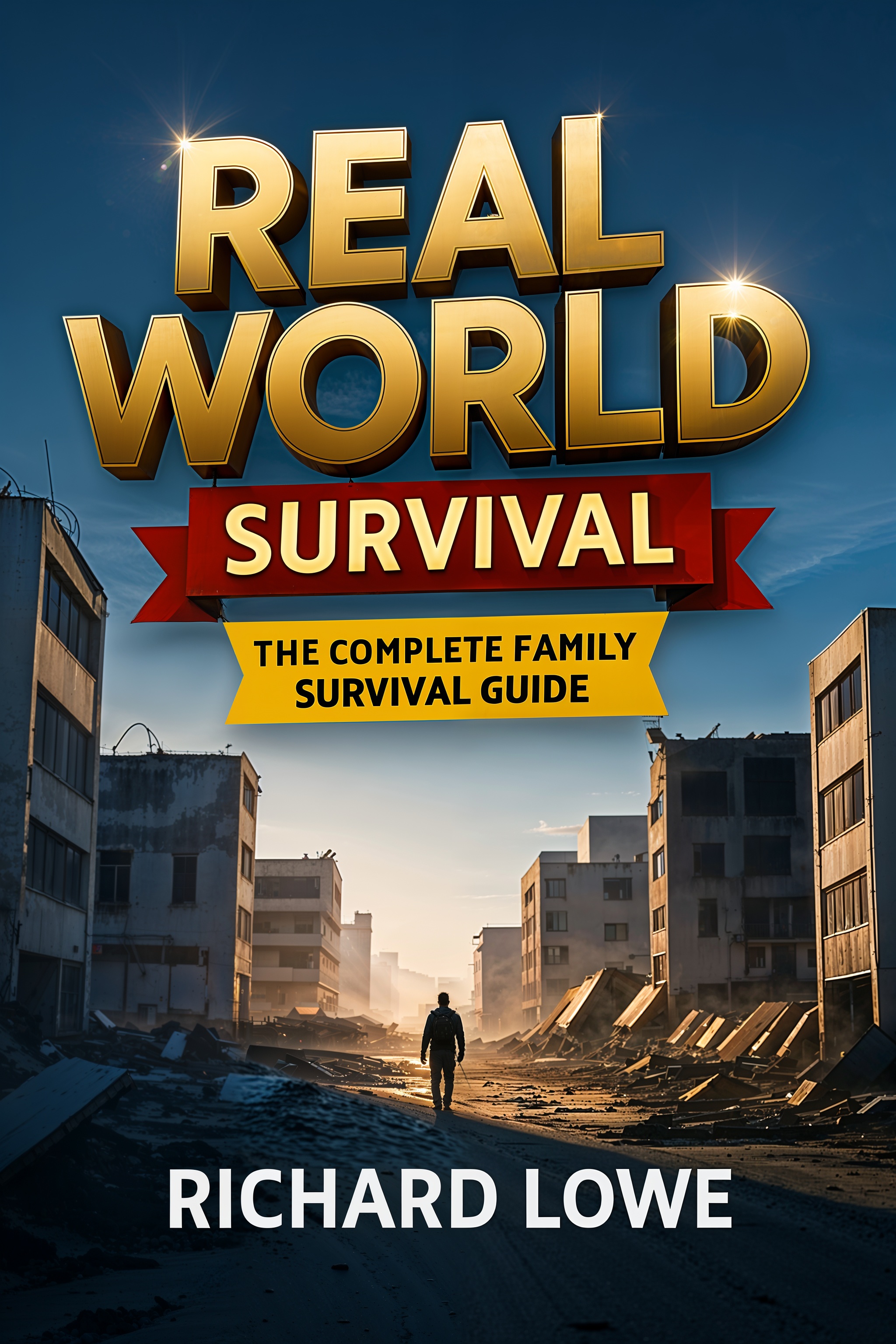 |
Christmas Day, 1986, and nobody knew where we were BUY FROM INGRAMSPARKAMAZONKOBOREAD THE INTRODUCTIONTABLE OF CONTENTS 240 pages · Paperback ISBN 978-1-946458-42-1 · ebook ISBN 978-1-946458-67-4 |
| 240Pages | 1986The Christmas hike | 200 ftShale cliff we climbed down | 1Meadow named after us |
Christmas Day, 1986, and nobody knew where we were
My father decided we were going to take a hike. Beautiful day, warm, snow still on the ground from the storm a week earlier. We’d be back by lunch. We left at seven with a few granola bars, sturdy shoes and the clothes we were wearing, and told the family we were going hiking without saying where.
The canyon behind the house became a stream, then a small river running with snowmelt. We lost track of time because it was beautiful. Noon came and went. We climbed down a two-hundred-foot shale cliff to a hidden waterfall that’s still one of the finest places I have ever stood.
More on the real subject behind this book: the emergencies that happen to ordinary people, what works, what costs nothing, and why the market sells the wrong thing.
Then my father had what looked like a heart attack, and I had to climb back out of that canyon in the snow to find help. The fire department airlifted him out the next day, from a spot they afterward named Lowe’s Meadow.
None of that needed to happen. Everything that went wrong came from decisions made before seven in the morning, by two people who weren’t being reckless, just ordinary. That’s what this book is about.
What is inside Real World Survival?
|
What actually happens
|
Before
|
|
During
|
Everyone else
|
What do readers say about Real World Survival?
Amazon reviews of the previous edition. 9 of them, averaging 4.44 out of 5.
This is an excellent, no-nonsense guide filled with practical wisdom of what to do to prepare for a disaster — instead of to panic and not know what to do after one strikes. Richard’s stories that he shares at the beginning of this book — his father and him on a mountain hike, the fire on the sides of a road in the mountains — and others could have ended in great tragedy, but taught him well, and now he teaches others what he has learned. One important lesson is to always pay attention to your surroundings and to understand your surroundings and local conditions from experts. Richard engages the physical senses with his descriptive writing, such as the terrifying earthquake that he, his wife and son experienced. “It was as if the Mad Hatter had taken control of our apartment,” he writes. Getting prepared before a disaster hits “can mean the difference between living through a disaster and not surviving at all.” The key is to be ready and to know what to do when one occurs, but finding the middle ground between not being prepared at all and being overly prepared, ruled by fear. Richard encourages the reader to be prepared to be without help from anyone for at least three days, and possibly up to two weeks in large disasters. Some ideas he offers, such as buying a portable generator or solar power panels, may not be possible for some people, especially those who are renting a home. Other suggestions, like buying MREs and lots of trash bags, having extra batteries, clothes, and blankets, keeping a supply of water (enough for two weeks for all people with you), are very doable and are great ideas. He includes suggestions to keep a full tank of gas, a renters’ insurance or homeowners’ insurance plan that includes a stay at a hotel for several weeks or months, going over escape routes in your home in case of flooding, fire, or other disasters. He also listed additional great resources for disasters, a list of foods for your emergency supplies, what should be in your emergency medical kit, and a binder with important documents, family contact info, maps, etc. I love the pictures in the book, too. One of the most important things to do before a disaster hits is to “Look around you. Just look.” Be aware. Be alert. Be prepared. Don’t wait until disaster strikes and it’s too late. This is a book everyone should read to help prepare in the event of some disaster. Loved it.
The author begins by listing his expertise and experiences which qualify him to write a book of this nature. He gives examples of disasters he has experienced and the lessons he learned from surviving them, e.g., hiking with his father, having his car surrounded by fire, and narrowly escaping a flash flood in a dry riverbed. He asks you to start by first asking yourself what kind of disasters are likely to occur in your area. Being aware of where you are and of what is around you can save precious minutes if/when disaster strikes. You need to be prepared to not be rescued for a minimum of three days to a couple of weeks. In this book, the author will teach you: how to prepare for and deal with disruptions to power, gas, water, sewage, trash collection, cell phone service, internet, and cable services; the types of disasters you might have to deal with (volcanoes, fires, earthquakes, chemical spills, floods, hurricanes, nuclear disasters, long-term power outages, rioting and looting, tornados, tsunami); and the disaster information services you can subscribe to. He will then lead you step-by-step to creating your disaster plan, a communications plan, preparing your home (including stockpiling water, food, flashlights, batteries), packing a go-bag, and preparing for trips and outings. The author maintains a light, conversational tone throughout, keeping your interest and making this book easy to read. There is a bit of repetition when you read the book from start to finish, but this allows you to re-read portions out of order as needed and still find the information required. This is an invaluable guide for everyone, not just the preppers. All I can say is that I hope you never have to implement the emergency preparations taught in this book. And, as the author advises, find the middle ground of preparedness and “don’t live your whole life waiting for a disaster to happen.” Littered with anecdotal experiences of the author as well as other people, this book makes for an interesting and informative read. Followed by a glossary of the terms used in the book and a list of recommended reading materials.
This survival guide is well-researched and written by a qualified expert. I loved the way this book was put together, catching my attention right off the bat and flowing perfectly. The author starts off having the reader consider what sort of disasters could occur in their area. It’s something I’d never really thought about, and I got hooked from the start. I felt like the author was sitting next to me, literally guiding me and telling his personal experiences to me. I commend the author highly for this. Earthquakes, floods, fires, volcanoes — you name it, the author has important information for readers. He discusses the importance of preparation and teaches the reader how to survive in any situation. I learned so much, and could see this as being an important book to keep on hand at all times. This was an interesting and informative read. I loved the author’s “voice” and respected his expertise. A well-deserved five stars!
First I found this book spot on, on everything he offered to get ready for an emergency. We have two go-to bags — mine I carry in my truck, the other my husband carries in his car — and when we’re together we take them both. But I had not included a whistle or thought of trash bags for bathrooms in case there’s no flushing water. In my personal opinion everyone that lives in areas where they know something big will happen should own it, follow it, and use it as a guide to get themselves ready and their family, because I had never thought to have a person outside the state as a contact person. Simple basic things you never think about — good book, very helpful, everyone should read it and follow his advice.
Who should read Real World Survival?
|
Read it if
|
Not for you if
|
Why did I write Real World Survival?
Richard Lowe, the Writing King
Twenty years running disaster recovery for Trader Joe’s, a 16 billion dollar company with 400+ stores, which is planning for the day the systems stop. Before that a Christmas hike in 1986 that nearly killed my father and taught me more than any drill. The stories in this book are mine and they’re not flattering.
► Behind the Book: Real World Survival
How this one got written, what went wrong, and what got cut.
► I Climbed Out of That Canyon at Eight at Night
One story from behind this book.
What do people ask about Real World Survival?
Also in Prepared, Not Paranoid
|
The Ultimate Bug Out Bag Guide What Goes In, and Why |
The Walls You Built and How to Get Past Them |
Preparation is not paranoia
It’s the difference between an inconvenience and the worst day of your life.
BUY FROM INGRAMSPARKAMAZONKOBOREAD THE INTRODUCTIONTABLE OF CONTENTS
Paperback and ebook.
Introduction
Real World Survival
On Christmas in 1986, my father decided we were going to take a hike. The day was beautiful, warm, but not hot. Snow still covered the ground from the storm of a week before. Our goal was to get back before lunch, so we left early, about 7 a.m., and anticipated returning home by noon.
Our front yard bordered on the south side of the San Bernardino Mountains. Just past Route 18, there was a steep drop of several thousand feet. A small canyon wound its way down the side of the mountain. It looked very scenic, and we thought we’d easily make the trek to the bottom and back in a few hours.
We began the hike with little more than a few granola bars, sturdy shoes, and the clothes on our backs. We slipped out of the house early, simply telling the rest of the family that we’d be hiking, without informing them exactly where we’d be. Talk about the perfect storm.
The hike down the mountain was beautiful. The small canyon soon became a stream, then it transformed into a small river filled with cold water from the melting snow. Because of the tremendous beauty of the surroundings, we soon lost track of time. Before we knew it noon had come and gone. We climbed down a 200-foot shale cliff to discover a magnificent hidden waterfall, with a deep pool shaded by the cliffs and trees all around it. One of the most beautiful places I’ve ever visited.
We remained at the waterfall for a while, then continued further down the riverbed. As we hiked, we finally realized it was much later than we thought. We began the long hike back up the mountain. My father suddenly grabbed his chest and exclaimed that he believed he was having a heart attack. He sat down, looked at me, and told me to hike out and get help. It started to snow.
These were the days long before cell phones existed, and even if they did, we wouldn’t have gotten service way down in that canyon. I turned around and began struggling to get back to where we started. I finally climbed out at 8 p.m., guided by the voice of my mother and sister walking around the top of the canyon calling our names. A fireman named Kurt took off down the mountain and eventually found my father covered in a pile of leaves to keep warm. As it turned out, he was fine. The firemen airlifted him out with a helicopter the next day and named the place where he was found “Lowe’s Meadow.”
My father and I could have avoided that emergency with some simple preparations. We didn’t bring any food, water, or supplies. We vastly underestimated the distance, didn’t tell people where we were going, and hadn’t looked at the weather report. The lessons I carried forward: research, prepare, check conditions, and always tell someone exactly where you’re going.
A few years later I was commuting from Lake Arrowhead to college in San Bernardino. One hot summer day, driving down the mountain, I realized the sides of the road were on fire. The trees and shrubs were burning all around me. I looked back and saw the fire had jumped the road. Everywhere I looked there was fire. At that moment I thought I was going to die.
Table of contents
Real World Survival
- Preface
- My qualifications
- Why This 2025 Edition
- Introduction
- Christmas Disaster, 1986
- Fire on the Mountain
- Desert Flash Flood
- The Northridge Earthquake
- 2025 Reality
- Part I: Foundation of Preparedness
- Chapter 1: Who Can You Depend On?
- Chapter 2: Situational Awareness in the Digital Age
- Chapter 3: Types of Modern Disasters
- Chapter 4: Information Networks and Early Warning Systems
- Chapter 5: Creating Your Comprehensive Emergency Plan
- Part II: Home and Personal Preparation
- Chapter 6: Fortifying Your Home Base
- Chapter 7: Essential Supplies and Smart Stockpiling
- Chapter 8: Water Security and Purification
- Chapter 9: Food Storage and Emergency Nutrition
- Chapter 10: Power Solutions and Energy Independence
- Part III: Emergency Response Equipment
- Chapter 11: Building the Ultimate Go-Bag
- Chapter 12: Medical Preparedness and First Aid
- Chapter 13: Communication Systems and Networks
- Chapter 14: Tools, Weapons, and Personal Defense
- Part IV: The Prepper Mindset and Lifestyle
- Chapter 15: Understanding the Prepper Community
- Chapter 16: Levels of Preparedness: From Beginner to Advanced
- Chapter 17: Long-Term Sustainability and Self-Sufficiency
- Chapter 18: Community Building and Mutual Aid Networks
- Chapter 19: Financial Preparedness and Bartering Systems
- Part V: Disaster Response and Survival
- Chapter 20: When Disaster Strikes: Immediate Response
- Chapter 21: Evacuation Strategies and Bug-Out Procedures
- Chapter 22: Sheltering in Place vs. Bugging Out
- Chapter 23: Special Considerations for Families, Elderly, and Disabled
- Chapter 24: ADHD Considerations in Emergency Preparedness
- Chapter 25: Post-Disaster Recovery and Rebuilding
- Chapter 26: Insurance, Documentation, and Legal Considerations
- Glossary
Amazon reviews of the previous edition
Real World Survival
This is an excellent, no-nonsense guide filled with practical wisdom of what to do to prepare for a disaster — instead of to panic and not know what to do after one strikes. Richard’s stories that he shares at the beginning of this book — his father and him on a mountain hike, the fire on the sides of a road in the mountains — and others could have ended in great tragedy, but taught him well, and now he teaches others what he has learned. One important lesson is to always pay attention to your surroundings and to understand your surroundings and local conditions from experts. Richard engages the physical senses with his descriptive writing, such as the terrifying earthquake that he, his wife and son experienced. “It was as if the Mad Hatter had taken control of our apartment,” he writes. Getting prepared before a disaster hits “can mean the difference between living through a disaster and not surviving at all.” The key is to be ready and to know what to do when one occurs, but finding the middle ground between not being prepared at all and being overly prepared, ruled by fear. Richard encourages the reader to be prepared to be without help from anyone for at least three days, and possibly up to two weeks in large disasters. Some ideas he offers, such as buying a portable generator or solar power panels, may not be possible for some people, especially those who are renting a home. Other suggestions, like buying MREs and lots of trash bags, having extra batteries, clothes, and blankets, keeping a supply of water (enough for two weeks for all people with you), are very doable and are great ideas. He includes suggestions to keep a full tank of gas, a renters’ insurance or homeowners’ insurance plan that includes a stay at a hotel for several weeks or months, going over escape routes in your home in case of flooding, fire, or other disasters. He also listed additional great resources for disasters, a list of foods for your emergency supplies, what should be in your emergency medical kit, and a binder with important documents, family contact info, maps, etc. I love the pictures in the book, too. One of the most important things to do before a disaster hits is to “Look around you. Just look.” Be aware. Be alert. Be prepared. Don’t wait until disaster strikes and it’s too late. This is a book everyone should read to help prepare in the event of some disaster. Loved it.
The author begins by listing his expertise and experiences which qualify him to write a book of this nature. He gives examples of disasters he has experienced and the lessons he learned from surviving them, e.g., hiking with his father, having his car surrounded by fire, and narrowly escaping a flash flood in a dry riverbed. He asks you to start by first asking yourself what kind of disasters are likely to occur in your area. Being aware of where you are and of what is around you can save precious minutes if/when disaster strikes. You need to be prepared to not be rescued for a minimum of three days to a couple of weeks. In this book, the author will teach you: how to prepare for and deal with disruptions to power, gas, water, sewage, trash collection, cell phone service, internet, and cable services; the types of disasters you might have to deal with (volcanoes, fires, earthquakes, chemical spills, floods, hurricanes, nuclear disasters, long-term power outages, rioting and looting, tornados, tsunami); and the disaster information services you can subscribe to. He will then lead you step-by-step to creating your disaster plan, a communications plan, preparing your home (including stockpiling water, food, flashlights, batteries), packing a go-bag, and preparing for trips and outings. The author maintains a light, conversational tone throughout, keeping your interest and making this book easy to read. There is a bit of repetition when you read the book from start to finish, but this allows you to re-read portions out of order as needed and still find the information required. This is an invaluable guide for everyone, not just the preppers. All I can say is that I hope you never have to implement the emergency preparations taught in this book. And, as the author advises, find the middle ground of preparedness and “don’t live your whole life waiting for a disaster to happen.” Littered with anecdotal experiences of the author as well as other people, this book makes for an interesting and informative read. Followed by a glossary of the terms used in the book and a list of recommended reading materials.
This survival guide is well-researched and written by a qualified expert. I loved the way this book was put together, catching my attention right off the bat and flowing perfectly. The author starts off having the reader consider what sort of disasters could occur in their area. It’s something I’d never really thought about, and I got hooked from the start. I felt like the author was sitting next to me, literally guiding me and telling his personal experiences to me. I commend the author highly for this. Earthquakes, floods, fires, volcanoes — you name it, the author has important information for readers. He discusses the importance of preparation and teaches the reader how to survive in any situation. I learned so much, and could see this as being an important book to keep on hand at all times. This was an interesting and informative read. I loved the author’s “voice” and respected his expertise. A well-deserved five stars!
First I found this book spot on, on everything he offered to get ready for an emergency. We have two go-to bags — mine I carry in my truck, the other my husband carries in his car — and when we’re together we take them both. But I had not included a whistle or thought of trash bags for bathrooms in case there’s no flushing water. In my personal opinion everyone that lives in areas where they know something big will happen should own it, follow it, and use it as a guide to get themselves ready and their family, because I had never thought to have a person outside the state as a contact person. Simple basic things you never think about — good book, very helpful, everyone should read it and follow his advice.
As a trained incident commander, an EHS professional of 25 years experience, and a certified Safety Professional, Richard’s book is well written and well formatted for the average person. It’s a wealth of knowledge on what you should do in the event of an emergency. Don’t rely on your common sense, because in the heat of the moment, like Richard’s late wife in the earthquake, we all will do something that in our “common sense” we know not to do. Thank you Richard for distilling down your CERT knowledge to help us all.
The book that made me realize as a parent there are so many things I can do to be prepared for any disaster. Easy to understand, practical, and thought provoking. This is a must have for everyone.
Right from the beginning Lowe draws us into the situation by giving anecdotes of personal experience where he wishes he knew what he knows now. Then he goes through a list of types of events — from floods to power outages — telling what can happen and how to prepare for it. This isn’t an alarmist book, but a simple, easy to follow bits of advice to help anyone get through an emergency. It’s a must read.
Unfortunately, it was more basic and general than I was looking for.
it was OK…nothing groundbreaking