
The Day Your Website Died
Optimizing for AI Search
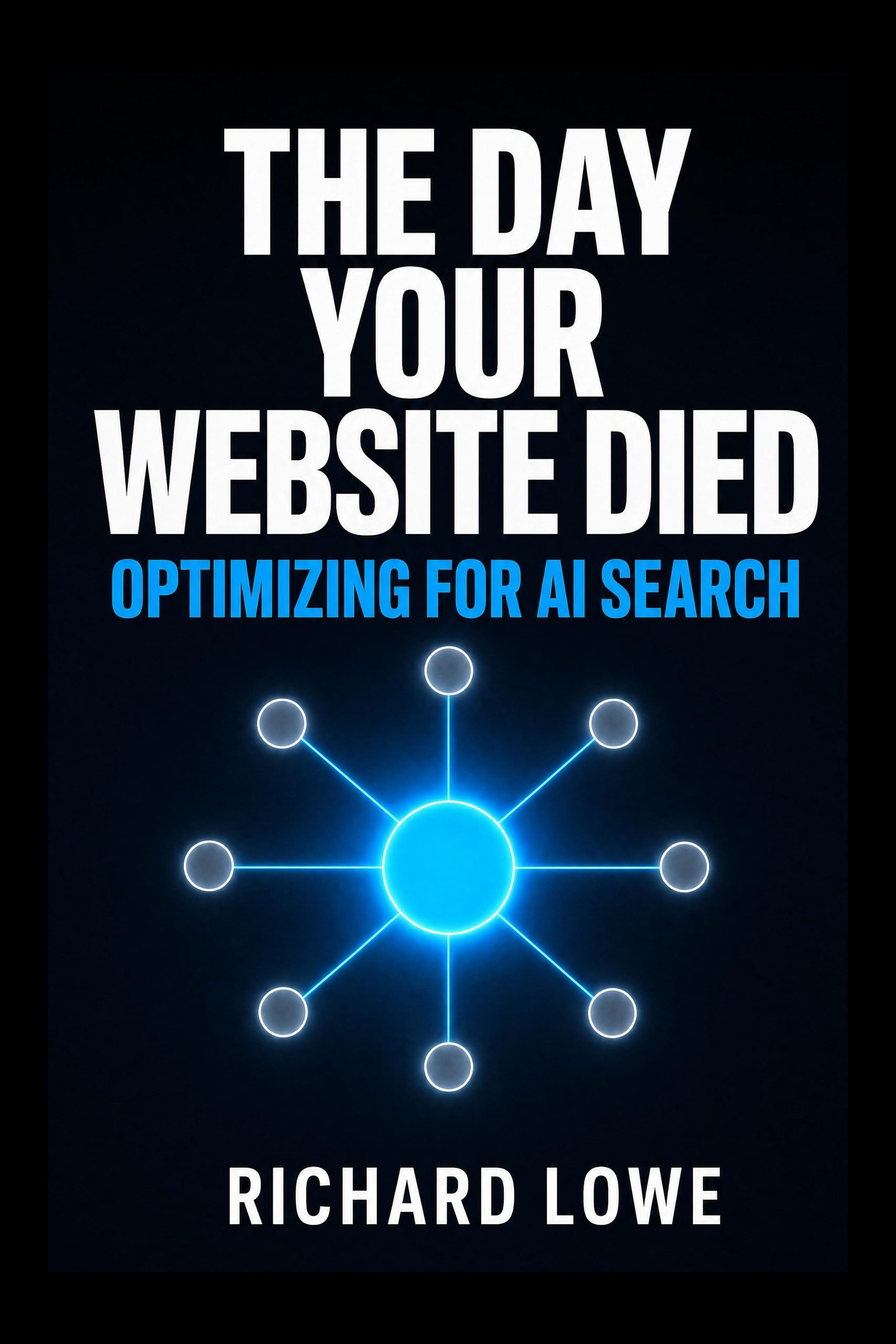 |
I got good at ranking websites, then the traffic changed shape BUY FROM INGRAMSPARKAMAZONKOBOREAD THE INTRODUCTIONTABLE OF CONTENTS 368 pages · Paperback ISBN 978-1-972810-77-4 · ebook ISBN 978-1-972810-78-1 |
| 368Pages | 42Chapters | 2Clients found me this way | 1Account nobody had written |
I got good at ranking websites, then the traffic changed shape
That’s search engine optimization, and like anybody who has done it for years I’ve ridden its ups and downs. You learn the rules, the rules shift, you learn them again. Over time I got fairly good at the whole dance.
Then the traffic started to change. Not all at once, and not in a way that set off alarms, just a shift in the shape of it.
So I did what I always do when something changes. I started reading. About AI, and from there about answer engine optimization, and I found a different world.
I want to set one expectation before you start, because it’s the thing that surprised me most and the thing most likely to throw you. This isn’t like SEO. I went looking for a clear account of how it works, couldn’t find one, and assembled the one I wish somebody had handed me at the start.
What is inside The Day Your Website Died?
|
What changed
|
How it differs
|
|
Doing the work
|
The honest limits
|
Who should read The Day Your Website Died?
|
Read it if
|
Not for you if
|
Why did I write The Day Your Website Died?
Richard Lowe, the Writing King
Years of getting websites to rank, then watching the traffic change and going looking for an explanation that didn’t exist. Thirty-three years in enterprise IT before that. That’s how I know the difference between a system changing and a system being replaced. Two clients have since found me through exactly the mechanism this book describes.
► Behind the Book: The Day Your Website Died
How this one got written, what went wrong, and what got cut.
► With SEO There’s Eventually a Big Bang. This Doesn’t Work That Way.
One story from behind this book.
What do people ask about The Day Your Website Died?
Also in The Publishing Series
|
How to Get Your Book Written for You |
The Complete Self-Publishing Guide |
|
Marketing Without the Hype |
Make a Living as a Self-Published Author Build the Business Behind the Books |
An answer has no page two
Which is the whole problem, and the whole opportunity.
BUY FROM INGRAMSPARKAMAZONKOBOREAD THE INTRODUCTIONTABLE OF CONTENTS
Paperback and ebook.
Introduction
The Day Your Website Died
I’ve spent a long time getting websites to rank, and I’ve been good at it. That’s search engine optimization, and like anyone who has done it for years, I’ve ridden its ups and downs. You learn the rules, the rules shift, you learn them again. Over time I got pretty good at the whole dance.
Then the traffic started to change. Not all at once, and not in a way that set off alarms at first, just a shift in the shape of it. So I did what I always do when something changes. I started reading. I started reading about AI, and from there about answer engine optimization, and I found a whole different world.
This book is the compilation of what I learned along the way. It’s been a long and twisty road, and an interesting one, and so far a successful one. I wrote it because I went looking for a clear account of how this works and couldn’t find one, so I assembled the one I wish I had been handed at the start.
I want to set one expectation before you begin, because it’s the thing that surprised me most and the thing most likely to throw you. This isn’t like SEO. With SEO there is, eventually, a kind of big bang. A day arrives when Google decides to rank you, and the traffic shows up. AEO doesn’t work that way. There’s no single moment, no flip of a switch, no morning you wake up ranked.
What happens instead is quieter. You get a trickle here and a trickle there. An engine names you in one answer, then another. And before you quite notice it’s happened, you’re seeing more traffic in certain areas, more of the right people finding you, more conversations that started with a machine recommending your name. It builds the way trust builds, slowly and then suddenly. If you’re used to the big bang, the trickle can feel like nothing is happening, right up until you look back and see how far it carried you.
That slow, twisty, rewarding road is what this book is about. Here’s what I learned walking it.
Parts of this book get technical. There’s a chapter about your domain and DNS, a chapter about code that describes your pages to machines, a chapter about reading your server logs. I’ve worked hard to explain all of it in plain language, and most of it’ll make sense as you go.
But some readers see a word like schema and quietly decide the whole thing is over their heads. If that’s you, I want to catch you before you put the book down, because that conclusion is wrong, and it would cost you the part that matters.
Table of contents
The Day Your Website Died
- Chapter 1: The Client Who Found Me Through a Machine
- Chapter 2: Two Kinds of Search
- Chapter 3: The Cost of Doing Nothing
- Chapter 4: The Mistake I Made First
- Chapter 5: What Carries Over and What Doesn’t
- Chapter 6: Three Moving Targets That Don’t Agree
- Chapter 7: What the Bots Cost You
- Chapter 8: The Density Principle
- Chapter 9: Your Site Is the Center of the Universe
- Chapter 10: The Plumbing: Your Domain, DNS, and the Bot That Cannot Reach You
- Chapter 11: The Blank Page: When the Crawler Can’t Read Your Site
- Chapter 12: The Anchor: One Org, One Author
- Chapter 13: sameAs: The Equals Sign of the Web
- Chapter 14: The Rest of the Schema: Facts the Machine Can Read
- Chapter 15: Wikidata: The Keystone
- Chapter 16: The Hard Identifiers
- Chapter 17: FAQ Content: Answers the Machine Can Lift
- Chapter 18: Building a Page the Machine Can Lift
- Chapter 19: The Evidence That Earns the Citation
- Chapter 20: Original Research: The Thing Only You Can Be Cited For
- Chapter 21: E-E-A-T: The Trust the Machine Checks For
- Chapter 22: The Pages That Actually Convert
- Chapter 23: Listings and Reviews: The Off-Site Layer You Control
- Chapter 24: Local: When the Customer Is Standing Nearby
- Chapter 25: Social Profiles: More Nodes in the Web
- Chapter 26: YouTube: The Citation Source Hiding in Plain Sight
- Chapter 27: GitHub: The Citation Source for Technical Authority
- Chapter 28: Posting: Marketing, Not Entity-Building
- Chapter 29: Wikipedia: The One You Earn
- Chapter 30: Reddit: The One You Cannot Fake
- Chapter 31: Quora: Expertise With Your Name On It
- Chapter 32: More Than One Domain: Expanding Without Diluting
- Chapter 33: How the Machine Actually Learns You
- Chapter 34: Reading the Crawl: How to Know It’s Working
- Chapter 35: Freshness: Why the Work Is Never Done
- Chapter 36: The Engines, One by One
- Chapter 37: Spoken Answers: Siri, Alexa, and the Voice Surface
- Chapter 38: The Agents Are Coming: Optimizing for Machines That Act
- Chapter 39: Poisoning the Well: How Your Entity Can Be Attacked
- Chapter 40: The Honest Limits
- Chapter 41: The Through-Line
- Chapter 42: The Operating Card