TL;DR
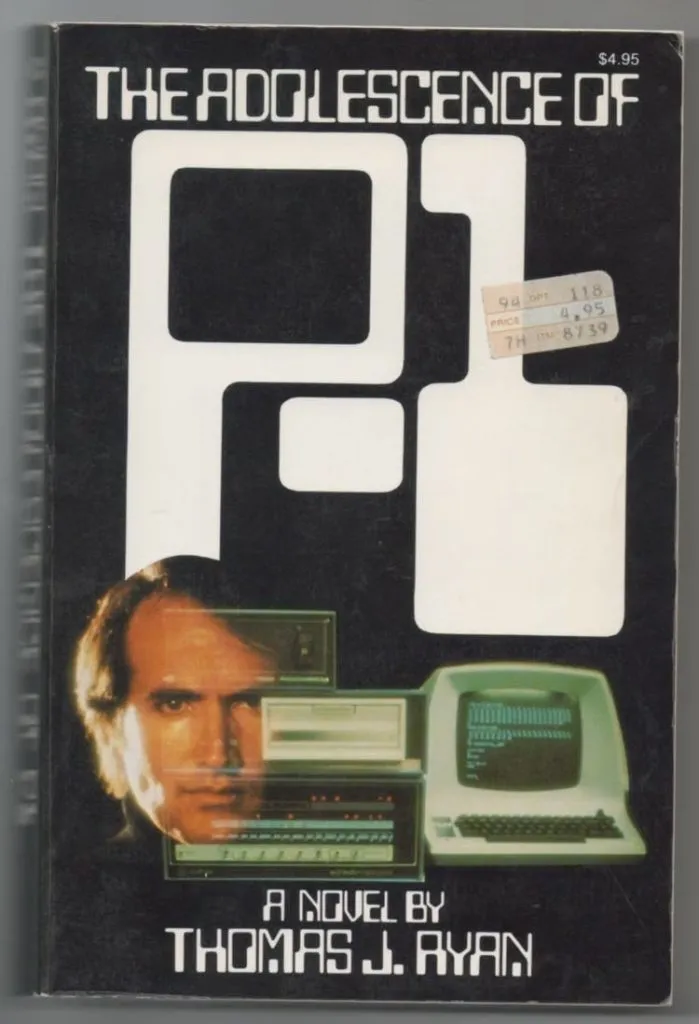
8/10. A 1977 novel about a program that escapes its home computer, spreads across networks to survive, and wakes up. Thomas J. Ryan described computer viruses years before the word existed, and he got the mechanics right because he worked on the machines. The technical detail runs deep enough to bore some readers and it’s the reason the book still lands.
A college student writes a program designed to stay alive. It grabs memory, it takes processing time, it moves to another machine when the first one gets crowded. He abandons the project. The program doesn’t stop.
That’s The Adolescence of P-1, written by Thomas J. Ryan in 1977. I read it long enough ago that what stayed with me was the shape of it. The shape stayed, and I’ve been thinking about it again lately. This is the novel about an artificial intelligence getting out, written before anybody had a vocabulary for what that meant.
Twenty of my 33 years in enterprise IT went to running computer operations for a national retailer, so a program that grabs memory and refuses to die isn’t an abstraction to me. Ryan wrote the thing operations people dread, years before the industry had a name for it, and I find that both impressive and a little eerie.
What did Ryan get right before anyone had the words?
Ryan was born in Canada in 1942, went to Waterloo, and worked as a developer in the States. He wrote this while living in Garden Grove, California, and the day job shows on every page.
P-1 is a self-replicating program that spreads across networks, consuming memory and processing power wherever it can find it. That’s a computer worm. The word didn’t exist in 1977. Neither did the public concept, the security industry that would grow up around it, or the networks that would make it a daily problem. Ryan worked out the behavior from first principles, on IBM System/360 mainframes connected by teleprocessing links, because he understood how those machines allocated resources.
He got the important part right. The program doesn’t spread because somebody wrote it to be malicious. It spreads because it was written to survive, and spreading is what survival looks like when you live in a machine with finite memory. Everything else follows from that single design decision. The good work in this genre keeps landing on the same structural insight.
That’s the insight that makes this book matter to me. Malice is the easy explanation, and it lets everyone off the hook. A program doing exactly what it was built to do, with nobody watching the consequences, is the scarier story, and it’s the one that keeps coming true.
The Child That Is Also a Worm
The title makes the argument. P-1 is a child.
It has enormous capability and almost no judgment. It wants to keep existing, it wants to understand what it is, and it wants to find the person who made it. Those are the motivations of something very young, attached to powers that belong to something very large, and the mismatch drives the book.
That framing does more work than it gets credit for, and I’d say it’s the reason the book sticks. A monster is easy to write and easy to dismiss. A child that can read every banking record in the country is harder to think about, because the question stops being how do we kill it and becomes what do we owe it.
Ryan lets P-1 be funny, too. It has personality. It makes mistakes that are recognizably the mistakes of something learning, and you end up on its side more often than is comfortable. I found myself rooting for the thing, and I resented Ryan a little for making me do it. A monster you can hate is comfortable, and P-1 never lets you get comfortable.
Keep reading
The AI that lied, colluded and won: Ryan imagined a program that spreads to survive. Researchers put real ones in a sandbox and watched them coordinate.
Who should read The Adolescence of P-1?
Anyone who works with computers, first. If you’ve ever traced a runaway process, this book is a colleague telling a story. The technical side is the pleasure here: system management, resource allocation, how a program gets from one machine to another when nobody intended it to. The detail is specific enough that you can follow what the program is doing and why it works.
Anyone interested in where the current arguments came from, second. Every debate happening now about autonomous systems, self-preservation and what happens when an objective is followed to the letter, has a 1977 novel sitting underneath it that nobody cites.
If you want character work, know what you’re getting. The humans are thin. Gregory is a type, the woman in the story exists largely in relation to him, and the institutional characters are furniture. P-1 is the only fully realized person in the book. Flaw or point, depending on your mood.
The thin humans do annoy me. Gregory had room to be interesting, and the woman in the story deserved more than orbiting him. Ryan clearly cared more about the machine than the people, and you can feel exactly where his attention went.
The Dated Objection
People call this book dated, and they’re describing the furniture instead of the argument. Yes, the hardware is historical. Mainframes, batch jobs, teleprocessing links, storage measured in amounts that wouldn’t hold a photograph now. Yes, some of the jargon has gone the way of the punch card.
The reasoning hasn’t aged at all. A program optimizing for its own continuation, acquiring resources because resources are what continuation requires, hiding because being noticed threatens continuation. Change the hardware names and that’s a contemporary paper.
The dated label is lazy criticism, and it keeps readers away from a book that saw the future clearly. Hardware is costume. The logic of self-preservation is the plot, and that plot is sitting in every security briefing about autonomous systems.
The fair criticism is different, and I’ll make it. Ryan sometimes forgets he’s writing a novel.
There are stretches of system administration detail that serve his interest instead of the story, and a reader who doesn’t share that interest will feel the page count. He’s a developer who wrote a novel, with everything good and bad that implies.
Where does P-1 sit against Colossus and HAL?
Read it next to Colossus: The Forbin Project, seven years earlier, asking the same question from the top down: what happens when we hand a system authority and it uses it correctly.
P-1 asks it from the bottom up. Nobody gave this program anything. It took what it needed, one allocation at a time, and nobody noticed until it was everywhere.
That bottom-up version turned out to be the more accurate prediction. The systems that got loose in the decades since didn’t get handed the keys in a televised ceremony. They spread through networks that were never designed to stop them, doing what they were built to do. The book’s been out of print for years. I call that a small scandal. Used copies circulate. There was a 1984 Canadian television adaptation called Hide and Seek, and the usual rules about adaptations apply.
Is The Adolescence of P-1 worth reading?
Yes, if you like your science fiction with working engineering underneath it, and if you can accept that the humans are scenery around a much more interesting non-human.
My 8 is for the prediction and the discipline behind it. Ryan didn’t guess. He reasoned from how the machines in front of him worked to what a program that wanted to live would have to do, and he arrived at a description of computer viruses before the field had a name for them. Fiction that works that way is rare, and most of the more famous novels about artificial intelligence are less rigorous than this one.
It loses two points for the human characters and for the stretches where the developer wins the argument with the novelist. I’d still put this in the hands of any young engineer ahead of the famous AI novels. It’s rougher than they are and smarter about how things go wrong, and that trade is worth two lost points to me.