TL;DR
5/10. A reference handbook to Tolkien’s fourteen invented languages. The principle is gold, languages first, world grown around them, but the book is decades out of date and in places simply wrong on Elvish grammar. Useful as a doorway to how invented language builds depth; unreliable as a manual. The weakest of the Tolkien cluster.
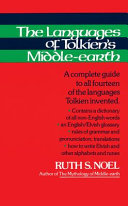
Of every book in this Tolkien cluster, this is the most specialized and the hardest to recommend without heavy qualification. The Languages of Tolkien’s Middle-earth by Ruth S. Noel is a reference handbook to the fourteen languages Tolkien invented, with a dictionary, grammar and pronunciation guides, the runes and Elvish scripts, and an English-to-Elvish glossary. It’s a tool for a narrow purpose, and an honest review has to be clear about both the purpose and the tool’s real limits.
The premise behind it is important for a writer, even if the execution has aged badly. Tolkien was, as the book stresses, a linguist first and a storyteller second, and his Middle-earth stories partly existed as vessels for the languages he’d spent his life inventing. That the languages came first, and the world grew around them, is among the most useful things a writer can absorb about how deep secondary worlds get made.
What does The Languages of Tolkien’s Middle-earth offer?
As a reference, it does collect a great deal in one place: an overview of all fourteen invented tongues, the most attention going to the well-developed Elvish languages Quenya and Sindarin, a working dictionary of non-English words from the Middle-earth books, guides to the writing systems, and a portrait of Tolkien the linguist. For a writer curious about how invented languages function inside a story, it’s a convenient single-volume entry point, and the sheer fact of seeing fourteen languages catalogd together drives home how much linguistic invention underpins Middle-earth.
Keep reading
Invented languages and naming in fiction: building names that feel real: the practical takeaway for writers, without needing this book’s outdated grammar.
Watch: Unpacking the Etymology of J.R.R Tolkien's Elves Of Middle Earth, One Nerd To Rule Them All
The serious caveat
The book is old, published before The Silmarillion and long before the deep linguistic material in Christopher Tolkien’s later volumes, and its accounts of Elvish grammar and the writing systems are in many places simply outdated or wrong. Serious students of Tolkien’s languages have long since moved to better, more accurate resources built on the fuller record. If you bought this expecting a reliable course in Quenya or Sindarin, you’d be learning errors. It’s a snapshot of what was known decades ago, and in a book whose whole job is teaching the languages, that’s a serious flaw.
For a working writer, that limitation matters less than it would for a language learner, because you’re not here to master Sindarin. You’re here for the principle: how invented languages create the illusion of cultural depth. For that, the book’s broad strokes are fine even where its specifics are dated, but you shouldn’t trust its grammar, and you shouldn’t cite it as authoritative.
The principle worth keeping
Strip away the dated grammar and one durable lesson remains, and it’s worth stating on its own because it survives the book’s flaws. A few fragments of an invented language, deployed well, persuade a reader that an entire culture stands behind them. You don’t need fourteen complete languages with full dictionaries, the trap Tolkien’s example can lure writers into.
You need a handful of consistent words and names that sound like they belong to the same tongue, and the reader’s mind fills in the rest, assuming a depth you never built. The catalog of Tolkien’s languages in this book inadvertently makes that case by contrast: almost none of this invented material appears in the novels, yet the trace of it that does is enough to make Middle-earth feel linguistically real.
That’s the takeaway a novelist should leave with, and it’s the best thing in the book, even though the book never comes out and says it.
Tolkien built fourteen languages because he couldn’t help himself; it was his lifelong joy, and good fiction doesn’t require it. A writer who’s not a philologist can achieve most of the effect with a fraction of the labor, by inventing a small, internally consistent set of sounds and being disciplined about using them. This book, for all its inaccuracy, shows both the towering version of the technique and, between the lines, why you don’t need to match it.
Is The Languages of Tolkien’s Middle-earth worth reading?
It deserves a place on the shelf only as a curiosity and a convenient overview, not as a reliable reference, and its dated inaccuracies keep it well below the other books in this cluster. A writer wanting to understand the role of invented language in world-building can extract the general lesson from it, but should reach for current resources for anything precise. Useful as a doorway, unreliable as a manual, and worth owning mainly if you’re already deep in Tolkien and want the historical artifact.
Among shelf-worthy Tolkien books it sits at the bottom, and the rating reflects that.
Explore the hub
The Writing Hub: world-building, language, and the rest of the craft, gathered in one place.