TL;DR
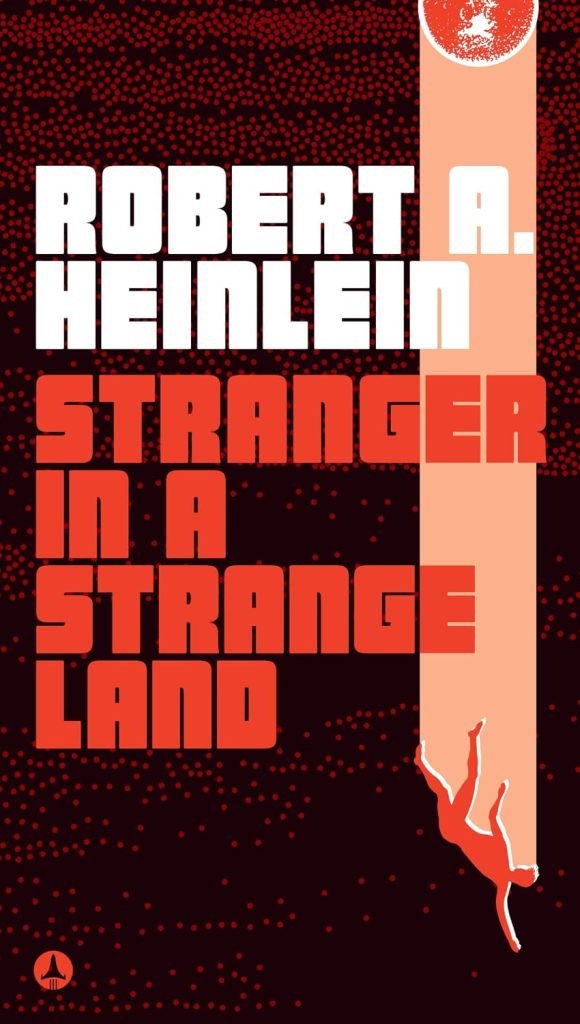
Robert Heinlein’s 1961 novel about Valentine Michael Smith, a human raised by Martians who comes to Earth and looks at humanity from the outside. It won the Hugo Award, gave the language the word grok, and was the first science fiction book I ever read.
When I was about twelve, a great aunt of mine died and the family received a box of her things. Inside was a copy of Stranger in a Strange Land. I got to keep it.
I’d been a reader for years by then, but I’d never really read science fiction. That one book cemented all of it for me. I went looking for everything else Heinlein wrote, and I’ve been reading the genre ever since.
What is Stranger in a Strange Land about?
A man from Mars who happens to be human. Valentine Michael Smith is born during the first expedition to Mars, the crew dies, and he’s raised by Martians. A second expedition brings him back to Earth, where he’s held at a hospital as a curiosity and a legal problem, since under the law he may own Mars.
A nurse, Gillian Boardman, shares water with him. By Martian custom, that makes her his water brother, a bond closer than marriage. She gets him out to the house of Jubal Harshaw, a lawyer, doctor and popular writer who shelters him, argues with him and wins his legal freedom. Harshaw is the book’s other great character, and most of its opinions come out of his mouth.
From there Smith learns what it means to be human, mostly by watching people and finding them baffling. He becomes a celebrity, studies Earth’s religions and eventually founds his own church. It doesn’t end well for him.
Is Stranger in a Strange Land a book for kids?
No. I was almost certainly too young for a lot of it at twelve. The concepts grabbed me anyway: life outside the body, an alien way of perceiving the world, a human raised by Martians coming back to look at us from outside. I found all of it interesting, even the parts I didn’t fully understand yet.
Why does Stranger in a Strange Land still matter?
It changed what science fiction could be. It won the Hugo Award for Best Novel in 1962 and became the first science fiction novel on the New York Times Book Review bestseller list. By 1997 it had sold more than 100,000 hardcovers and nearly five million paperbacks. The Library of Congress included it in its 2012 exhibition of books that shaped America.
A lot of that success came from readers well outside the usual science fiction crowd. The counterculture of the late 1960s adopted it, with its free love, its distrust of organized religion and its outsider hero, though Heinlein had written it years before any of that arrived and never claimed the role.
It also gave the language a word. Grok, Smith’s Martian word for understanding something completely, ended up in the Oxford English Dictionary.
Readers should know there are two versions. The 1961 edition was cut for publication. After Heinlein died, his widow, Virginia, restored the original manuscript, and the uncut version came out in 1991. Critics still argue about which one is better.
Who was Robert A. Heinlein?
He was born in Butler, Missouri, in 1907, graduated from the Naval Academy in 1929 and left the Navy in 1934 after a case of tuberculosis. His first story appeared in Astounding in 1939. He won four Hugo Awards for best novel and in 1974 became the first Grand Master of the Science Fiction Writers of America. Before the war he’d been active in California politics, and during it he worked as a civilian engineer at the Philadelphia Navy Yard, alongside Isaac Asimov and L. Sprague de Camp. He died in 1988.
He was one of my favorite authors growing up. As an adult, I’ve wrestled with his work.
He deserved both.
Keep reading
My tribute to Robert Heinlein: how a box from a great aunt put this book in my hands at twelve, and why my feelings about Heinlein got complicated.