Latest
The Money Appeared the Week After the DisasterHow a Stranger Decides You Are Credible in Nine SecondsWhat You Have to Decide Before Anybody WritesWriting It Before You Need ItCross Training Covered Everything Except the Role That Mattered MostBehind the Book: The Woke VirusBehind the Book: Galactic InvasionBehind the Book: You Don’t Own Anything AnymoreWhat’s New at The Writing King: Week of November 8, 2026Alexander Zhidkov: Decision MakingJessi Szurek: Expand Your RangeYou Don’t Own Anything AnymoreThe Budget Decided How My Department Was ShapedWhy Your Competitor’s Book Is Working and Yours Would NotWhy Are These Guys Smiling? A Business Book That Became a Wrestling MemoirPangram Wants to Decide Who Gets PublishedWhat You Have Enough Material For Right NowWhen a Book Is the Wrong ToolThe Woke VirusGalactic InvasionChatGPT Turns Four: From a Free Research Preview to GPT-6What’s New at The Writing King: Week of November 1, 2026Diwali: The Festival of Lights and the Story Behind the LampsHow Much Water and Power Does Heavy AI Use Take? I Ran My Own NumbersBad Boys: Ride or Die (2024)Vesuvius Day: The Teenager Who Wrote Down Pompeii’s Last DayAnti-Communism Week: Remembering the Writers Communism SilencedVoyager 1 One Light-Day: Fifty Years to Travel One Day of LightVellum Added an Optional AI Feature. A Pile-On Killed It in a Day.Are AI Subscriptions Losing Money? The Gym Membership Math Says NoAI Terms Every Writer Should Know, and Why Each One MattersWorking While Sick: What 24/7 On Call Cost MeHe Banned AI From His Writing Group. His Own Cover Got Called AI Slop.Who Writes the Fake Fan Mail Authors Get? Inside the Scam CompoundsSMS Appointment RemindersFree BooksDarrell Stern: Stop Being Invisible, Become UnmissableJoe Rockey: Ghostwriting His BookHow to Turn Your Expertise Into a Book People Want to Read | The Expert MethodWhat’s New at The Writing King: Week of October 25, 2026Challenger Remembrance Day: The Engineer Who Wouldn’t SignJoel Salomon: The Truth About MoneyReddit Is Putting Up a Login Wall. Wikipedia Won’t Be Far Behind.Victoria Chemko: The Body Is the First TechnologySir Patrick Stewart: A TributeA Year in the Bank: ADHD, Face Blindness and the Freedom to Walk Out | The Impossible Puzzles Show, Episode 326A Yale Economist Says We Won’t Be Missed. He Forgot the Bread Line.Walter Koenig: A TributeI Don’t Post Bad ARC Reviews. I Send the Author a Note.AI Has Paid Off Outside Tech. Apollo Is Reading the Wrong Scoreboard.

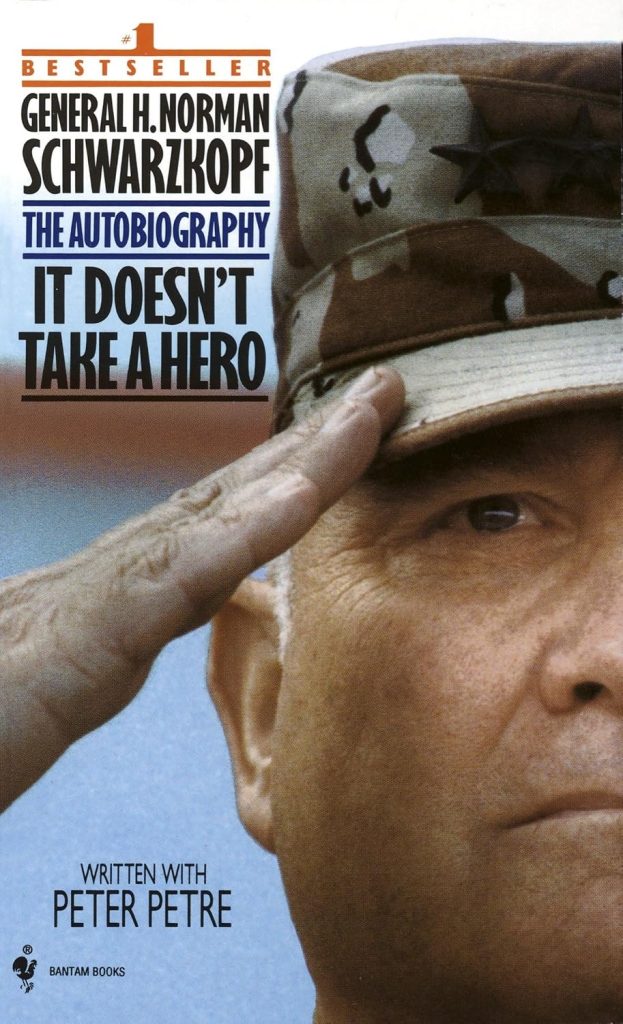
It Doesn’t Take a Hero

It Doesn’t Take a Hero

The Autobiography

Publisher:Bantam Books
ISBN:0553089447
Pages:530
ISBN:9780553089448
Language:English
Share:

Buy Now

Description:

TL;DR

The autobiography of General H. Norman Schwarzkopf, written with Peter Petre, covering his childhood, two tours in Vietnam and his command of the 1991 Gulf War from Central Command at MacDill. He retired to Tampa afterward.

In 1988 the Army handed H. Norman Schwarzkopf a command most officers considered a backwater. U.S. Central Command sat at MacDill Air Force Base in Tampa, its war plans looked unrealistic, and nobody expected it to fight anything soon. Two years later it was running the largest American military deployment since Vietnam. It Doesn’t Take a Hero is Schwarzkopf’s account of the road to that moment, written with Peter Petre and published by Bantam Books in 1992. It became a New York Times bestseller.

What is It Doesn’t Take a Hero about?

All of it, from childhood on.

Schwarzkopf writes about his father, a general who organized the New Jersey State Police, and about the strain his mother’s drinking put on the family. He covers West Point, his two tours in Vietnam, his wounds and the day he crossed a minefield to reach an injured soldier. He’s also candid about how close he came to leaving the Army after Vietnam. A reader expecting a victory lap gets a much fuller portrait of the man than that, including the doubts and the family troubles a more guarded author might have left out.

The Gulf War chapters cover the scramble to move troops and supplies to Saudi Arabia in 1990, the logistics problems on the ground and his frustration with officials in Washington who wanted a faster, harder war.

Reviewers noted that the battle itself takes fewer pages than the career leading up to it. That’s a fair reading of what the book cares about.

Who was H. Norman Schwarzkopf?

He graduated from West Point in 1956 and earned three Silver Stars in Vietnam.

He served two tours there. On the first he advised the South Vietnamese Airborne Division. On the second, from December 1969, he commanded the 1st Battalion, 6th Infantry, and came home with two Purple Hearts to go with the Silver Stars.

He commanded the 24th Infantry Division, served as deputy commander for the 1983 Grenada operation and took over Central Command in November 1988. After Desert Storm he retired in August 1991 and settled in Tampa, where he lived until his death in 2012.

Retirement was busy. He worked for a time as a military commentator for NBC, raised money for children’s charities, spoke publicly about prostate cancer and sat on the board of the Nature Conservancy. He’s buried at West Point.

How did readers react to It Doesn’t Take a Hero?

They bought it. The book was on the bestseller lists within months, and the Christian Science Monitor’s reviewer that November credited Schwarzkopf for how candidly he wrote about his own life.

Not everyone was pleased. Some Saudi officials publicly disputed parts of his account of the war, and his criticism of officials in Washington drew attention of its own. A memoir published a year after a war will always land in the middle of arguments about it, and this one did.

What would a ghostwriter take from It Doesn’t Take a Hero?

The family chapters. A general’s memoir is expected to be about the war, and plenty of them are about nothing else. Schwarzkopf put his father, his mother’s drinking, his own wounds and his doubts about staying in uniform on the page, and those chapters are the reason the war chapters land. By the time the reader reaches Riyadh, they know the man giving the orders.

When I interview a retired officer, the stories they’d prefer to skip are usually the ones the book needs. The career is the spine. The life around it is what makes a stranger care.

Why does It Doesn’t Take a Hero belong on this shelf?

It’s the Tampa book on a Tampa shelf. Schwarzkopf ran his war from MacDill and came home to the same city.

It also shows how a famous commander handles collaboration. Petre was a Fortune editor who later worked on books with Alan Greenspan and Arnold Schwarzenegger. His name sits on the cover next to the general’s, and the book still reads like Schwarzkopf talking. Anyone who wonders whether working with a writer will cost them their voice should read a few chapters.

Keep reading

Hiring a ghostwriter for a retired general’s or admiral’s leadership book: how senior military leaders turn a career into a book, and what has to stay out.

Sources

Frequently Asked Questions

Who wrote It Doesn’t Take a Hero?
General H. Norman Schwarzkopf wrote it with Peter Petre, a former Fortune editor. Bantam Books published it in 1992, a year after Schwarzkopf retired from the Army. Petre is credited on the cover as his collaborator.
Is It Doesn’t Take a Hero only about the Gulf War?
No. It covers his whole life, including his childhood, West Point, two tours in Vietnam and his rise through the Army. The Gulf War is the climax, but reviewers noted it takes fewer pages than the career before it.
Where did Norman Schwarzkopf command the Gulf War from?
He commanded U.S. Central Command, headquartered at MacDill Air Force Base in Tampa, from 1988 until 1991. During Desert Storm he led the coalition from a forward headquarters in Saudi Arabia.
Did Norman Schwarzkopf live in Tampa?
Yes. He retired from the Army in August 1991 and settled in Tampa, the city where he’d run Central Command. He lived there until his death in December 2012 and is buried at West Point.
Was It Doesn’t Take a Hero a bestseller?
Yes. It reached the New York Times bestseller list in 1992, when public interest in the Gulf War and its commander was at its peak.
Who is Peter Petre?
Peter Petre is a former Fortune writer and editor who has collaborated on several major books. Besides Schwarzkopf’s autobiography, he worked on books with Alan Greenspan, Arnold Schwarzenegger and IBM’s Thomas Watson Jr.
Categories and tags
CategoriesMemoirs

About the author

H. Norman Schwarzkopf with Peter Petre

H. Norman Schwarzkopf

General H. Norman Schwarzkopf Jr. commanded U.S. Central Command and led the coalition forces in the 1991 Gulf War. A West Point graduate who served two tours in Vietnam, he retired in 1991 and wrote his memoir, It Doesn't Take a Hero, with Fortune editor Peter Petre. He died in Tampa in 2012.

More about H. Norman Schwarzkopf

Peter Petre

Peter Petre is a former Fortune writer and editor who became a book collaborator. He wrote It Doesn't Take a Hero with General H. Norman Schwarzkopf and later worked on books with Alan Greenspan and Arnold Schwarzenegger.

More about Peter Petre

Back