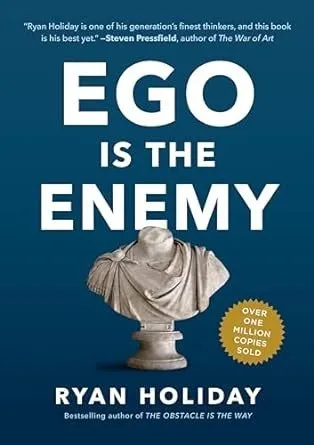
TL;DR
9/10. Ego at three stages: when you’re aspiring, when you’ve succeeded, and when you’ve failed. Better than The Obstacle Is the Way because the argument cuts against the reader instead of encouraging them, and because the success section is aimed at exactly the person likely to be reading.
The claim is that ego is the need to be perceived a particular way, and it costs you differently depending on where you are.
Aspiring, it substitutes talking for working. Successful, it makes you unable to hear anything corrective. Failing, it makes you unable to accept the situation and start again.
This book needles me the way a good editor does.
It keeps pointing at behavior I’d prefer to call something nicer, and it’s right every time. Most self-help flatters the reader into buying the next volume. Holiday wrote one that makes the reader the problem, and I respect him more for that than for anything else in the trilogy.
The three-part structure mirrors the earlier book and the content is harder. This is the one I return to.
Why does talking about your work hurt it?
Because announcing a project delivers the recognition you were going to receive for finishing it. That’s the sharpest sentence in either book and it explains a behavior I’ve watched for thirty years. Somebody tells everyone about the book they’re going to write. The telling produces the response, the interest, the sense of being a person who writes books. The reward has been collected and the work becomes optional. Holiday cites research on this and the research is contested. That doesn’t much matter, because anybody who has announced a project instead of doing it recognizes the mechanism from the inside.
The practical instruction is uncomfortable and correct. Do the work quietly and let the finished thing be the announcement. For a writer that means not telling people you’re writing a book until there’s a manuscript, which almost nobody manages.
This one makes me uncomfortable, because the announcement feels so good. Somebody posts about the memoir they’re starting, collects a round of applause, and I’d bet most of those memoirs stall before chapter three. The applause is the trap, and Holiday puts his finger on it without any scolding.
Watch: Ego Is The Enemy Summarized by Ryan Holiday (In less Than 5 Minutes), Daily Stoic
What does ego do to a successful person?
This is the section almost nobody writes, and it’s why the book is better than its predecessor. Advice assumes a climbing audience. Books sell to people who want something they don’t have, so the entire genre aims at the aspiring, and the failures of the successful go undocumented because nobody is buying a book about them. That gap is the genre’s biggest blind spot. The people with the most power to do damage are the ones nobody writes for, and they’re often the ones buying business books anyway. Holiday aims straight at them, and it’s the bravest choice in the book.
Holiday spends real pages on it. Successful people surround themselves with agreement, because disagreement has become expensive for everyone around them. They mistake luck for skill, and the error grows because success gives no feedback that separates the two. The failure that scares me most is the inability to take correction from anybody junior, because it cuts you off from the only people who can still see clearly.
And entitlement, control, and paranoia, which he treats as the characteristic failures of people who have got what they wanted and are now defending it.
How should you handle failure?
The third section deals with ego when things have gone wrong, and its argument is that ego makes failure permanent. A person without much ego assesses a failure, extracts what’s usable, and starts again. A person with a great deal of it can’t do the assessment, because the assessment requires admitting the thing happened and was partly theirs, and so the failure becomes an identity instead of an event.
The chapter on the difference between being wronged and being ruined is the useful one. Plenty of things are unfair. The question is what you do afterward, and ego answers that question by demanding the unfairness be acknowledged first. That frequently means nothing happens at all.
I’d make this chapter required reading for anyone who’s been treated badly and is still waiting for an apology before moving on. The apology may never come. Every month spent waiting for it hands the person who wronged you a second win, and Holiday is right to say so bluntly.
Does Ego Is the Enemy have the same flaws as the first book?
Yes and it survives them better.
Holiday chooses the examples to fit and compresses the history, and a reader who knows one of the figures well will find the treatment thin. That’s the standing problem with this format.
The difference is that the argument holds without the examples. Take out every case study and the claim that the need to be perceived a particular way will stop you at each stage of a career survives intact, because the reader can test it against their own behavior. That’s not true of everything in this genre and it’s not true of the first book, where the case studies are carrying more of the load.
The thin history counts for less here, because the book never asks you to trust Holiday’s reading of a general or an executive. It asks you to check your own habits against his claim, and that test doesn’t depend on his research at all.
Verdict
The best of Holiday’s three, and the one worth rereading. If you take one thing, take the observation that announcing a project provides the recognition you were going to get from finishing it. That’s why the announcement so often ends the project. Read the success section even if you don’t feel successful. It describes a failure mode you won’t spot from inside it, and I’d much prefer you recognize it early in a book than late in your own career. Of the three, this is the Holiday I’d push into a writer’s hands first.
Explore further
The Psychology of Writing Hub: what drives creative work and what stops it.