
My first instinct was that this was a cultural problem. A social media problem, possibly a generational one. Something organic that had grown out of real grievances on both sides and been amplified by algorithms that profit from conflict.
That instinct was incomplete.
The further I looked the more a different picture emerged, and the book is the account of what I found and where it led.
What I found was ugly, and it still is. Watching men and women treat each other as enemies is hard enough. Realizing that somebody may have been feeding that fight on purpose for decades, while the rest of us mostly let it happen, was the part I couldn’t put down.
Nobody on either side of the gender fight will find a champion in this book. It doesn’t take sides between men who feel wronged and women who feel threatened, it doesn’t blame women for what happened, and it doesn’t excuse men for their part in it. Books that pick a team and call it analysis are a con, and I refused to write one.
It’s a national security argument, and the question it asks isn’t who’s right in the conflict playing out on a screen.
Why does The Emasculation of America open with a note to the reader?
It comes before everything else because a book with this title will be misread, and I’d rather pre-empt that than complain about it afterward. The book examines that ideological structure and analyzes it as a delivery mechanism. Where it came from, how it was institutionalized, and what it produced. That isn’t a judgment on anybody who holds those views.
People arrive at their beliefs through education, experience, relationships and the culture around them. Most people who hold the views this book examines hold them sincerely, reached them in good faith, and are trying to make the world better as they understand it. The book doesn’t dispute their sincerity. It disputes the origins and the effects of the structure they’re working inside.
And if your own philosophy includes commitments to fairness, to human dignity, and to honest examination of how power works, the book’s argument is that this particular structure doesn’t reliably produce them.
The book on this: The Emasculation of America argues that the collapse in relations between American men and women is the product of a documented influence operation, not an organic cultural shift, and invites readers to check the primary sources.
Who should skip a book about masculinity and culture?
Books that pick a team and call it analysis are a con, and I refused to write one.
A specific audience, named explicitly, and that exclusion is doing real work. It isn’t for anybody who wants to be told that one sex is superior to the other. It isn’t for anybody who thinks the answer to the problems it documents is hostility toward women. And it isn’t for anybody looking for absolution. Here the book presents the operation it describes as real and the damage as real, and it offers neither as an excuse. It offers them as an explanation. That’s a different thing and it points somewhere different.
That paragraph is in the front matter because a book making this argument will attract readers who want it to say something it doesn’t say. I’d rather lose those readers on page one than have them quote me for a cause I don’t hold.
What is the central argument of The Emasculation of America?
That the divide didn’t start where it became visible.
The argument is that you can’t beat the United States in a straight fight. You can’t outspend it, outproduce it, or outlast it conventionally. So an adversary doesn’t fight it conventionally. It fights the culture and the confidence, and it works on the men who would defend the country by persuading them, and the women around them, that the traits which made them worth having are the problem.
The book’s position is that this has been running for sixty years, and it sets out to document how it worked, what it produced, and what it’s still producing. That’s a large claim, and I never lost sight of how large it is. A claim that size owes readers a chapter and an appendix of sourcing, and I’d have been embarrassed to hand them a footnote.
What sources support claims about ideological subversion?
Documentary material, and it names it up front so readers can check.
The Mitrokhin Archive. Senate Intelligence Committee reports on Russian active measures. The Bezmenov interviews. They’ve been publicly available since 2013. Peer-reviewed research, educational achievement data, and military recruitment figures. The instruction the book gives is the right one for material like this. Take what’s useful, examine what’s disputed, and check the primary sources. The argument either survives that examination or it doesn’t.
That’s also the main caveat to put on an essay about it. The interpretation the book builds from those sources is contested, and several of the empirical claims are actively disputed in the literature. A reader who takes the book’s invitation seriously will find that out. Presumably that’s why the invitation is there.
Where does the decline of American masculinity start?
With an interview from 1984 that’s been publicly available for decades.
Yuri Bezmenov was a KGB defector who had run active measures operations before coming to the West in 1970. By 1984 he’d spent more than a decade trying to get somebody in a position of authority to listen. He gave lectures, wrote reports, and did interviews. One of those interviews ran over an hour and set out, in calm and careful detail, a strategy for defeating the United States without firing at it.
That material is the book’s starting point, and the introduction is called The Warning Nobody Heard for a reason. None of it was hidden. It sat in plain view for decades and the people whose job it was to listen didn’t act on it, and I find that harder to forgive than any secret.
Why ask who benefits from a cultural shift instead of who caused it?
Because causation in a social system is rarely clean enough to assign to one actor. That’s the question the book keeps returning to. Not who did this, which invites an argument nobody can settle, but who’s served by the arrangement continuing.
Following the benefit produces the incentive structure that sustains a phenomenon regardless of how it started. That’s a more durable form of analysis than tracing an origin, and it survives disagreement about the origin. The book’s claim is that most accounts of the decline of American masculinity leave this out. They document the decline, describe the mechanism, and stop before asking who the current arrangement suits.
What’s the interlude in The Emasculation of America for?
Putting faces on the numbers, and it’s the only chapter with no argument in it. The chapter before it’s data. The interlude is seven documented public accounts of real people, drawn from court records, congressional testimony, published interviews and on-the-record journalism. Nothing composite and nothing invented. That’s stated up front, and it matters given how the rest of the book handles evidence.
Five of the accounts are men and two are women. That’s deliberate. Both sexes appear in the data and both are described as paying a cost.
The reason it exists is stated plainly. The argument is about what happens to specific human beings instead of demographic categories. I wanted readers to meet those people before the book asked them to accept anything else, because it’s easy to argue with a chart and much harder to dismiss a real person’s account of what it cost them.
What hopeful finding came out of the research for The Emasculation of America?
Evidence that the damage wasn’t total, and that’s the chapter he wanted to write from the start. He also says something about his own state while writing that’s unusual to admit in print. He wasn’t angry at the beginning. At the beginning he was trying to understand what he’d seen in a rabbit hole of videos. The anger built as the list built, and his own framing of it is that he didn’t set out to write an angry book. He wrote an honest one and the honesty produced the anger.
That’s a useful thing for a reader to know before starting, and putting it in the text instead of leaving it in the tone is more honest than the alternative.
Does The Emasculation of America claim to know how the story ends?
No, and the final chapter is careful about the difference between a position and a certainty.
It opens by conceding the starting point. The operation succeeded, and the damage is described as ongoing with the mechanisms still running.
Then the admission. He doesn’t know whether the trajectory reverses. He doesn’t know whether enough people will read it and act in time to matter. He has a view about what’s possible and no certainty, and he says so before making the case. A book this confident about its diagnosis ending with an explicit statement of what its author doesn’t know is the most persuasive thing in it, whatever a reader concludes about the rest.
Why publish a book that you know will draw blowback?
Because I stopped optimizing for the reaction some years ago. This book will produce blowback. I knew that going in and I don’t care. I’m getting older, I prefer my own company, and I stopped worrying about what people thought of my conclusions around the same time I became more interested in whether the conclusions were true. Some of the blowback will come from people who haven’t read it carefully. Some will come from people who have read it carefully and don’t like where it goes. Those are different responses and only one of them is worth answering.
My take
Read the note to the reader first, and skip the book if it names you as someone it isn’t for. The strongest part is the people. Men and women both appear, both paying a cost, and those accounts are harder to wave away than a chart. I respect an author who admits in print that the anger built as the research did. That honesty tells you how to read the rest. Stay for the chapter showing the damage wasn’t total.
What does The Emasculation of America say is real whatever the cause?
A list of things it argues are real regardless of what anybody concludes about the cause.
Men checking out. Women who can’t find men worth choosing. Boys falling behind in school. A military struggling to find qualified recruits. A birth rate below replacement. Those are the observations the book starts from and the explanation is what it argues for. A reader can reject the explanation entirely and still be left holding the observations. That’s the position most people are already in.
The final part is about response instead of diagnosis, including a chapter on men who refused and one on what taking it back would involve. I’m proudest of those chapters. Anybody can write a book about damage. The people paying for this, the boys falling behind and the men and women who can’t find each other, deserve a book that also tells them what comes next, and I’d have counted this one a failure without it.
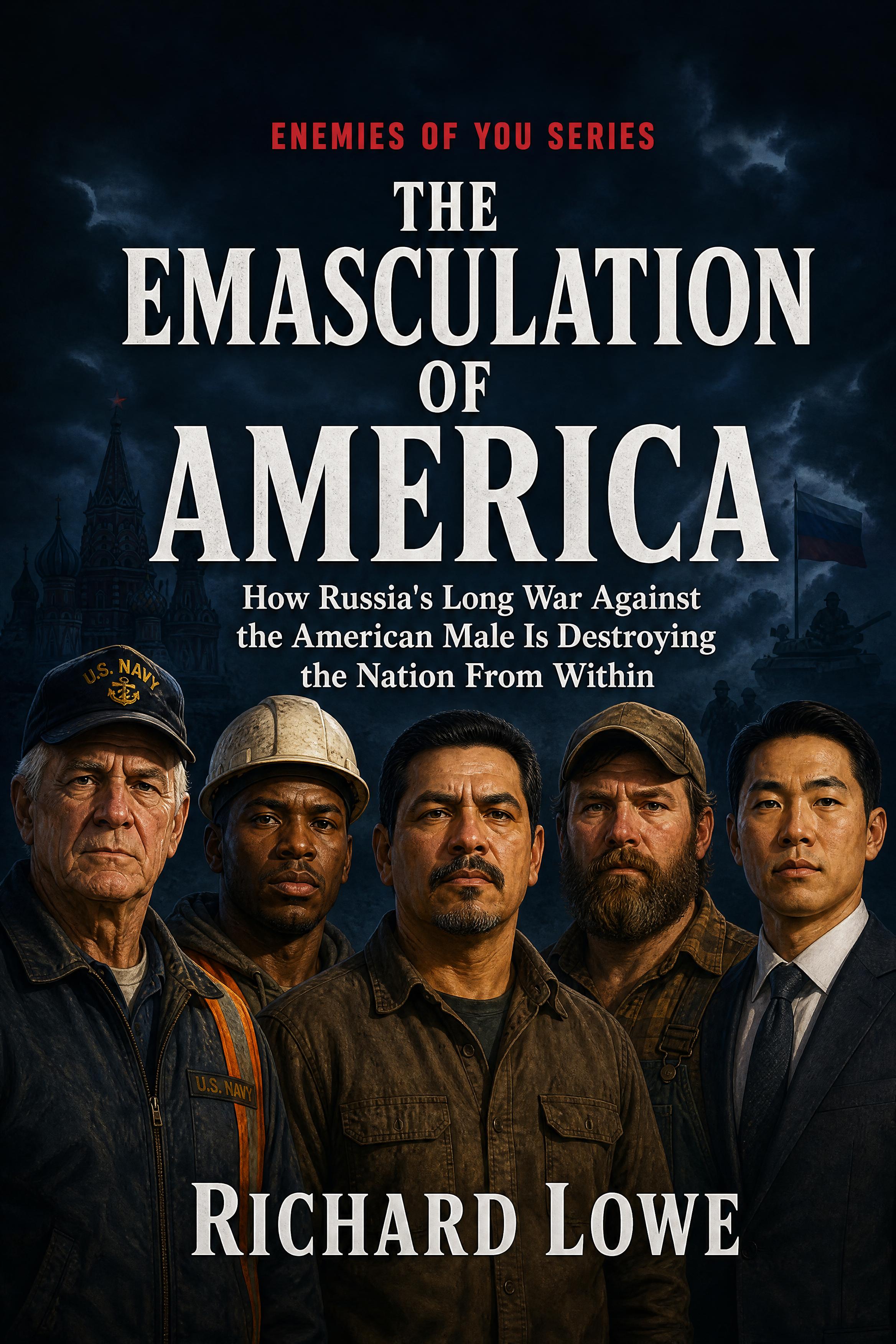
In 1984 a KGB defector explained what was being done. The Emasculation of America looks at what Bezmenov described and why nobody acted on it.



