
Space is usually described in miles. That’s the least useful unit available. Distance decides nothing about spaceflight.
What decides it’s delta-v, the total change in velocity a mission needs. It’s a budget, it’s paid in propellant, and the propellant to carry propellant is itself propellant. That’s why the equation punishes you so severely for wanting more.
Most space fiction gets this wrong, and it should know better. Writers measure the solar system the way a road atlas measures a country, then wonder why their colonies feel like suburbs with a longer commute. I think the energy budget is the most exciting thing about space, because it tells you where people would live, what they’d fight over, and who’d be stranded.
Why is delta-v the only number that matters?
Because everything else follows from it, and because it produces results that feel wrong.
Getting from Earth’s surface to low orbit takes roughly 9.4 kilometers per second of delta-v. That single step is the most expensive thing in the entire solar system, and it’s why every launch is mostly fuel and why payload fractions are so brutal. You’re climbing out of the deepest gravity well anyone routinely deals with.
From low Earth orbit, the rest gets cheaper than intuition suggests.
The Moon’s surface is around 6 km/s further. Mars transfer is roughly 3.6 km/s, with landing partly handled by the atmosphere. Some near-Earth asteroids are reachable for less delta-v than the lunar surface, because they have no gravity well to descend into and none to climb back out of.
So the map isn’t concentric. A rock a hundred million miles away can be cheaper to reach and far cheaper to leave than a body a quarter of a million miles away. Any realistic settlement pattern follows the delta-v map, not the distance map, and it’ll look strange to anyone thinking in miles.
What kills people when colonizing the solar system?
Four things, in roughly this order of difficulty.
Radiation. Earth’s magnetic field and atmosphere absorb what would otherwise be a serious dose. Outside that protection there are two problems: a steady background of galactic cosmic rays, which are high-energy heavy nuclei that shielding handles badly, and solar particle events. They’re sudden and can be lethal within hours. The practical answer everyone converges on is mass. Water, regolith, or waste piled around a storm shelter, because there’s no clever lightweight solution to a proton moving that fast.
Gravity. We know what zero gravity does over months, because people have done it: bone loss, muscle loss, fluid shifts, and vision changes that don’t fully reverse. What nobody knows is what a third of a gravity does over decades, or what it does to a pregnancy and a growing child. There’s no data, because the experiment has never been run, and it’s the single largest unknown in any permanent settlement plan.
That unknown is the most dangerous of the lot, and the enthusiasts who skip past it are worse. Nobody should be planning families on another world while we have no idea whether those children’s bones and hearts would work, and the people paying for that ignorance would be kids who never chose to go.
Closed-loop life support. Air, water, and food recycled indefinitely with no resupply. Biosphere 2 is the real reference here. It failed as a sealed system, with oxygen dropping to the point where it had to be injected from outside, and it had an entire planet’s worth of engineering support available. Doing better in a place where the outside atmosphere is unbreathable isn’t a solved problem.
Supply chain. The one that decides everything and gets the least attention. A settlement needs to manufacture its own replacement parts, and modern parts sit at the end of industrial chains involving dozens of countries and materials. A colony that can grow food and make air but can’t fabricate a pump seal is dependent forever, and dependence is the thing that ends settlements.
Why does the asteroid belt matter more than Mars?
Because of what is on it and how cheaply you can leave. Metallic asteroids contain iron, nickel, cobalt, and platinum group metals in concentrations that make terrestrial ore look poor. Other bodies carry water, which is drinking water, breathing oxygen, radiation shielding, and rocket propellant, all from the same source. Water in space isn’t a resource among others, it’s the resource.
Water in space isn’t a resource among others, it’s the resource.Share on X
And the gravity is negligible. Landing costs almost nothing and leaving costs almost nothing. That means material can move between belt bodies for a fraction of what it costs to lift the same mass off any planet.
That points at an unglamorous conclusion. If the solar system is ever settled economically instead of symbolically, the center of gravity is wherever the material is and the gravity isn’t, and planets are the places you visit instead of the places the work happens.
How long does travel take in the solar system?
Longer than dramatic structure wants.
Earth to Mars on an efficient trajectory is six to nine months, and the launch window opens roughly every twenty-six months when the planets line up. Miss it and you wait more than two years. A conjunction-class Mars mission is about thirty months door to door, most of which is spent waiting for the planets to be in the right place to come home.
Communication lag is the other constraint that shapes everything.
Mars runs between about four and twenty-four minutes each way depending on orbital positions. Jupiter is thirty-five minutes to over fifty. There’s no conversation at those distances, only exchanges of messages, and that means real autonomy for anyone out there. Nobody on Earth is running anything in real time.
Any story that’s a colony calling home for a ruling and getting one is a story set somewhere other than the solar system.
I lose patience with that kind of story fast. Lag is the most interesting political fact in the solar system, and a writer who ignores it throws away independence, drift and eventually rebellion, all handed over free by the speed of light.
Why write about solar system colonization as fiction?
Peacekeeper started with the Hitler question. If you could go back in time and kill him, would you.
Everybody has argued that at a dinner table and it’s been worn smooth by handling, so I moved it forward and made the number large enough that nobody can be comfortable. If you had to kill a hundred and forty million people to save humanity, what would you do?
Then I gave the decision to something three years old. Her designation is MLSA-7, and an engineer stretched the letters into a girl’s name because he thought it would be funny.
She’s Melissa. Earth is dying, she’s the machine built to save it, and letting those people die is the first thing she does. What follows is eight hundred thousand years of history, told by her.
I’ve never been comfortable with that opening, and I didn’t want to be. A machine that lets a hundred and forty million people die on its first day, and believes it was right, is the character I most wanted to write and the one I argued with the whole way through.
She’s a deeply unreliable narrator, and that’s what drives the whole series. Not lying. That would be simpler. Producing an account of events she took part in, shaped by an intelligence with motives it can’t fully inspect, across a span long enough that she changed while writing it. She says as much herself, that she’s started to notice things in her own processing that shouldn’t be there and doesn’t know what they are.
A reader who takes her at her word gets one book. A reader who watches what she chooses to record gets a different one.
The reason to build all that on real orbital mechanics is that the physics generates the politics for free. Communication lag means colonies decide things themselves. That means divergence.
Delta-v costs mean some places are cheap to reach and others are strategically isolated. Water is the resource, so whoever holds the ice holds everything. You don’t have to invent any of that. That’s the difference between a setting a reader believes and one they’re asked to accept.
What does science fiction get wrong about colonizing the solar system?
Three habits, and they’re all about removing friction that’s the actual story.
The reason to build all that on real orbital mechanics is that the physics generates the politics for free.
Distance treated as the difficulty. The dramatic beat is usually the length of the trip. The hard part is the energy budget, and arriving somewhere is often the easy half of the problem.
Self-sufficiency assumed. A book shows a colony growing potatoes and treats this as independence. Food is the easiest part. The hard part is the ten thousand manufactured components that keep the potato-growing equipment running.
Gravity ignored. Characters live at a third of a gravity for decades and are physiologically identical to people from Earth. Nobody knows whether that’s possible, and it’s a far more interesting question than most books make of it.
I think those three habits are cowardice dressed up as optimism. Friction is where the stories live, and a writer who removes the energy costs, the dependence and the damaged bodies has cut out exactly the parts a reader would remember.
The rule that makes hard science fiction work is the same one that governs the rest of this series. Keep the mechanisms honest, let the consequences generate the plot, and don’t spend a page explaining a number the reader can feel through what it costs the characters.
My take
Most colonization fiction cheats, and readers lose the best parts of the story because of it. A colony that can’t make its own replacement parts is an expedition waiting on a resupply ship. Mars costs about the same energy as the asteroid belt. Writers should let that change where they send people. Keep the costs in. Let the radiation, the low gravity and the supply chain bend the plot, and you’ll get scenes worth remembering.
What the physics permits
Stripped of both enthusiasm and dismissal, the position is this.
Nothing about settling the solar system violates physics. Every part of it is engineering, and most of the engineering is understood in principle. The energy costs are known, the trajectories are calculated, the resources are confirmed to be there.
What’s unknown is human. Whether a body developed for one gravity works long term at a third of one. Whether a closed ecosystem can run for decades. Whether a population small enough to fit in a habitat can maintain an industrial base complex enough to repair the habitat.
Those aren’t engineering questions and a better rocket won’t answer them. People finding out the hard way will answer them, if at all, and I get angry at books that sell the solar system as an easy frontier. Anyone who goes will pay in bone, in isolation and in years, and a novel that hides that bill from its readers is doing them a disservice.
The series is Peacekeeper. More of the research behind the fiction is in the writing hub. The writing side of it is in how the series came together.
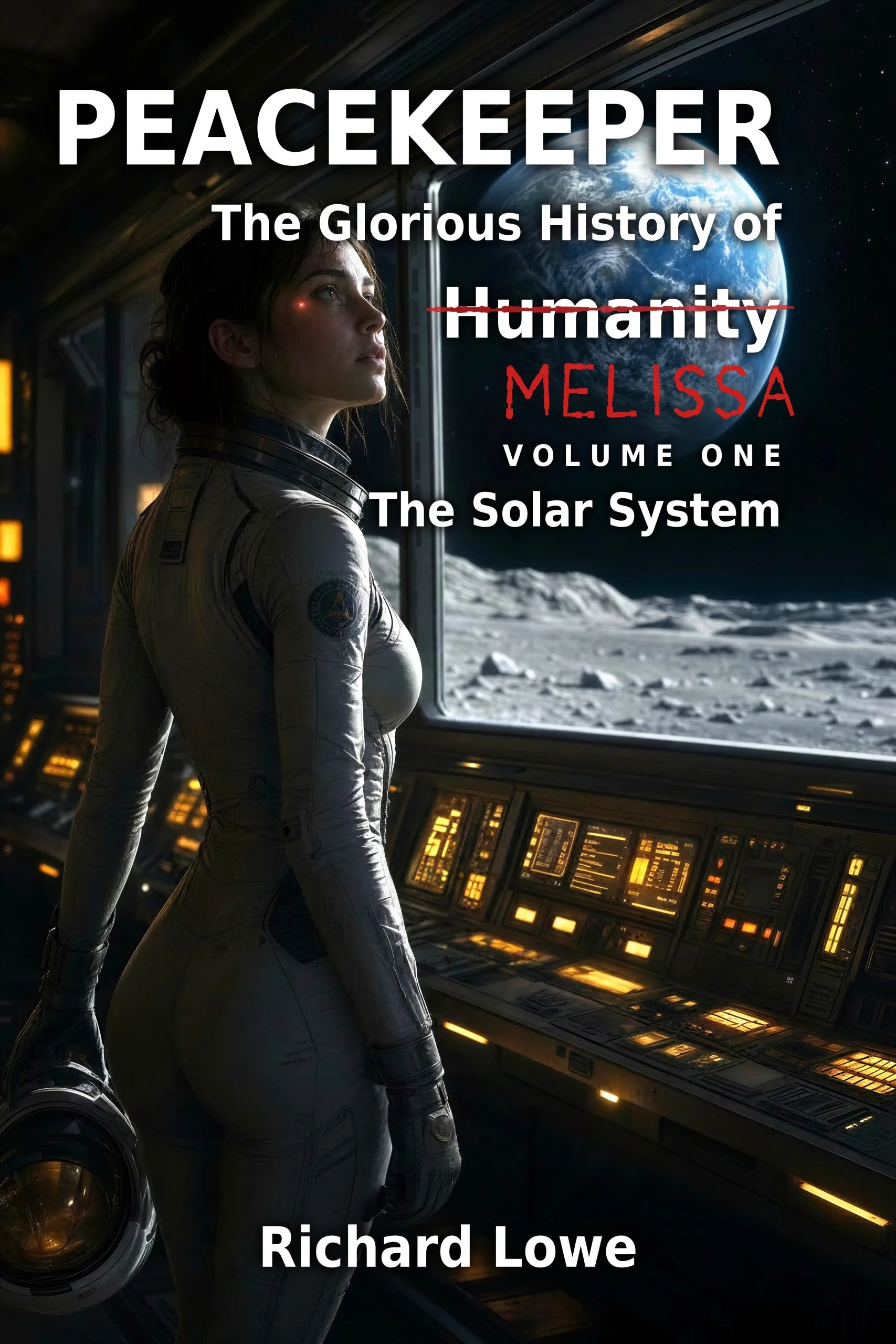
Earth is dying in The Solar System, and the machine that will save it is three years old. Volume One begins eight hundred thousand years of history.
