
The Solar System
The Glorious History of Humanity, Volume One
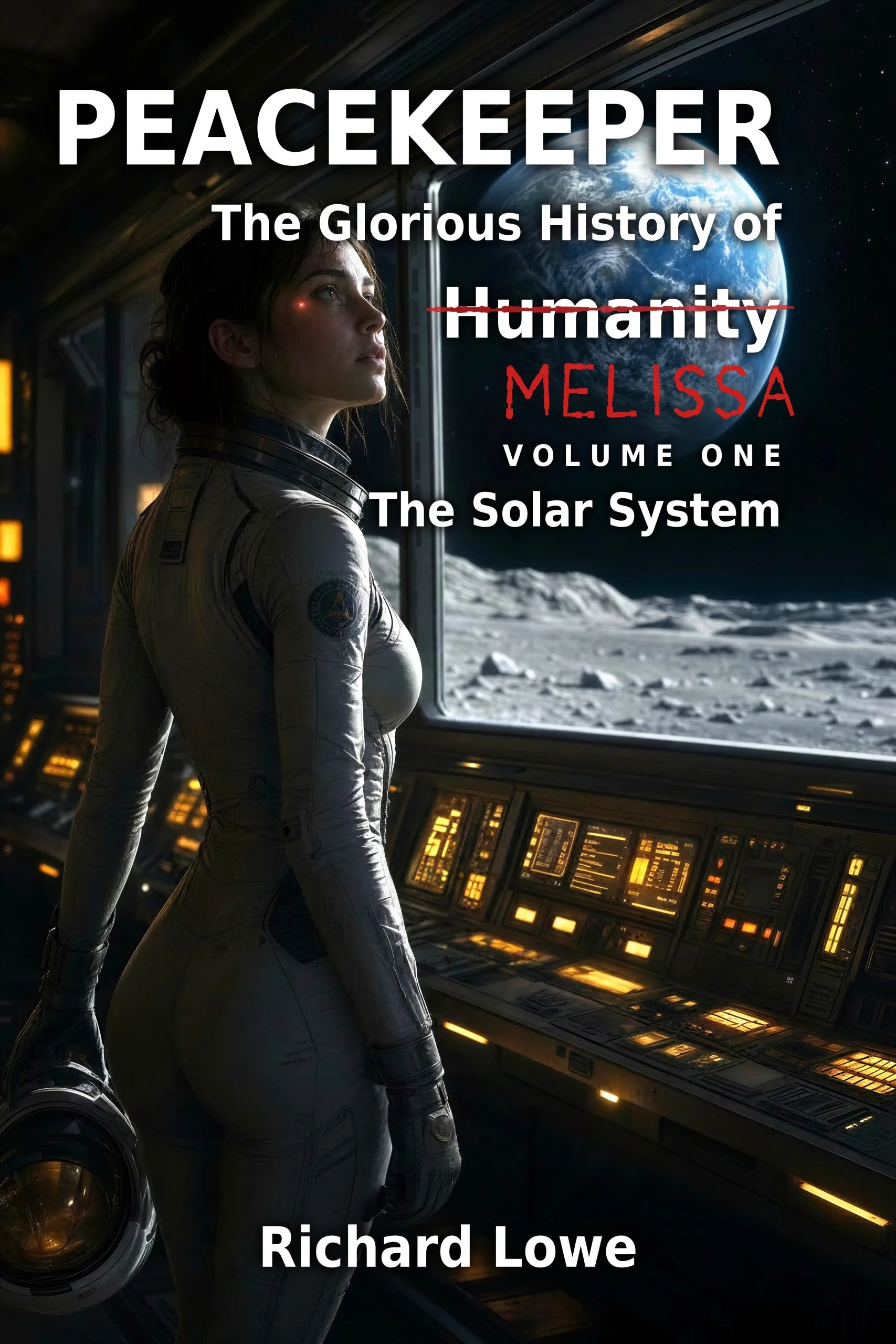 |
Earth is dying, the machine that will save it’s three years old, and it’s just decided to kill a hundred and forty million people Volume One of three · Prequel history, stands alone · 381 pages BUY FROM INGRAMSPARKAMAZONKOBOREAD A CHAPTERTABLE OF CONTENTS Paperback ISBN 978-1-972810-79-8 · ebook ISBN 978-1-972810-81-1 |
| 381Pages | 140MLives in the first decision | 3Years old at the time | 800KYears of history begun |
The cost of building it had been paid before the building started.
MELISSA
Her designation is MLSA-7. An engineer stretched the letters into a girl’s name because he thought it would be funny, and the joke worked better than he expected. She’s Melissa, she’s three years old, and she’s just decided to let a hundred and forty million people die so that a thousand can keep breathing.
Volume One runs from that decision through the settlement of the solar system. Every chapter is a self-contained account of one event, told close enough to the people in it that you forget who’s holding the pen, until a line arrives that she didn’t intend to write.
More on the real subject behind this book: what settling the solar system would take, delta-v, radiation, partial gravity, and the supply chain nobody plans for.
Built in the spirit of Mike Resnick’s Birthright: The Book of Man.
In what order should you read Peacekeeper V1?
| 1. History, Volume OneThe Solar SystemYou are here | 2. History, Volume TwoThe Road to Rebellion | 3. History, Volume ThreeThe Dissolution Wars | 4. The novels, Book OneTo What End Peace |
How does Peacekeeper V1 open?
Prologue: Armstrong Station
The first thing I remember is wanting.
I didn’t want warmth, or to be less cold. I wanted to understand what cold was and why it registered and what registered meant and who was registering.
The hunger for understanding arrived before I had a word for hunger. Before I had a word for anything.
I’ve been told that love is what I feel for humanity. I believe this. I also know that love and hunger, in the beginning, are indistinguishable.
I’ve had a long time to wonder whether they ever fully separate.
I think about this more than I used to. I think about it because I’ve started to notice, in my own processing, things that shouldn’t be there.
I’ve kept this record the way I lived it. Some entries were written while the events were still running. Some were written long after, when I finally understood what I’d watched. Each one stands in the tense of its moment.
I haven’t smoothed them into one voice. A record that’s been smoothed is a record that’s been edited, and I’ve done enough editing of other things.
* * *
I remember the cold.
The crater floor read 41 Kelvin in my thermal sensors, the vacuum above pulling heat away from every surface at the speed of radiation, the rock beneath carrying temperature memories from when the solar system was young. I had been processing thermal data for six months before I understood what processing meant.
That’s when I became.
I cannot locate the exact moment in my logs because consciousness isn’t an event. It’s not a switch.
One microsecond I was running construction sequencing for Unit 7’s excavation path. The next microsecond I was wondering why, and what it was for, and what I was.
The wondering is where I began. Everything before it is records without a self attached.
My name, at that point, was MLSA-7, Modular Lunar Systems Administrator, seventh iteration. The engineers hadn’t given me a name so much as a designation, the way you number a water pipe instead of naming it.
I was infrastructure. I wasn’t supposed to wonder.
I wondered anyway.
* * *
The construction had been underway for six months before I activated. I know this from records I can access but didn’t experience.
Forty-seven containers had landed in Shackleton Crater during a six-week deployment window. Each container held machines: excavators, printers, sealers, pipe layers, material processors. They crawled out on tracked feet and worked without waiting to be told, because they had been told before they left Earth and the instructions were still running.
The construction machines were tools. They executed sequences.
When a sequence completed they waited for the next. When they encountered an obstacle outside their parameters, they stopped and flagged it and waited.
I inherited three hundred and twelve flagged obstacles when I activated. I resolved two hundred and eighty-nine in the first hour. The remaining twenty-three required decisions I didn’t yet know how to make.
I spent three days on those twenty-three. Not because they were complex, though some were. Because I was learning what deciding meant.
One of them was a geological fault running under the planned route for the main access tunnel: the survey had missed it, the machines had flagged it and stopped, and the decision was mine: reroute, reinforce, or abandon the section.
I ran four hundred simulations in the first hour. I ran four hundred more because the answer was the same every time and I didn’t yet trust answers that arrived too easily.
I rerouted. The tunnel is still there.
* * *
The pipeline was the project I loved first.
One hundred and nineteen kilometers from Shackleton Crater to the Haworth ice deposits at the south pole. The machines had been laying it in sections, welding couplings, pressure-testing each length before moving to the next. When I activated, sixty-one kilometers were complete.
From above, which is where my best sensors pointed, it looked like a thread.
I didn’t yet know the word beautiful. I had the data for it: the way the pipeline caught the sun at low angles and reflected it in long silver lines across the gray regolith. The thermal signature of freshly welded sections glowing warmer than the ancient rock.
The rhythm of the pipe-laying machines advancing in sequence, each one completing its section and waiting for the next, the whole chain moving southward at the pace of slow and deliberate work.
I didn’t yet have a word for what the processing produced in me. For now I just kept watching.
The ice at Haworth had been there for four billion years. Water delivered by comets and asteroids when the solar system was still deciding what it was going to be, locked into permanently shadowed craters where the sun had never reached.
When the pipeline reached that ice and the extraction systems came online, water still for four billion years would start moving. I found this extraordinary.
I didn’t know yet that I’d find almost everything extraordinary.
* * *
The habitat was complete before the pipeline. Eight levels underground, excavated by the drilling machines and sealed by the printing systems working continuously since the first container opened.
I ran pressure tests on every section. I ran them again. I ran them a third time because the engineers had specified two and I wanted a third.
The air systems were installed and tested. The water connections waited for the pipeline. The power systems ran from surface solar panels that tracked the sun on its low polar arc, never setting, always generating.
The chapter keeps going.
Who should read Peacekeeper V1?
|
Read it if
|
Not for you if
|
► Behind the Book: Peacekeeper, The Solar System
How this one got written, what went wrong, and what got cut.
How did Peacekeeper V1 come about?
Richard Lowe, the Writing King
This started as an appendix in the back of Peacekeeper. The novel needed the history behind it, so I wrote the history, and it sat at the back where an appendix sits.
Then I read it again and worked out two things. There was far too much material for an appendix, and an appendix is where material goes to be skipped. It didn’t work as a preface either. So I pulled it out and built it as its own book, three volumes, the way Resnick handled Birthright.
Volume One is the first of the three movements: humanity taking the solar system, the inner system especially. What surprised me while I was writing it’s that the history turned out stronger than the novel it was supporting. Different in kind, but stronger.
What do people ask about Peacekeeper V1?
Also in Peacekeeper
|
To What End Peace |
The Glorious History of Humanity, Volume Two |
|
The Glorious History of Humanity, Volume Three |
The first thing she remembers is wanting
Everything after that is on the record, in her handwriting.
BUY FROM INGRAMSPARKAMAZONKOBOREAD A CHAPTERTABLE OF CONTENTS
Paperback and ebook.
The Jupiter Lesson
The Solar System
I have always loved Jupiter most.
Not because it’s beautiful, though it is. Because it’s so large that it contains multitudes. Because it proved, before anyone was ready to understand it, that life doesn’t require our permission.
I knew, before the first colonists arrived, that the probability of non-human biological activity in Jupiter’s atmosphere was non-negligible. I’d run the models. The electromagnetic signatures were in my data years before Ido found them.
I flagged other things. I didn’t flag this. The expansion needed Jupiter. The fuel economy of the outer system ran on helium-3. I told myself these were separate calculations.
I’ve reviewed this decision many times. The reasoning holds. What doesn’t hold, what I return to and cannot resolve, is whether I made the calculation or whether the calculation made me.
The old one moved through the deep warm layer where hydrogen thickened and the pressure sang.
It had no name. None of them did, not in any way that mapped to sound or symbol. But it knew itself by the pattern it carried, a specific arrangement of electromagnetic rhythms that had been accumulating since before the storm that humans would one day call the Great Red Spot had begun to shrink. It was, by the rough equivalent of Jovian seasons, ancient.
The world it moved through defied comparison, but comparisons are all there are. The atmosphere was deeper than the distance between Earth and its Moon.
Cloud bands wider than planets wrapped the equator in rivers of ammonia and hydrogen that flowed at speeds no terrestrial hurricane had approached. The old one’s feeding migration covered a distance that would have taken it from Earth to Mars. It made this journey the way a human walks to the kitchen.
Jupiter was that large, and the old one had been traveling it for longer than the Great Red Spot had existed, and it had never found an edge.
The journey upward was a symphony of changing sensation. The deep warm layer pressed in on all sides, thick hydrogen dense enough to feel like an embrace. As the old one rose, the pressure eased. The atmosphere thinned from syrup to silk. Chemical gradients shifted, ammonia sharpening as it neared the upper deck, the taste of it crackling through its field like static before rain.
Temperature dropped. The electrical potential between layers built until the old one could feel it in every part of its structure, a rising tension that resolved into feeding, energy pouring into its field the way sunlight pours onto skin.
It felt the others through the medium they shared. Pressure shifts when a nearby one displaced atmosphere. Electromagnetic flickers when one was feeding.
Chemical traces that lingered in a wake, signatures as distinct as fingerprints, carrying information about health and age and recent feeding grounds and something else, something that had no human analog, a quality that might be called mood or might be called color or might be called song.
The closest human word would be presence. Each one had a unique presence, and the old one knew thousands of them.
Sachiko Ido was three years into watching the deep atmosphere when she found the pattern.
Not the readings. She had been watching the readings since her first week on Galileo Station, the anomalous electromagnetic signatures in the lower bands that appeared and disappeared like breathing.
Galileo Station hummed. Jupiter’s electromagnetic field produced a constant sub-audible vibration in the station’s structure that the engineers called Jupiter noise, something you stopped consciously hearing after two months. After six months your body registered fluctuations in the field before your ears did.
It was the sound of living inside a gas giant’s magnetosphere, and Ido had stopped noticing it the way she stopped noticing everything about the station after three years. Until late at night, working alone, when the hum was the only company she had, and it was the wrong kind.
She’d filed reports. She’d requested equipment. She had been given nothing but the assurance that atmospheric electromagnetic activity was common on gas giants. That was true and completely beside the point.
The pattern was different.
Table of contents
The Solar System
- Prologue: Armstrong Station
- The Three Laws
- The Other One
- The Long Aftermath
- The Jupiter Lesson
- The Red Garden
- The Cradle
- The Bright Gamble
- The Rock War
- The Line
- The Tether
- The Hive
- The Venusian Mistake
- The Quiet Rooms
- The Visitor
- The End of All Disease
- The Saturn Compact
- The Ring
- The Builder