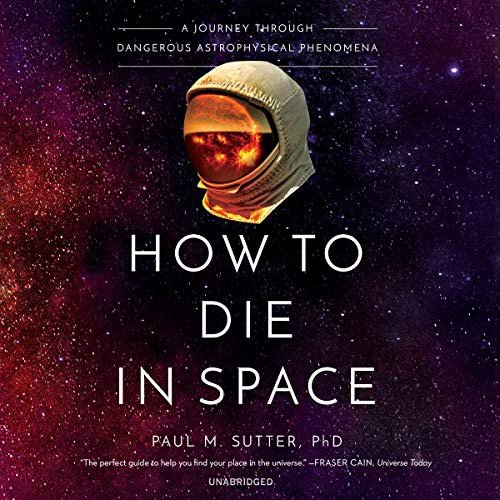
TL;DR
8/10. An astrophysicist runs through cosmic rays, black holes, supernovae, magnetars, gamma ray bursts, and vacuum decay, organized by how each one would kill you. The framing is a gimmick and it works, because a hazard is easier to remember than a phenomenon.
Paul Sutter is a working astrophysicist and a practiced communicator, and the conceit is a guidebook written for a traveler planning a trip through the universe. Each chapter takes an object or process, explains the physics, and then explains what it would do to you.
The range runs from the mundane, meaning radiation and micrometeoroids, up to vacuum decay. That would rewrite the laws of physics at light speed and give no warning at all.
I had more fun with this book than with most popular science I’ve read. Sutter clearly enjoys scaring you, and the grim framing turns what could have been a dry catalogue into something closer to a thriller. My one reservation is that a gimmick is still a gimmick, and I wanted it to step aside now and then so the physics could breathe.
What does How to Die in Space cover?
The near hazards come first. Micrometeoroids are small and moving fast enough that mass stops mattering. Cosmic rays are single particles carrying the energy of a thrown baseball, and they pass through shielding and through you. Then come solar events, and the general problem that space is a vacuum and a human is a pressure vessel. That last line is my favorite description of an astronaut anywhere.
Then the stellar objects. Red giants, supernovae and the distance at which one becomes lethal, neutron stars and the tidal forces near them, magnetars with magnetic fields strong enough to disrupt the chemistry of your body from a distance measured in thousands of kilometers.
Then the exotic. Black holes and what happens as you approach one, which is less cinematic and more interesting than the films suggest. Gamma ray bursts, the most energetic events since the Big Bang, would sterilize a planet from across the galaxy if aimed correctly. Few sentences in popular science have made me feel smaller.
And finally the theoretical, including cosmic strings, wormholes, and vacuum decay.
Why does the framing work?
Because it forces specificity. A book about magnetars can stay abstract. It can say the fields are strong and move on. A book about what a magnetar’s field would do to the iron in your blood at a stated distance has to give you numbers, and the numbers make the scale land.
I wish more science writers were forced into this kind of specificity. Vague awe is cheap, and a number attached to your own blood chemistry is anything but.
It also solves the ordering problem that afflicts popular astrophysics. Most such books are organized by size, or distance, or chronology, and the reader ends up on a tour with no reason to care about the sequence. Organising by threat puts things next to each other that wouldn’t normally share a chapter, and the comparisons are where the interest is. And a hazard is memorable in a way a phenomenon isn’t. I retained more from this book than from several more thorough ones, because each item came attached to a consequence.
What is vacuum decay?
The chapter worth the book, and the one I’ve used since.
The theory is that the vacuum of space may not be in its lowest possible energy state. If it’s in a metastable state, a false vacuum, then somewhere it could transition to the true one, and that transition would propagate outward as a bubble expanding at the speed of light.
Inside the bubble the constants of physics are different. Atoms as we know them don’t hold together. There’s no warning, because the bubble travels at the speed of light and so arrives at the same time with any signal announcing it. There’s no defense and no possibility of one.
It may already have started somewhere. We wouldn’t know. That line scares me more than most horror fiction does. Sutter delivers it flatly, and the flatness is what makes it effective. For a fiction writer this is a gift and almost nobody uses it. A genuine physical possibility with no warning, no defense, and no survivors is a rare combination, and the entire drama has to happen before the event because there’s no after.
Is How to Die in Space useful for science fiction?
It’s the best reference I know for anything set outside the solar system.
The failure modes are specific. The distances at which each hazard becomes lethal are given. The survivable and the unsurvivable are clearly separated, and Sutter is honest about which numbers are well established and which are estimates on the edge of current theory.
That last distinction is the valuable one. A novelist writing hard science fiction needs to know what’s dangerous and also how confident the field is, because the confident material constrains your plot and the uncertain material is where you have room. Most science fiction gets space wrong in the same direction, treating it as an ocean with weather. This book will cure that. Few things irritate me more in science fiction than ships banking through vacuum like fighter planes. Writers who want to be taken seriously have no excuse for that once a book this readable exists.
Verdict
Popular astrophysics that respects the reader, with a conceit that carries real content instead of replacing it.
Read it for pleasure, and keep it if you write anything set outside the solar system, because the specificity is what most science fiction is missing and this book supplies it in usable form.
The conceit occasionally crowds the content it carries, and that keeps the book just short of the top of my list. Everything else about it deserves a permanent spot beside the desk of anyone writing hard science fiction.
Explore further
The Writing Hub: craft, technique, and the books worth learning from.