
A pastor who’s preached every Sunday for twenty years has produced more words than most novelists ever will. Nearly all of those sermons were recorded, and somebody in the congregation has asked, at one point or another, when the book is coming. Unfortunately, the sermons stay on a hard drive in the church office, the book never comes, and the pastor feels guilty about it every January.
I understand why. A sermon that moved a room on Sunday reads flat when you print the transcript. Hand a volunteer a year of messages to type up over the summer, and nobody gets past page ten of the result. The pastor decides the book was a bad idea, a book that deserved to exist dies in a binder, and it was avoidable.
Think of a sermon as a live concert. You play it for a room full of people you know, you read the crowd, you stretch the chorus when they’re singing along and cut a verse when they’re restless. A book is the studio album. Somebody you’ll never meet puts it on alone in a parked car, with no crowd and no stage lights, and every track has to hold up on the fifth listen. A ghostwriter takes the songs that worked live and records them so they work in that car.
Can a ghostwriter turn my sermons into a book?
Yes, and your sermon archive is one of the richest starting points a ghostwriter can get. The recordings hold your ideas, your illustrations, your voice and years of testing what reaches people. What they don’t hold is a book’s structure, because a year of sermons follows the church calendar and the needs of the moment, and a reader needs one argument built chapter by chapter.
The work starts with the archive. Your ghostwriter listens to or reads a large batch of sermons and pulls out the three or four ideas you return to most. I use AI every day as a digital assistant for transcripts, summaries and first-pass outlines, and it saves a lot of hours on any large archive of recordings. I write the book myself; the AI finds pages, and I decide which story made your congregation go silent.
Interviews come next, and there are a lot of them. A sermon leaves out everything the room already knew: who you are, how you came to believe what you believe, what happened in the church the year you preached that series. Someone reading alone needs all of it. I build books from interviews because writing in someone’s voice means becoming them for a while, and I record every session and say so in the contract.
My article on turning speeches, podcasts or videos into a book covers the same conversion for other spoken material.
Why don’t sermons read well as a book?
They were built for the ear. A sermon depends on repetition, rhythm, pauses, call and response, a joke about the parking lot, and a room that reacts. On paper the repetition reads as padding, the local jokes mean nothing, and the moment the whole room laughed is gone.
Back to the concert. On stage you can see the crowd drifting and pull them back with a song they know. A studio album gets no second chance with a listener who’s already reached for the skip button, so every track has to keep that listener, in order. Your ghostwriter’s job is to cut the repetition that worked out loud, keep the illustrations that hold the idea up, and add the context a reader needs, all while keeping the cadence your congregation would recognize.
Your voice is the part I care about most in a pastor’s book. If your people read it and don’t hear you, the writer failed, and I’d take that failure personally. Hand a finished chapter to someone who’s sat in your pews for a decade. If they stop halfway down the first page and say it sounds like you preaching, the voice is right.
Do I need a Christian ghostwriter for a devotional?
You need a ghostwriter who respects your faith, learns your tradition’s language and writes what you believe. Whether they share your denomination is your call to make. A Baptist, a Catholic and a Pentecostal use different words for overlapping ideas, and a writer from another corner of your own faith can get those words wrong as easily as an outsider.
Once I’m under contract, I write what the client wants. I’ve written books whose views I completely disagree with. A ghostwriter’s own beliefs, whatever they are, stay out of your book, and a writer who can’t manage that shouldn’t take the job. My article on whether your ghostwriter will respect your opinions goes further into it.
The worst thing a ghostwriter can do to a faith book is slip their own theology into it. A phrase here, an emphasis there, and your congregation reads something you’d never say from the pulpit. That is unforgivable, because the pastor’s name is on the cover and the writer walks away clean. Ask every candidate how they’ll keep that from happening, and expect a real answer.
Devotionals are their own form. Each entry runs about the same length, opens with a passage, builds a short reflection around one idea, and ends with something the reader can carry into the day, a prayer or a question or a small practice. The collection needs an arc too, across 30 days, 40 days, 52 weeks or a full year. A devotional is closer to a daily column than a book, and holding the same length and tone for a year of entries takes discipline.
How do I quote the Bible in a published book?
Follow the permission rules of the translation you quote. Modern translations are copyrighted, and each publisher posts its own terms. Crossway’s permissions page, for example, allows up to 500 ESV verses without a formal license, as long as they don’t amount to half of any book of the Bible or a quarter or more of your work, and it requires a copyright notice worded its way.
Pick one primary translation for the book and note any others where you use them. Keep a running list of every verse quoted, because a devotional quotes scripture every day and the count climbs fast. Your editor or publisher will check the notices, and it’s far easier to hand them a clean list than to reconstruct one.
Can a ghostwriter help me write my testimony?
Yes. A testimony is a memoir with a turning point, and ghostwriters write memoirs all the time. The process is the same as any life story: long interviews, recorded, with the ghostwriter asking about the same events several ways to get at what happened, since everyone misremembers and inflates or shrinks what mattered.
The worst thing a ghostwriter can do to a faith book is slip their own theology into it.
Testimonies stand or fall on the before. Readers need to believe the low point to believe the change. I deliberately probe for failures and setbacks in every book, and a testimony with a sanitized past reads like a tract. Memoir clients drift toward one of two extremes, and in a testimony those look like the hopeless sinner or the saint who was never really lost. I talk people toward the middle, where a reader can see themselves.
Addiction stories come up in my work all the time, and so do divorce and bad marriages. People start out hurt and wanting to settle scores, and I talk them down and coach a balanced rewording. That version is kinder, and it’s legally safer. My article on writing an addiction and recovery story with a ghostwriter covers that ground in detail.
Your family is in your testimony whether they like it or not, and some of them won’t like it. Ask them before the interviews start. I’ve pulled an entire chapter from a coaching book because one family asked not to appear in it.
Clients cry in interviews all the time, and I tell the embarrassed ones the emotion is part of the book. When a story is too painful to tell in one sitting, we come at it over several sessions, and I offer to leave it out. The choice stays with you.
Is it dishonest for a pastor to use a ghostwriter?
No, if the ideas, the convictions and the stories are yours. A ghostwriter helps you say what you already believe, in your voice, to people who weren’t in the room. The sermons behind the book were yours, and so is the life behind the testimony. Nobody calls a pastor dishonest for preaching from a commentary or a concordance. Why would a writer be any different?
Whether to tell your congregation, your board or your publisher that you worked with a ghostwriter is entirely your call. Some pastors mention it in the acknowledgments, and others leave it out. Either choice is honest. My article on whether using a ghostwriter is cheating takes up the broader question.
Does the church or the pastor own a book written from sermons?
Whoever holds it in a signed agreement, so write that agreement before anyone starts. If the church pays for the book, the church and the pastor need to agree in writing who owns it and who keeps the royalties, and what happens if the pastor moves on. Have a lawyer read that agreement before anyone signs.
I’ve written several company-paid books, mostly for small companies owned by the person who hired me, so ownership never came up. A church isn’t owned by its pastor. Picture a pastor who leaves for another pulpit and finds out the board thinks the book belongs to the congregation, and you can see why the paper has to exist first. Who owns a company-paid ghostwritten book if you leave covers the same problem in a business setting, and the lessons carry straight over.
How much does it cost to have a ghostwriter turn sermons into a book?
It depends on how long the book runs, how much usable material the archive holds, how many interviews it takes, and how fast you need it. I price by the word, with an “up to” word count in the contract, so length drives my price directly, and a longer book means a change order. Other ghostwriters quote per project, per page or by the hour, and some set minimums because interviews and research don’t shrink as fast as the word count does.
Rush books carry a higher rate and a larger down payment, and a church has its own hard dates: an anniversary, a building dedication, a conference where you’re speaking. Tell your ghostwriter about the date on the first call. What a ghostwriter costs and what moves the price breaks the factors down, and my current rates are on the ghostwriting service page.
Ask who’s paying before you ask what it costs. A pastor paying personally, a church board voting on a budget line and a donor who wants to fund the book each need their own agreement about who owns the result. How would you explain to the congregation, five years from now, where the book money went and who kept the rights?
My take
Settle who owns the book before anyone talks about sermons. A pastor paying personally, a church board and a donor each need their own agreement, and the congregation will ask later. Sermons give you the ideas and the stories, but they have to be rebuilt for someone reading alone. Pick a writer who respects your faith and writes what you believe. Check the permission rules of the Bible translation you quote, and tell the writer your hard date on the first call.
How do I start turning my sermons into a book?
Pick the series that got the strongest response, the one people still bring up years later, and gather every recording and note from it. Write one paragraph on who the book is for: your congregation, new believers, other pastors, someone in crisis who’s never been inside a church. That paragraph decides what stays and what goes.
Be realistic about money. I warn every client up front that sales of the book are very unlikely to cover what they paid for it. The return comes from what the book opens up: speaking invitations, retreats and conferences, a teaching series, a gift to every new member, a ministry that reaches past your own building. The vanity outfits that sell pastors publishing packages with promises of reaching millions, then leave the church with a garage full of boxes paid for out of the offering plate, are a racket.
Then talk to a ghostwriter on a real call. My ghostwriting service takes the book from the archive to a finished manuscript. The Book Discovery Intensive is a shorter first engagement for working out which sermons belong in the book. If you’d rather write it yourself with guidance, book coaching does that, and the Ghostwriting Hub answers the rest.
Twenty years of live sets deserve a studio recording. Someday a woman you’ll never meet will sit in a parked car at the worst point of her year, open your book to the chapter you preached one ordinary Sunday, and hear you as clearly as the front row ever did.
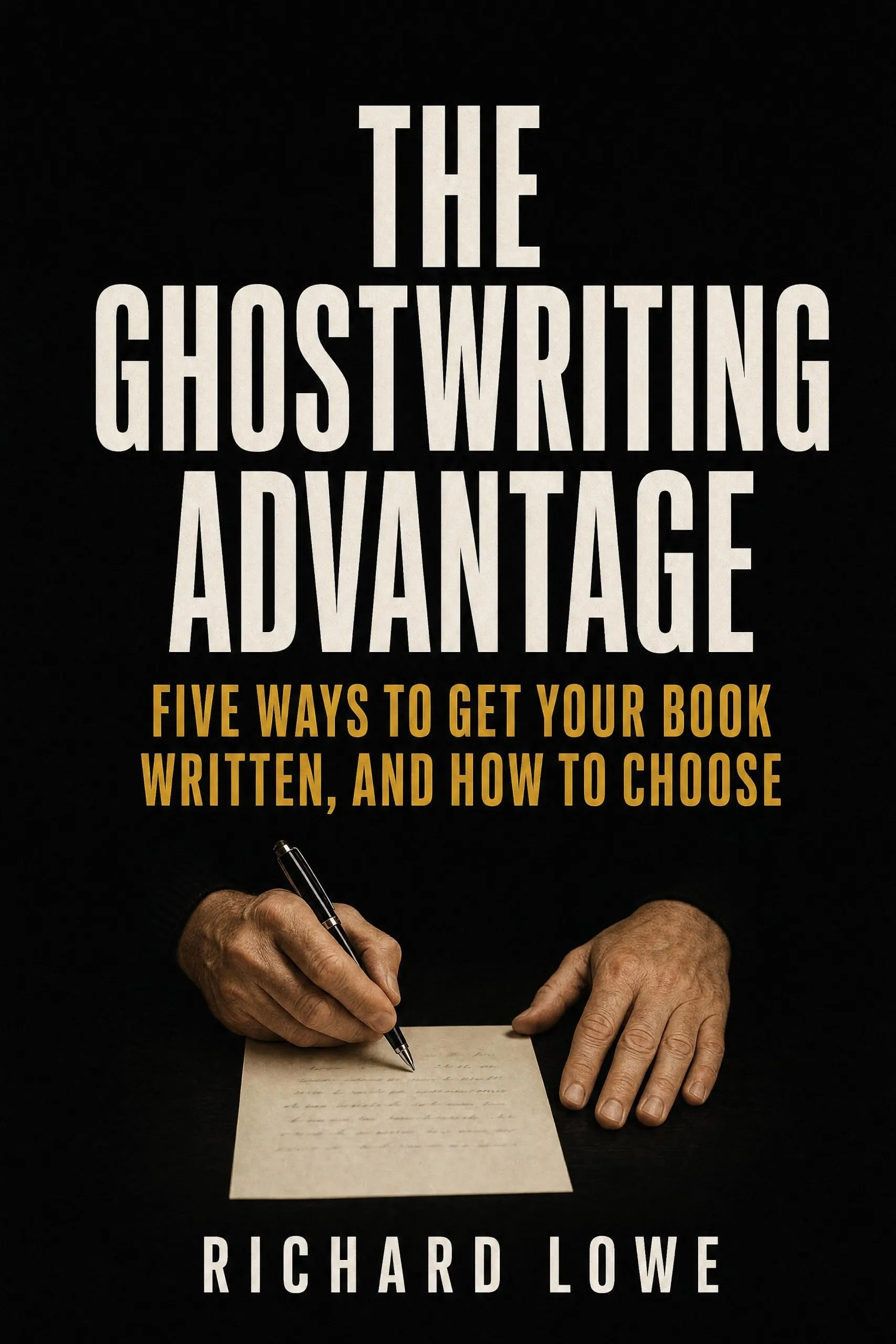
Sermons hold the ideas, and a ghostwriter turns them into chapters. The Ghostwriting Advantage explains how to get your book written for you, from a devotional to a testimony.
