
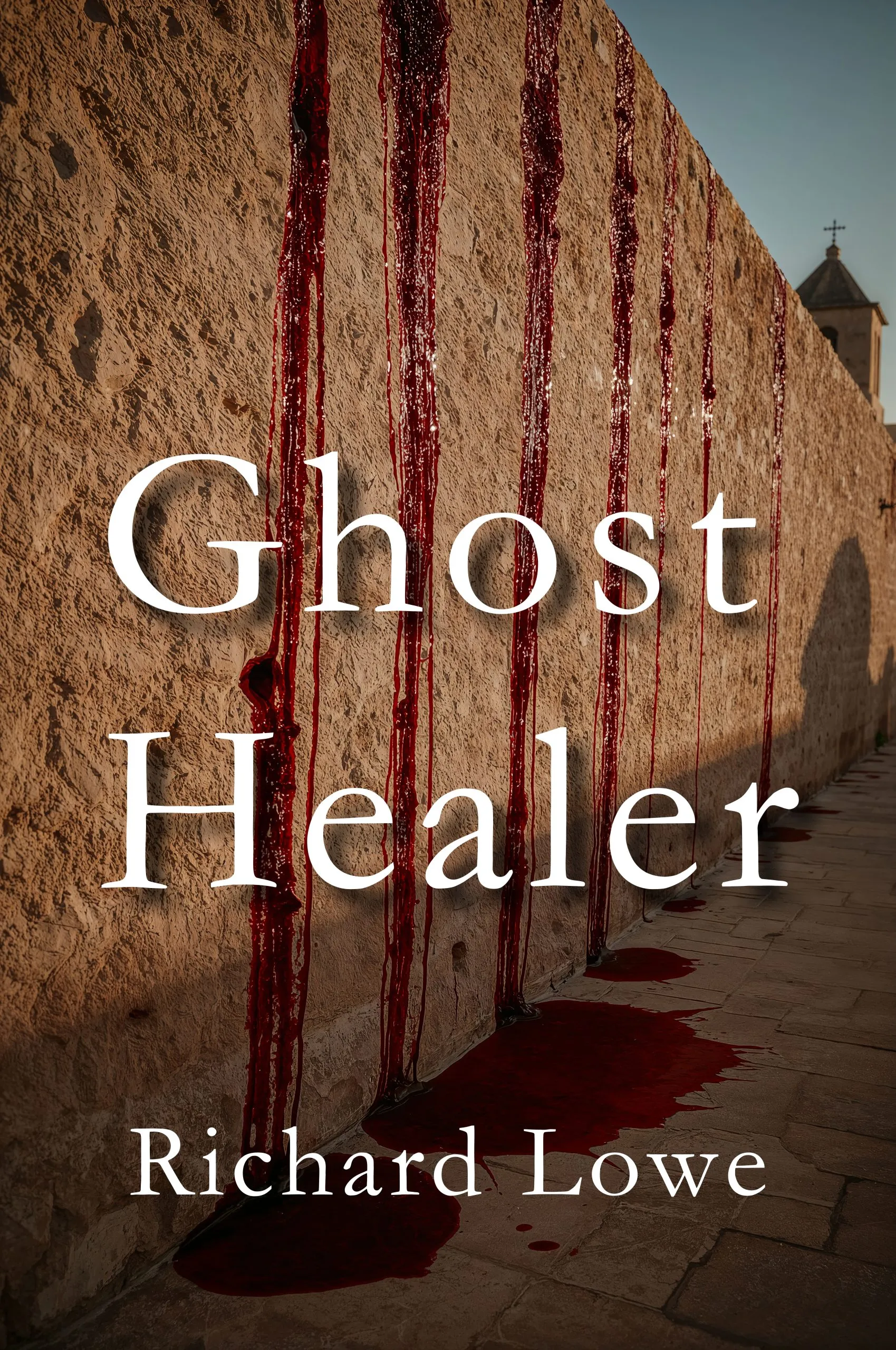
Ghost Healer
He doesn’t think of himself as a ghost hunter. He corrects errors.
 |
Every haunting is organized around one thing the dead believe about the world that’s not true Standalone · 258 pages · First person, Cal Rourke BUY FROM INGRAMSPARKAMAZONKOBOREAD A CHAPTERTABLE OF CONTENTS Paperback ISBN 978-1-972810-45-3 · ebook ISBN 978-1-972810-46-0 |
| 258Pages | 140Years one ghost held on | 1Error per haunting | 1Therapist who disagrees |
He had been wrong for a hundred and forty years.
Cal Rourke, from the novel
Cal Rourke doesn’t chase ghosts and doesn’t rattle chains at them. He finds the false belief that’s holding a presence in a room, a belief about the external world and never about the person themselves, and he corrects it. Then the room is empty and stays empty.
Destiny MacGee is a therapist in Savannah who doesn’t believe in any of this and won’t pretend she does. She’s curious about Cal, which is a different thing, and her questions are harder than the hauntings because they’re about him.
For readers of Kevin Wilson’s Nothing to See Here and Paul Tremblay.
How does Ghost Healer open?
Prologue, and The Mission
The concrete floor of the warehouse was cold against my cheek.
I had been lying on it for what felt like a long time. My right side had two broken ribs. Something in my lower back reported a problem I didn’t yet have the clarity to classify. The ceiling above me was high and industrial, the structural members exposed, a skylight at the center that had been painted over long ago. No light came through it. The building smelled of printer’s ink so strongly I could taste it on the back of my tongue.
I tried to get up.
Something hit me back down. Not a hand. Not anything I could point to or describe to the paramedics who would eventually find me.
Something that worked through me, not on me, that knew where to press to produce the most damage and pressed there with the deliberation of something that had been thinking about this for a long time.
The second rib went.
I went back to the floor.
I pressed my palm flat against the concrete and breathed in the short careful way broken ribs require and looked at the ceiling.
I was in an empty warehouse in Charleston, South Carolina. I was thirty years old. I’d driven here on a Tuesday morning and I’d come through the loading dock door and now I was on the floor and I wasn’t going to get up the way I usually got up.
The pain in my lower back worsened. My left ear rang in the way it had been ringing for a year, the sound I’d given up expecting to leave. My vision went gray at the edges.
Through the gray I was aware that the gap between a functional Cal Rourke and whatever was on the other side of losing consciousness was narrowing in a direction that was going to resolve against me.
I had one thought before the gray took it.
The cylinder. Augusta. Six feet to the left of where it should be.
That was the ninth month of the third year.
This is how it started.
* * *
I was twenty-six years old and taking a semester off from college and I’d driven down from Los Angeles on a Tuesday morning because I remembered hating this place on a high school field trip and wanted to see if I still did. That was the reason I gave myself.
The actual reason was harder to look at: the high school trip was one of the last things I did before my parents separated, and the mission had become tangled up in my memory with the period just before everything changed, and I wanted to stand in the place again and feel whatever I felt.
I paid my admission and walked into the complex. Mud brick walls, worn stone pathways, the ruins of a stone church that an earthquake had knocked down in 1812 and nobody had bothered to rebuild. The stone in the walls was old in the way that only certain stone is old, not weathered, not worn smooth, but settled. The mortar between the bricks had gone soft in places and been repointed and gone soft again. The pathways were worn into slight channels by the accumulated footsteps of everyone who had ever walked this route, the stone dished out in the middle where most feet had fallen.
I read every sign. I’d never been able to walk past a sign without reading it. The one about the swallows. The one about the bells. The one about the founding priests that someone had recently improved with a marker pen.
Around eleven o’clock I started feeling wrong.
Not sick. I’d eaten that morning and my heart rate was normal. Not dizzy in the way that means you need to sit down and drink water.
This was something else, a pressure behind my eyes that wasn’t quite a headache and a sound in my ears at a frequency I could feel more than hear, like being near a piece of machinery that was running at a tone just below audible.
I stopped walking and stood still for a minute, taking stock. Nothing hurt. I wasn’t nauseous.
The air in front of me was doing something it had no business doing.
It shimmered. Not the heat shimmer you get over hot asphalt on a summer day, the kind that resolves into ordinary air if you wait for it. October in Southern California wasn’t warm enough for that and the stone pathways of a Spanish mission weren’t the right surface for it.
This was something else, a slight distortion in the air about ten feet ahead of me, like looking through glass with imperfections in it, glass that warps what’s on the other side in a way that’s not random but consistent. The shimmer didn’t move with the air or the light.
It just stayed there, a fixed wrongness in an ordinary afternoon.
The hair on my arms stood up.
A smell had been building for a few minutes without my registering it. Sweet on top, like flowers, but underneath the sweetness something coppery, and underneath the copper something that had been sitting in a warm enclosed space for too long, the smell of organic matter past its moment. Sweet bait and rot in the wrong proportions. I looked around for the source. Stone path. Old walls. A tree. Nothing that should smell like that.
The chapter keeps going.
Who should read Ghost Healer?
|
Read it if
|
Not for you if
|
► Behind the Book: Ghost Healer
How this one got written, what went wrong, and what got cut.
How did Ghost Healer come about?
Richard Lowe, the Writing King
I visited Mission San Juan Capistrano on a junior high field trip. I remember almost nothing about the day except the quality of the air inside the walls and the sense that the stones had absorbed something over two centuries that hadn’t finished being absorbed. I was twelve or thirteen and had no language for it. I tipped my hat to the dead and kept walking.
Years later I worked near the Huntington Library in San Marino and walked the grounds at lunch. There’s a plaque between two of the gardens for William Hertrich, the head gardener who shaped the place. Every time I passed it I had the impression he was still there, sitting, watching. I tipped my hat to him too.
The novel started with those two impressions and the question they share: what keeps somebody in a place after they have every reason to leave it. I don’t know the answer. Cal Rourke thinks he does, and the difference between his certainty and my uncertainty is what the book is about.
What do people ask about Ghost Healer?
Also in What the Dead Leave
|
An evaluator with a scroll, and forty thousand years of human death |
A memoir, told by the cat who was paying the most attention |
He corrects errors
Somebody was going to ask him about his own eventually.
BUY FROM INGRAMSPARKAMAZONKOBOREAD A CHAPTERTABLE OF CONTENTS
Paperback and ebook.
Room 11
Ghost Healer
“What changed after Capistrano?” Destiny asked.
“The way a room feels when I walk in,” I said.
“Describe it.”
I tried. I talked for about two minutes, using words like weight and pressure and texture, none of which were quite right. She wrote down what I said and then read it back to me with the particular flatness she brought to everything she read back.
“That’s not quite right,” I said.
“Keep trying,” she said.
Three months after Capistrano I was in New Mexico on a Tuesday evening. I’d driven through fourteen states by then and had covered somewhere in the neighborhood of eleven thousand miles and had no plan worth describing.
What I’d done was drive, and stop when I felt like stopping, and move on when I felt like moving on. I was looking for something and I couldn’t describe what it was. I wasn’t sure I’d know it when I found it.
The three months had a rhythm to them that I hadn’t anticipated when I loaded the Tahoe and drove away from my apartment. I’d expected the absence of routine to feel like freedom. It felt, instead, like a different kind of structure: the structure of motion, of forward progress, of constant arrival.
Whether that was what I was supposed to be doing, I couldn’t tell.
I’d gotten good at reading motels from the road. I could tell from the parking lot whether the coffee would be worth stopping for and I was right about this more often than I had any reason to be.
The cases had been three in those three months. Patrice in New Mexico would be the first. Before her there had been a house in Mississippi that I’d stopped at without planning to stop, drawn off the highway by a quality in the air of the county road that I’d pulled onto by accident and never pulled off.
An old woman who had been wrong about her son for forty years, believing he’d stolen from her, and the son hadn’t stolen from her, he’d borrowed money in a crisis and repaid it and the repayment receipt was in a shoebox in the attic. I’d found the shoebox.
She’d gone. I’d driven away not entirely sure what I’d done or whether I had the right to do it.
Before that, a motel in Tennessee, a different room, a man who had believed he was late for work. He had been late for work. He had been late for work every day for thirty years and he had been organized around the anxiety of that lateness for all thirty of those years and he’d died believing he was late and I’d shown him that the shift had ended and he went.
That one I understood less than the Mississippi case. I didn’t know how to read a success I didn’t understand.
So three cases and eleven thousand miles and the paper maps in the door pocket marked with small pencil dots at the places where I’d stopped for coffee that was worth stopping for.
I stopped at a motel outside Albuquerque because it was getting dark and because the sign said vacancy and because there was a diner attached that, through the window as I pulled in, appeared to have working coffee equipment. The coffee turned out to be better than it had any right to be in a diner attached to a roadside motel, and I ate a sandwich and noted the coffee in the unofficial ledger I kept in my head of places worth remembering, and then I went to check in.
Nobody had sent me here. Nobody had told me anything about this motel or what was in it. I had no prior read.
I was just stopping because it was late and the coffee had been good.
The woman at the front desk gave me Room 12 without looking up from whatever she read. Room 12 was on the ground floor in the middle of the row, and I carried my bag down the outdoor walkway toward it.
The walkway outside Room 11 was wrong.
I didn’t yet have good language for this. Something in the air felt different from the walkway on either side of it. Colder, by a few degrees, though I wasn’t sure if I was measuring that accurately or just feeling something that my mind was translating as cold. There was a smell, cheap floral perfume underneath something else I couldn’t name. I stood there for longer than made sense and couldn’t decide what I was doing.
Table of contents
Ghost Healer
- Prologue
- The Mission
- Room 11
- The Print Shop
- Bad Weeks
- Walterboro
- The Lemon Soap
- Why Destiny
- The Temporal Anomaly
- Did Any of It Matter
- They
- The Clock
- The East Line
- The Surveys
- Charleston
- After
- The Closed Door
- Frank Delacroix
- The Knob
- June
- Roy
- Wednesday
- The Appointment Book
- The Kitchen
- The Cylinder
- Roy’s Room
- Thursday