
Buttercup
A memoir, told by the cat who was paying the most attention
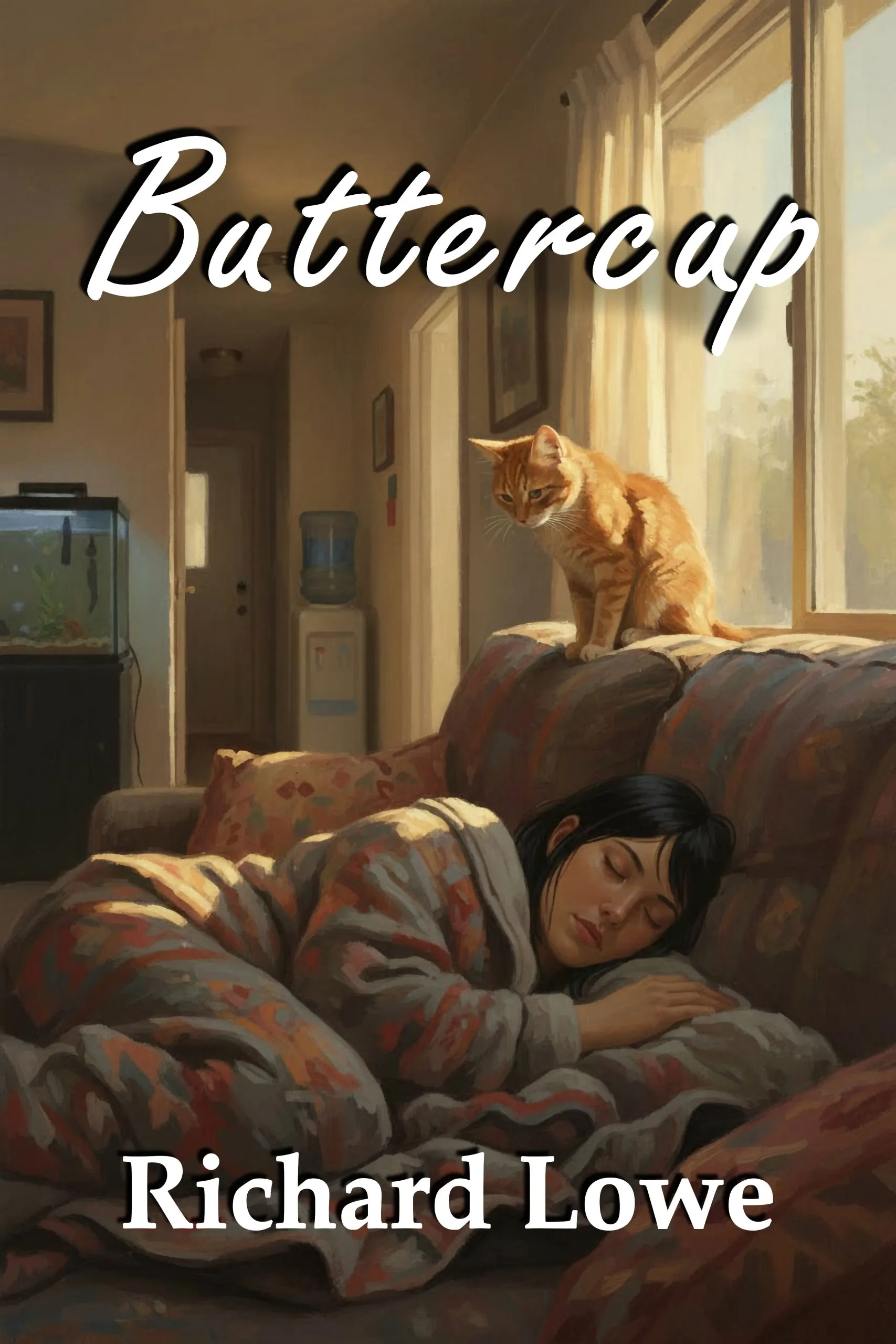 |
Claudia died on January 31, 2005. Buttercup died two weeks later. Standalone memoir · 160 pages · Narrated by the cat BUY FROM INGRAMSPARKAMAZONKOBOREAD A CHAPTERTABLE OF CONTENTS Paperback ISBN 978-1-972810-20-0 · ebook ISBN 978-1-972810-21-7 |
| 160Pages | 2Weeks between the deaths | 1Sack in the river | 10Years in that apartment |
The weight would settle, not disappear but settle, find its place, stop being the thing at the front.
Buttercup, from the memoir
Somebody pulled her out of a river at two weeks old. She had been thrown in a sack with her littermates and he was the one walking the bank when she washed up. He gave her CPR. She bit him. Then she let him carry her to the shelter, where she climbed the wire and made Richard stop walking past her cage.
What follows is ten years in a Los Angeles apartment, told by her: the emergencies, the ordinary evenings, the long bad months, and the good days when Claudia cooked something complicated and talked to her while she did it. The vet said kidney failure. He also said cats can die of grief.
How does Buttercup open?
The Sack
I died once.
I was pulled out of a river, laid on mud, and a stranger pressed my chest until the water came out and the air came back in.
I vomited. I coughed.
Something that had stopped started again.
This is how it happened.
🐾
Warmth first. Her smell, milk and something deeper, something that went into me before I had words for going or for in. The press of small bodies against mine, their heartbeats distinct and close: four of them, five, each rhythm slightly different, all of us breathing together in and out in and out without knowing we were doing it.
I hadn’t opened my eyes. I had no reason to. The world was smell and warmth and the low sound she made, the sound that meant: keep breathing, I’m here, keep breathing. Her breath moved across my face warm and milk-sweet. The whole universe was exactly the size it needed to be and I was at the center of it.
She licked us. One at a time. The rasp of her tongue, the pressure of it, the warmth spreading where she touched. I felt myself become more solid under it. More real. Each pass of her tongue saying: you’re here, you’re here, you’re mine and you’re here.
I didn’t know what happiness was. I’d only been alive for days. But I was in it.
🐾
Then her breathing changed.
One beat different. A held quality entered it, a listening I could feel through the vibration of her chest against mine. The warmth of her shifted: not gone, just changed underneath, a new smell rising through the milk smell. Sharp. Wrong.
Something.
I didn’t have the word afraid. I had the smell of it flooding into me through her, and my body responding to hers before I understood anything.
Footsteps outside. Wrong weight. Wrong speed. Not the footsteps that came with food and warmth and the gentle hands that sometimes counted us and smelled like soap. These smelled like nothing warm at all.
She made a sound I’d never heard from her. Low and urgent, vibrating from her chest through the floor through my paws through my whole small body. She pressed herself between us and whatever was coming.
A hand, not careful, not slow. It grabbed without asking. I heard her fighting, the sounds of it, and then her sounds got smaller and smaller and then there was nothing where her sounds had been.
Nothing where her smell was. Nothing where her warmth was.
Find her. Get back to her. Find her.
🐾
Dark. Fabric closed around us, rough against my skin. Her smell still on me but already fading, the cold taking it. The others pressing in from every direction. All of us breathing too fast. The smell of our fear rising inside the sack, six small bodies terrified together, that smell filling every breath until there was room for nothing else.
The world lurched.
Not swinging yet. Moving. A different kind of motion: continuous, low, a vibration rising through whatever we rested on and into our bones. A sound started beneath us, a deep mechanical rumble unlike anything I’d ever felt, going into my chest and staying there. And a smell flooded in through the fabric, sharp and wrong and nothing alive in it, nothing I had any name for. The rumble changed pitch. We were moving.
The others pressed into me. I pressed into them. The smell of our fear kept rising.
One of them started crying. Thin and desperate and continuous, and then another joined it and then another, all of us crying for her, crying for the warmth, crying because the rumble and the motion and the sharp wrong smell and the dark were all too much and there was nothing else to do with any of it.
The blow came without warning.
Something hit the outside of the sack: hard, enormous, the impact slamming through the fabric and through all of us at once. I felt it in my ribs. In my teeth. The crying stopped. All of us stunned into silence.
Then a voice from outside. Not low and patient like the voice that would come later. Sharp and annoyed. Short sounds that meant nothing to me except their tone, and the tone said: be quiet, stop, I don’t care about your noise.
We tried to hold it.
But the crying started again (not all of us, just one and then two) the terror too large to fit inside our bodies. And the blow came again. Harder. The sack swung from the impact and all of us tumbled into each other, claws and fur and the warm smell of urine sudden and sharp among us.
Silence.
This time we held it.
The rumble went on. In the dark we pressed together and breathed and made no sound, each of us holding our crying inside us as tightly as we could, the warmth of each other the only warmth left in the world.
The motion slowed. Stopped.
🐾
A new sound. Air, open air, a rushing cold through the fabric. Something vast out there. The sharp wrong smell faded and something else came through: green and cold and moving. A smell with no name yet.
Then we were lifted.
My claws went into the fabric. Found nothing. The floor was gone. Whatever we’d rested on was gone. Everything that had ever been solid was simply gone, and there was only the sack swinging, back and forth, and the others pressing into me and away with every swing and none of us making any sound now, just breathing, fast and small and fast and small.
The chapter keeps going.
Who should read Buttercup?
|
Read it if
|
Not for you if
|
► Behind the Book: Buttercup
How this one got written, what went wrong, and what got cut.
How did Buttercup come about?
Richard Lowe, the Writing King
Claudia died on January 31, 2005. Buttercup died two weeks later. The vet told me she died of grief. I didn’t know cats could do that. I do now.
This book is theirs, not mine, though I’m in it. I chose Buttercup as the narrator because she saw everything. She was there for the emergencies and the ordinary evenings and the long bad months and the good days when Claudia cooked something complicated and talked to her while she did it. She tracked things I didn’t notice I was doing.
If you want to know what those years were like in the rooms where we lived, instead of what I thought about them afterward, Buttercup is the honest witness. She’d spent ten years calibrated to Claudia. When Claudia was gone she didn’t know how to recalibrate.
What do people ask about Buttercup?
Also in What the Dead Leave
|
An evaluator with a scroll, and forty thousand years of human death |
He doesn’t think of himself as a ghost hunter. He corrects errors. |
The vet said cats can die of grief
He hadn’t known that either.
BUY FROM INGRAMSPARKAMAZONKOBOREAD A CHAPTERTABLE OF CONTENTS
Paperback and ebook.
Midnight
Buttercup
I smelled her before I saw her.
A thin smell, tightly held, like something folded in on itself. Not the deep settled presence of Tabby, not the complicated warmth of the room’s years. This smell was small on purpose. An animal that had learned to send as little of itself into the air as possible.
I tracked it to the bedroom.
Is there something under that bed, I thought, or is that just shadow.
The shadow blinked.
Cat.
Her heartbeat, once I found it, was wrong. Too fast, not the fast of something frightened right now, but the fast of something frightened for so long that pitch had become normal. Her whole body running at that pitch, all the time, the way a note held past the point where the breath is gone becomes something else entirely.
She had it in her smell too. Fear old enough to have become just the way she smelled. Something had happened before this apartment and it had never finished happening.
A door closing in another room and she was gone: not moving out of the room, gone, dissolved into whatever space was smallest and least accessible. A voice above normal pitch and I’d watch her disappear into the wall.
I watched her from across the room sometimes, both of us resting, her under a chair and me on top of it. The distance between the top of a chair and underneath it’s not very far. She never once looked up.
She slept pressed against the wall in the furthest corner under the bed. I checked once when the bedroom was empty: cold floorboards back there, dusty, no reason to be there except it was the hardest place to reach. That was the reason. That was the whole reason.
She ate after both of us, when the kitchen was empty. She stood over the bowl with her weight shifted back, ready to leave, eating fast. When the bowl was empty she’d look at it for a moment. I couldn’t read what was in that look. Then she’d go.
She had a spot in the afternoon, a narrow strip of sun on the bedroom windowsill, just wide enough for her to press herself flat into. She approached it carefully every time, checking it from several directions before she lowered herself in.
But once the sun was on her she went still.
The pitch of her (the wrong-fast heartbeat, the tightly held smell) it would ease. Not stop. Ease. Her eyes closed. She pressed her face into the warmth.
Just a cat in a window.
Just that, for a little while.
I never went near her on those afternoons. The sun was hers. The stillness was hers. The only gift I’d for her was to leave her to it.
She and I weren’t companions in those early weeks. We were two animals sharing space, maintaining distance, extending each other the particular courtesy of pretending not to notice. I understood, without being told, that this was the highest kindness available in her language.
But I watched her.
The way she moved, always close to walls. The way she ate, already leaving. The way she found the smallest possible space and pressed herself into it as if she could make herself smaller still, could get small enough that nothing would be able to find her.
Something had done this to her. Something before this apartment, before these humans, before whatever safety existed here. Something that had gotten all the way in and stayed.
The humans moved slowly around her. Voices low. No sudden sounds if they could help it. When they were gentle (really gentle, the slow deliberate kind) something would happen in her. Not trust. Something smaller than trust. A leaning. An almost.
I knew the almost. I’d felt it myself in the shelter, watching the door, needing to climb the wire and not quite being able to make myself do it yet.
The almost is the worst feeling.
But she wasn’t gone. Something in her was still reaching, still finding the sun in the afternoon and pressing her face into it. Still here, even if she took up as little space as possible.
I didn’t know yet what I’d come to know about her.
Table of contents
Buttercup
- The Sack
- The Humane Society
- The Car Ride Home
- First Night
- The Mirror
- Tabby
- Midnight
- Earning Her Place
- The First Winter
- The Lap
- The Tiny Office
- Claudia
- The Adrenaline
- The Wound
- Midnight’s Secret
- The Carrier
- The Fish Tank
- Dexter
- The Chinchilla
- The Sickness That Wasn’t
- Hades Arrives
- Living With the Enemy
- Ordinary Days
- The Bird
- The Attack
- The Christmas Lights
- The Earthquake
- The Outside
- The First Disappearance
- She Comes Back Changed
- The Boarding Place
- The Lung
- Catalina
- Claudia Is Gone
- Griffith Park
- The IV Week
- The Business Meeting
- The Last Room
- Tabby
- Midnight
- Epilogue: The Botanical Garden