
Altverse
Forty-three symbols, and a man who documents buildings for a living
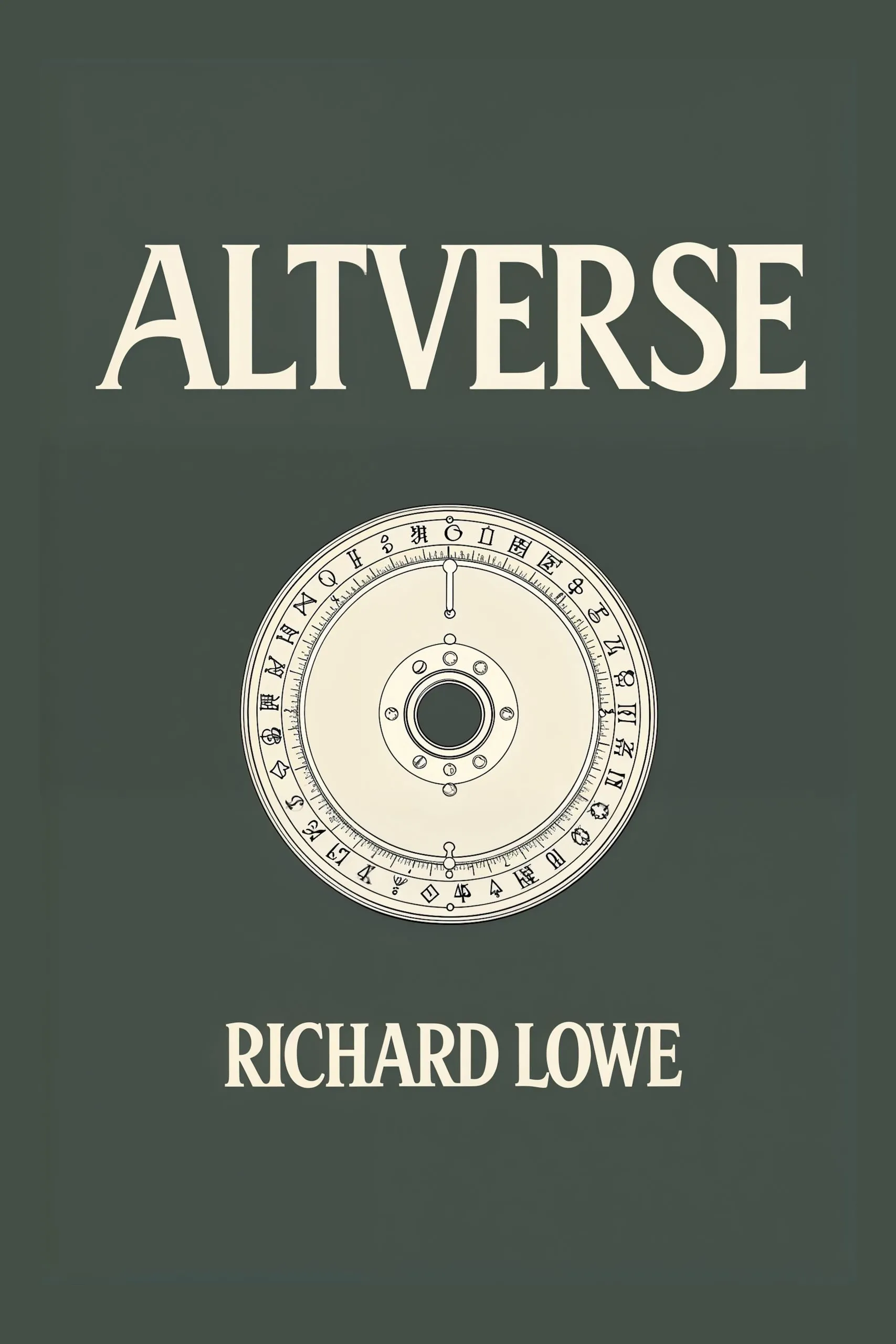 |
The building was coming down on Friday, and the door in the basement that should have been locked wasn’t Standalone · 212 pages · Close third, Ari BUY FROM INGRAMSPARKAMAZONKOBOREAD A CHAPTERTABLE OF CONTENTS Paperback ISBN 978-1-972810-24-8 · ebook ISBN 978-1-972810-25-5 |
| 212Pages | 43Symbols on the ring | 6Weeks on the contract | 1Notebook |
It was the most accurate sentence in the notebook.
from the novel
Ari maps condemned buildings. Six weeks of noting cracks and photographing what’s about to stop existing, and on the last week of the contract there’s a maintenance corridor behind a door that should have been locked, and a device about the size of a large hardcover book.
It’s forty-three symbols on its ring and each one opens somewhere else. A city lit from inside its own buildings, where a woman named Meren is fighting a council that’s already decided her district’s failing grid doesn’t matter. A desert that answers when you make a sound in it. Ari does what Ari always does, which is take notes, and the notebook is the reason any of it can be argued about later.
Loosely built on Piers Anthony’s Omnivore, Orn, and OX, the Of Man and Manta books.
How does Altverse open?
The Basement
The building came down on Friday. Ari had known this for six weeks. That was how long the mapping contract had run, and had spent those six weeks noting the crack propagation in the load-bearing walls, the foundation drift, the slow lean of the east wing toward the neighboring parking structure. The east wing had been leaning for years. It was still leaning when they decided to stop it.
The basement had a section behind a door that should have been locked and wasn’t, a maintenance corridor that hadn’t been properly maintained since the building’s construction.
The room beyond the unlocked door wasn’t interesting. There was a junction box. A shelf held cleaning supplies dried into their containers sometime in the late nineties. There was a drain that hadn’t seen water since longer than that. Ari cataloged it in the notebook and took three photographs and was nearly done when the other thing became visible.
It was in the corner, on the floor, the way objects sit when they’ve been somewhere long enough to stop being noticed. It wasn’t hidden. There was no reason to hide it because there was no reason to look. Someone with a cleaning assignment had been coming into this room for decades and seeing it and not noting it.
The projector was about the size of a large hardcover book. The material wasn’t quite metal, held like metal but weighed less than it should, and it kept the light differently, as though the light made a decision about it. Around its middle was a ring. The ring had symbols cut into it, forty-three of them, each distinct, the work of something sharper than a standard engraving tool and considerably more patient.
Ari picked it up.
The habit of it: the thing is going to be demolished with the building on Friday and it’s the kind of thing that should exist in a record somewhere. The notebook opened to the next blank page. Pen moving: material, dimensions, weight estimate, ring mechanism, symbol count. Forty-three symbols, each one distinct. The ring had the feel of a mechanism meant to turn. There was a small indentation in the body that suggested an indexing point, a symbol positioned to align with it.
Ari turned the ring.
The hallway revised its opinion about perspective.
It was neither quickly nor violently. The tiles on the floor changed their mind about where the far wall was over two or three seconds, the vanishing point shifting sideways, and a door appeared in the wall that hadn’t been there. The dead fluorescent strip above the junction room came on, but it wasn’t fluorescent light anymore, something cooler and more deliberate, the color of something that had decided to be a light.
The air around the door’s edges smelled of rain. It wasn’t rain happening. Rain remembered.
Ari stood in front of the door and kept writing. The door: dimensions, the material (not glass but translucent, frosted in a way that wasn’t sanded or acid-etched), the gap of cold air at its lower edge, the smell. Eleven seconds of writing and then the door was pushed.
Beyond it was outside.
The ground was asphalt but darker than city asphalt, the darkness compositional, not dirty. The air was the rain-smell larger and everywhere with no rain. The light was afternoon but slightly wrong, the shadows too green, a saturation that was biological, not atmospheric, as though the light had been filtered through something living before arriving. Across the street: buildings, recognizable as buildings, and in one upper window a light made a slow circuit of the room. It wasn’t carried. It wasn’t projected. Moving the way something alive moved, leaving a faint trail before it faded. Blue-green. Warm.
There were no people in immediate view. Sounds from further away. Voices. A low ambient hum that might have been a city’s infrastructure noise or might have been something else.
Ari stood in the doorway for eleven seconds. The notebook was in hand. Nothing was written in those eleven seconds.
Back through the door. The ring turned back. The hallway was a hallway.
* * *
Ari sat on the floor of the northeast maintenance corridor with the projector in hand and looked at the door that was no longer a door.
The fluorescent strip above was steady. It had been flickering for six weeks and it was steady now and slightly too bright. The notebook was open to the page with the building description and the page was blank except for the mark where the pen had started and stopped. The cleaning supplies on the shelf were dried out in their containers. The junction box made its small electrical sound. These things were facts about the room and Ari noted them as facts about the room.
The thermos was in the bag. Ari took it out and drank cold coffee and the cold coffee was fine.
The projector sat on the floor.
Something had changed in the room and it wasn’t the projector or the fluorescent strip or the cold coffee. Ari couldn’t locate what it was. The notebook was open and the page was blank and writing felt like a thing that happened to other tasks, not this one, not right now.
The building came down tomorrow. The junction box made its sound. The pen was in hand and wasn’t moving.
This lasted about forty minutes, the not-writing, the sitting on the floor of the maintenance corridor with facts arriving as facts and nothing else. At some point the fluorescent strip began flickering again.
Ari put the projector in the bag and left the building.
The chapter keeps going.
Who should read Altverse?
|
Read it if
|
Not for you if
|
► Behind the Book: Altverse
How this one got written, what went wrong, and what got cut.
How did Altverse come about?
Richard Lowe, the Writing King
This one was a concept I wrote for the hell of it. Alternate universes have interested me for as long as I’ve been reading, and I wanted a set of them built properly instead of used as scenery.
It’s loosely based on Piers Anthony’s Omnivore, Orn, and OX, the Of Man and Manta books, where each volume runs on a different structural idea and leaves the reader to work out the rules.
Ari is a mapper, somebody whose whole profession is documenting a place carefully before it stops existing. No chosen one and no prophecy. A notebook, a camera, and forty-three symbols copied as accurately as one man can copy them.
What do people ask about Altverse?
Also in Doors to Elsewhere
|
The Woman Who Walked Through Walls Whatever happens on the other side doesn’t follow you back |
Two hundred rooms, twenty categories of treasure, and one deserter |
Forty-three symbols on the ring
Nobody left documentation, so Ari wrote some.
BUY FROM INGRAMSPARKAMAZONKOBOREAD A CHAPTERTABLE OF CONTENTS
Paperback and ebook.
The Choir Desert
Altverse
The seventh symbol opened to desert.
Or not desert exactly. Desert light: the specific brightness of open sky with nothing between the sun and the ground. The ground was pale rock and sand in the proportions of a place that had always been this and hadn’t found it lacking. But the air moved. Continuously, not as wind, more as breath, and within that breath there was structure. Frequencies. Not music, not organized into anything with rhythm, but discrete tones moving through the air, some sustained and some shifting, some arriving from distances that were hard to estimate because sound here worked differently, carried differently.
The door behind was still there. Ari stood twenty meters from it.
The flat hour had started in the kitchen, as it always did, the warmth of the projector cooling in the hand, the kitchen wall reasserting itself. The desert was information. The tones in the air were information. The pale rock under the boots was information. Ari took out the notebook and began writing.
Date. Time by the phone, which read the time it had read when the kitchen wall was a kitchen wall. Light conditions: harsh, direct, no cloud cover. The temperature was significantly warmer than home. Air movement: continuous, low-velocity, structured. The sound profile appeared below in the notes.
The sound profile below took four pages.
Some of the frequencies were geological, the low sustained tones that came from the south and might have been the rock itself, the vibration of something ancient and large and not concerned with observation. Some were clearly human, voices from a settlement over a ridge visible from the crossing point, a kilometer away, maybe more. Some were in between, frequencies that had the quality of instrument without the quality of instrument-playing, not generated by hands but not geological either.
Ari walked toward the settlement.
The sound grew as the distance closed. More voices came as the distance closed. The back-and-forth cadence of commerce, which had a recognizable shape even when the words didn’t. There was a market. But organized differently from Greenlight City’s market. Here the organization was acoustic. The voices weren’t directing people to goods. The voices were the transaction.
A man stepped into the path.
It wasn’t aggressive. He stepped into it the way a person stepped into a path when they’d decided to be stepped into. Deliberately and without threat. Fifty, perhaps, weathered in the way the desert weathered things, not damaged but refined. Clothing layered and functional. An instrument at his belt that Ari didn’t immediately identify. The instrument had strings but wasn’t shaped like any stringed instrument Ari knew. It was small enough to be held in one hand and the strings were arranged in a pattern that wasn’t for playing in the standard sense.
“You’re making a sound I don’t know,” he said.
His voice had something under the words. A second frequency, a resonance that accompanied the speaking, not an accent but a layer. Ari hadn’t been paying attention to the ambient sound for the past ten minutes, moving through the settlement’s edge in writing mode, pen moving, head down, and the notebook had twelve pages of description and zero awareness of being heard.
“I don’t mean to,” Ari said.
The man’s secondary frequency shifted, went lower. “You’re not from the desert.”
“No.”
“Where from?”
“Somewhere without this.” Ari indicated the air, the tones.
He checked the notebook. “What are you writing?”
“What I hear. What I see.”
“You can’t record sound in that.”
“I’m recording that it exists and how it works.” Ari looked at the market, the voices moving through it. “What does it do?”
He was quiet for a moment. The desert breathed around them.
“Sound here’s true,” he said. “A lie at full voice in an enclosed space can break bones. A small lie in the open disperses. But it registers. The harmonics go wrong. Anyone nearby will hear it.”
Ari wrote this.
“So the market operates on true statement.”
“The currency is authenticated sound. Statements witnessed and verified. You can’t pass a false note because it sounds false. Most people here can hear the difference. There are listeners in the market whose function is catching false notes.”
“What happens to someone caught?”
“Depends on the note.” He looked at the market. “Small falsity, public correction. Large falsity.” He made a sound below speech, a frequency that settled in the chest. “The desert has ways.”
Table of contents
Altverse
- The Basement
- Greenlight City
- The Report
- The Choir Desert
- The Council Chamber
- Three Patterns
- The Inverted Garden
- The Memory Market
- The Committee
- What Was Taken
- The Stone Record
- Venn
- Thirty-Eight Percent
- The Lying Sky
- Correspondent
- Ysel
- The Truth
- The Gravity Pockets
- Fifty-One Percent
- The Water City
- The Bleed World
- The Hearing
- Tuesday
- Three Days
- The Return
- The Frequency in the Air
- Six Months