
Dungeon
Two hundred rooms, twenty categories of treasure, and one deserter
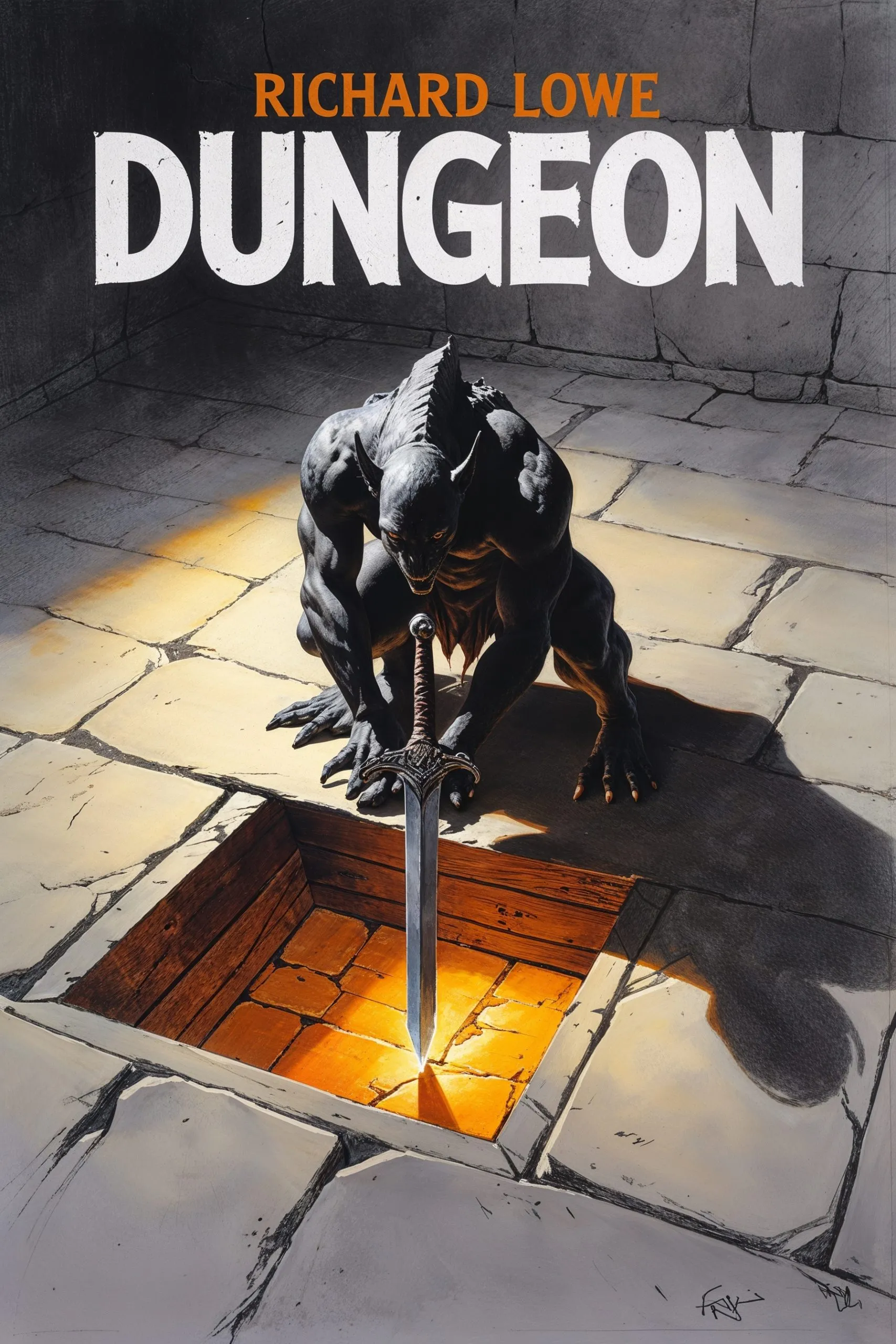 |
A deserter with one option left walks east into a hole under a white house at the edge of a forest Standalone · 210 pages · Close third, Corvin BUY FROM INGRAMSPARKAMAZONKOBOREAD A CHAPTERTABLE OF CONTENTS Paperback ISBN 978-1-946458-90-2 · ebook ISBN 978-1-946458-91-9 |
| 210Pages | 200Rooms | 220Objects | 20Categories of treasure |
He put down his provisions, buckled his sword belt, and went east into the dungeon.
from the novel
Corvin Cray gave ten years to the Imperial Legion and refused one order, and now his name is on a warrant. East of Miren, north off the main road, there’s a house with a maintained mailbox and a leaflet inside explaining everything. Beneath the house is a dungeon with treasure enough to make a man invisible.
He goes in careful. Lamp, rope, provisions, a map he draws as he goes. The dungeon contains a troll, a thief, a cyclops, at least one grue, and a locked trophy case waiting on twenty categories of treasure. It was never designed with the survival of the person inside it as a priority.
If you played Zork or its FORTRAN ancestor, this is that dungeon, walked by a man who has to survive it.
How does Dungeon open?
Six Months Before
The order came down at dusk on the fourteenth day of the siege, which was the fourteenth day Corvin had been standing in the same field outside Halvenmark watching the same fires on the same ridge while the Legion’s engineers worked on the same problem they’d been working on since the second day. The problem was the town. The town was full of people who had come there because the Legion had told them to come there, which was a detail that had become inconvenient to the officers managing the siege.
The order was passed by a sergeant whose name Corvin didn’t know.
Read it. Sign here.
Move on.
He read it. He didn’t sign. He stood in the field with the paper in his hand for a moment that lasted longer than a moment, and then he folded it and put it in his coat and walked north.
It took the Legion six hours to notice he was gone.
He knew this because he’d covered roughly eighteen miles by the time the first rider came through, which was fast enough that they’d sent the rider before they’d properly decided what to pursue him for. Desertion was the correct charge but it required documentation he doubted they’d had time to file. By morning it would be filed.
By afternoon copies would be moving to every garrison and posting station within two days’ ride.
He’d twelve silver pennies, the clothes he stood in, the Legion sword he’d drawn ten years ago and carried since, and the specific problem of a man who has done an irreversible thing and hasn’t yet worked out the implications.
He worked them out over the following weeks.
The first implication was money. Twelve pennies lasted eight days if he was careful, four days if he wasn’t. He was careful.
He found work: two days clearing a field outside a town whose name he didn’t learn, three days helping a carter whose horse had gone lame between towns. The carter had questions about where Corvin was coming from and where he was going. Corvin said east and kept working and the carter let it go.
People who moved carts across difficult roads in difficult seasons had a practical interest in not asking about the men who appeared to help them.
The second implication was the warrant. He saw the first copy in a town called Oriel, tacked to a post outside the garrison, and stood in front of it long enough to read it carefully. Height, build, the scar on his left forearm, the way he carried his shoulders from ten years of pack weight.
No likeness. The reward was modest. Not worth the serious manhunt, only the distributed inconvenience of his description on every post between here and the sea.
He took the notice off the post and walked away and spent the rest of that day rearranging how he held his shoulders.
The third implication, which took longer to arrive, was where he was going.
He’d been going east because east was away from Halvenmark and away from the garrison at Miren where most of the Legion’s administrative functions ran. East meant forest eventually, and forest meant reduced road traffic, and reduced road traffic meant reduced likelihood of meeting anyone with a financial interest in reading warrant notices carefully. This was sound reasoning for two weeks.
After two weeks it was just movement without destination, which he recognized as a different problem.
He spent three days in a town he didn’t learn the name of, working at an inn, and thought about the problem. He was a ten-year infantryman with skills that were useful in contexts he could no longer safely enter. He could survive in the field, which had turned out to be useful, but surviving in the field indefinitely without a destination was a way of postponing a problem, not solving it.
He needed somewhere warrants didn’t reach.
The man in the tavern was drunk enough to be telling the story badly and sober enough to know he told it badly. That made him the best kind of source. A man who was drunk enough to believe his own story told it smoothly. This man kept losing his thread and backing up and changing details and apologizing for the details he’d changed, working from something real and trying to fit it into the shape of a story worth telling.
The shape was this: a house at the edge of the eastern forest, abandoned, with a dungeon beneath it, and in the dungeon treasure enough to make a man comfortable for the rest of his life. The man hadn’t been into the dungeon himself. He knew someone who had.
The someone had come back with a coin. Here the man produced it: gold, worn, the face on it belonging to no dynasty Corvin recognized. And a story about a trophy case and twenty categories of treasure and a leaflet that explained the whole thing.
Corvin looked at the coin. He looked at the man. He thought about the qualities of a place that had been written up in a leaflet and apparently maintained a mailbox and a trophy case and a set of structured categories for its contents.
“Where,” he said.
The man told him. The directions were imprecise, heard from someone who’d heard them from someone else, but precise enough. Three days east of Miren, north off the main road, look for the house at the clearing’s edge.
He put two pennies on the table.
“That’s all you’re giving me?” the man said.
“You didn’t go in,” Corvin said. He picked up his pack and went east.
The chapter keeps going.
Who should read Dungeon?
|
Read it if
|
Not for you if
|
► Behind the Book: Dungeon
How this one got written, what went wrong, and what got cut.
How did Dungeon come about?
Richard Lowe, the Writing King
The dungeon was written in MDL at MIT’s Laboratory for Computer Science in 1977 by Tim Anderson, Marc Blank, Bruce Daniels, and Dave Lebling, then translated into FORTRAN IV by a DEC engineer who preferred to stay anonymous. I worked from that translation, version 2.2A, dated 18 January 1979.
It contains two hundred rooms, nine hundred exits, two hundred and twenty objects, and twenty categories of treasure waiting on a locked trophy case in the living room of a white house. It’s a troll, a thief, a cyclops, several ghosts, at least one grue, a volcano gnome, a robot, a singing canary, and a great deal of darkness. It was never designed with the adventurer’s survival as a primary objective.
Two characters are mine. Spot, a pewter-gray reptile of indeterminate species, because a man alone down there for three weeks needs something to not talk to. Troi, a seamstress from Miren who got in by accident a month earlier, because the original design has nobody in it worth finishing for.
What do people ask about Dungeon?
Also in Doors to Elsewhere
|
Forty-three symbols, and a man who documents buildings for a living |
The Woman Who Walked Through Walls Whatever happens on the other side doesn’t follow you back |
It was never designed for your survival
Two hundred rooms, nine hundred exits, and a great deal of darkness.
BUY FROM INGRAMSPARKAMAZONKOBOREAD A CHAPTERTABLE OF CONTENTS
Paperback and ebook.
The Cyclops
Dungeon
The smell reached him before the entrance. Old meat, the thick sweet-rot of large quantities of animal matter in decomposition, large predator’s den. And underneath it: glandular, acrid, the smell of a large animal awake and aware.
He stopped on the slope. Spot pressed against his left leg.
He stood and listened. Breathing from below, large, slow, intervals too irregular for sleep. A large thing sitting still, not especially concerned, aware of what the passage brought.
He went down and stood in the entrance.
The chamber was large enough to accommodate what was in it, which implied that whoever built this section had known what would be living in it. The cyclops was against the far wall, knees drawn up, back against the stone. Not troll-large, the troll was scaled up without adjustment, too dense.
The cyclops was the same proportions at a different setting. Its hands were the hands of something that built and carried. Its single eye, tracking him from the moment he entered, wasn’t dull.
The club across its knees was larger than anything he could usefully engage with. He noted this first.
He thought about what he had: sword, axe, boot knife, the FROBOZZ potion, and the string of hot peppers from the kitchen, intense enough that handling them had left his fingers burning for an hour. He’d heard somewhere that hot peppers and water produced a specific result in cyclopes. He looked at the peppers and at the complete absence of any water source in the room and noted it: requires additional components.
He thought about what he knew: the troll had been force and geometry. This wasn’t the troll. This was evaluation, something thinking about his position because it thought.
He couldn’t remember if the name was the cyclops’s name or the name of the man who’d originally dealt with the problem. He thought about this for the three seconds he could spare.
“Ulysses,” he said.
The cyclops stood up. The speed with which something its size went from sitting to standing was its own kind of information. Then it stopped.
Standing at full height, head near the ceiling, club in hand but not raised.
He didn’t move.
It went to the east wall and crouched, put its hand on a section of stone indistinguishable from the surrounding wall, and pushed. The stone slid on a mechanism, revealing a passage sized for him, not for the cyclops. Then the cyclops went back to the far wall and sat down and put the club across its knees and looked at the middle distance.
He looked at the passage. He looked at the cyclops. He went through without running, at his normal pace, hands visible, attention forward.
Spot was in the corridor on the other side, looking back past him at the passage he’d just exited.
“It worked,” he said.
In an alcove cut into the east wall at knee height, sized to its contents, a chalice. Silver, engraving worn smooth where a hand would hold it. Hunting scene or battle, the figures reduced by wear to gesture.
He stood in the corridor with it and thought about the cyclops and the alcove and the relationship between a guardian and the thing it guarded, and then put it in his pack.
Spot looked at him.
“Don’t.”
He went east. Spot fell in at his left heel and they went on in the usual formation.
He thought about the cyclops for the rest of that day. Not the resolution, that had been luck compounded by partial knowledge compounded by what he was unwilling to call luck a second time. About the eye.
The intelligence in it, tracking him from the moment he entered, evaluating. Not hungry. Not territorial.
Something that knew the name Ulysses and responded to it with neither aggression nor indifference.
That night he wrote the name in his notebook, and the date, and nothing else.
Table of contents
Dungeon
- Six Months Before
- West of House
- The Gallery
- The Studio and the Mine
- The River
- The Bat
- The Forest
- The Maze
- The Carousel and the Well
- The Pool Room
- Flood Control Dam Number Three
- The Glacier
- The Machine Room
- Aragain Falls
- The Bank of Zork
- The Tea Room
- The Pool Room
- The Riddle and the Grail
- The Spirits
- The Thief
- The Cave
- The Cyclops
- The Woman
- The Tomb
- The Dome
- The Sand Rooms
- The Guardians
- The Pass
- The Rainbow
- The Barrow
- The Gnome
- The Lower Passages
- The Deep
- The Flood Room
- The Mirror
- The Sealed Room
- The Robot
- The Argument
- The River Again
- The Eastern Rooms
- The Bills
- The Water Rising
- The Last Two
- The Endgame
- The Deposit
- The Figure
- The Morning
- The Flood
- The Leaving
- The Letter
- The Master
- Item Six
- The Selection