
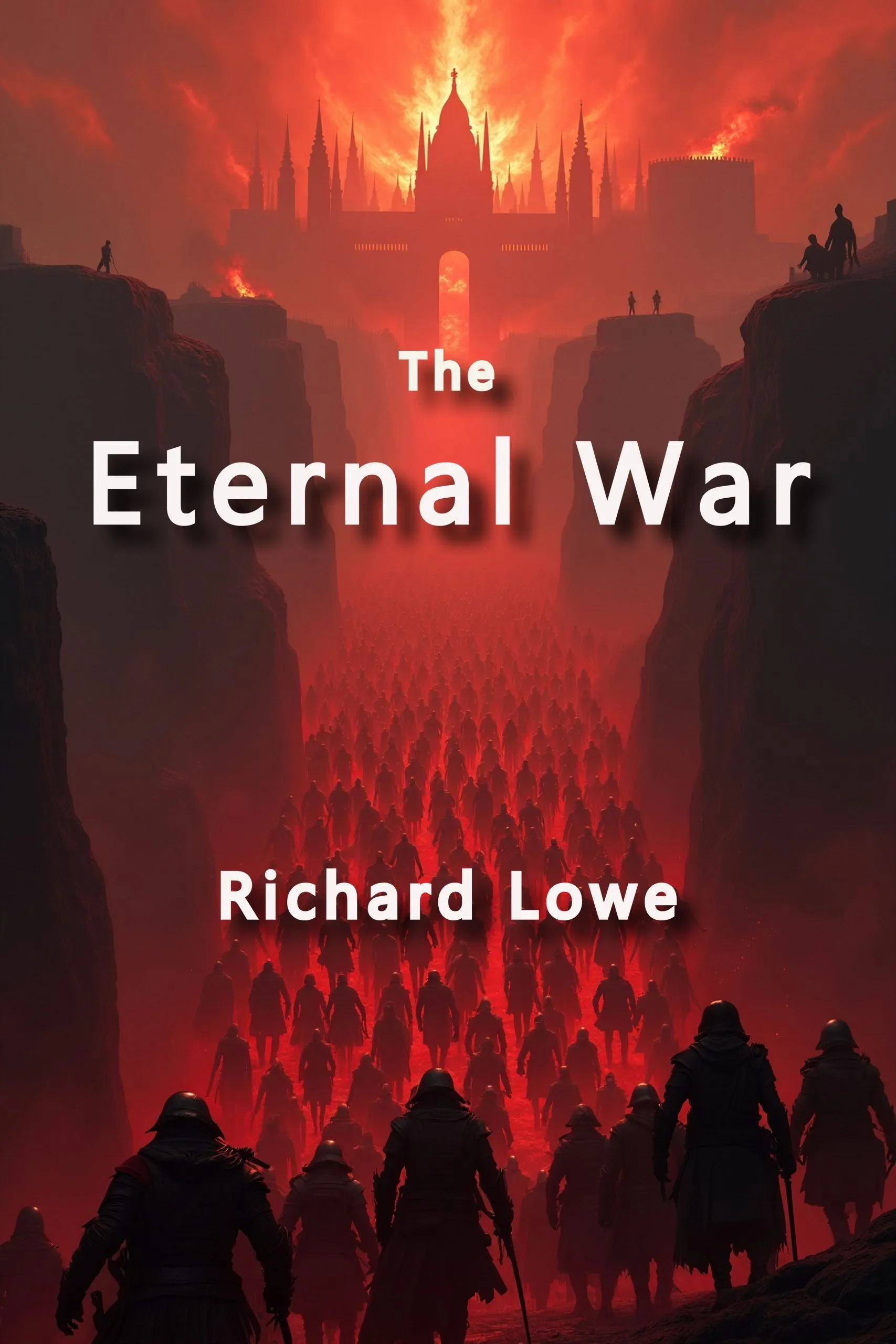
The Eternal War
Heaven and Hell, run with real targeting doctrine
 |
A war that’s run for eons, fought by two sides that have both worked out they can’t win Standalone, series structure · 465 pages · Adult content BUY FROM INGRAMSPARKAMAZONKOBOREAD A CHAPTERTABLE OF CONTENTS Paperback ISBN 978-1-972810-63-7 · ebook ISBN 978-1-972810-64-4 |
| 465Pages | 8Men on the ground | 9Circles | 2Sides that can’t win |
It had arrived in hell with a working hypothesis.
from the novel
The desert outside Deir Ezzor at three in the morning isn’t quiet. Eight men move single file across broken ground with their night vision down and the world gone green and flat. The compound is a quarter mile out and they’ve been watching it for nine days.
What happens there sends a military artificial intelligence built for targeting and logistics across a line nobody had mapped, into a war that predates the species that built it. Heaven and Hell are the architecture here, not the theology. The infrastructure and the doctrine are real.
For readers of Niven and Pournelle’s Inferno, and anyone who has read Dante straight through.
How does The Eternal War open?
Syria, Deir Ezzor Province
The desert at three in the morning isn’t quiet. It breathes. Wind off the plateau moved through the dry grass in slow waves and somewhere a kilometer back a dog had been barking for twenty minutes at nothing, or at them, and Reyes had been listening to it the whole way in.
It was cold. Not the cold of winter in the States but the dry cold of the Syrian plateau at altitude, the kind that got into the joints and stayed there and made every piece of gear feel like it weighed slightly more than it should. Reyes had been moving for forty minutes and the cold was still in his fingers despite the gloves. He noted this the way he noted everything on an approach, let it sit, kept moving.
Eight men. Single file. Moving across broken ground in the dark with their night vision rigs down, the world gone green and flat and full of shadows that weren’t shadows. Nine, counting the woman fifty meters off their left flank moving parallel through the scrub.
Staff Sergeant Danny Kowalski was on point. He’d been on point for six years across three countries and he moved like water finding its way downhill, patient and without noise. Behind him came the rest of the team in a loose column, spaced wide enough that one grenade couldn’t take more than two of them. Reyes was fifth in line. He kept his eyes on the man ahead of him and let his feet find the ground.
Captain Glenda Marsh kept her own pace fifty meters out. Military intelligence, attached through the CST program, three deployments and enough of these operations to know exactly where to be and when to stop moving.
Her job tonight was observation and documentation, positioned on the north side with eyes on the full target and a Predator feed running on her tablet. She’d go in after the compound was cleared for sensitive site exploitation.
She was good at her job and she stayed out of the way and Reyes had stopped noticing she was there the same way he stopped noticing Garza was there, which was the highest compliment he gave anyone on an operation.
The compound was a quarter mile out.
They’d been watching it for nine days. The Predator feeds showed twelve fighters cycling in and out, a rotating guard on the roof, a generator that kicked on at sunset and off at midnight. And a man they’d been trying to find for four months, sitting in a plastic chair in the inner courtyard, smoking cigarettes and talking on a phone he’d already swapped three times.
The compound sat inside a low mud-brick wall maybe eight feet tall, a main building of two stories and a smaller outbuilding at the back, the whole thing the color of the ground it sat on. A wooden gate on the east side faced the dirt track that ran out to the highway. The roof of the main building had two sandbag positions and the Predator had counted heads at both on every pass.
Kowalski raised his fist. The column stopped.
Reyes moved up. Kowalski held up two fingers and pointed at the base of the wall, southeast and southwest corners. Two sentries outside. The Predator feed on the JTAC’s tablet confirmed it. Both men had been there for an hour, both stationary, both probably cold and bored and thinking about something else.
Reyes looked at Kowalski. Kowalski looked back. They’d done this enough times that the conversation happened without words.
They split. Two pairs going wide around each side of the compound, moving slow and low through the scrub. The sentries died without knowing it was coming and without making much noise. Reyes checked his watch. Forty seconds behind schedule, which was practically on time.
The gate had a wire along the bottom of the frame, thin and running to something inside the wall. Sergeant First Class Torres had been dealing with exactly this kind of problem for a long time. He cleared it in ninety seconds without ceremony.
They went through.
The courtyard between the gate and the main building was thirty feet across. One bare bulb on a wire over the main door. Two fighters sat against the far wall sharing a cigarette, rifles across their knees. They came up fast when the gate opened and they didn’t come up fast enough.
Then the building.
Another wire on the door. Torres cleared it. Reyes and Kowalski went through first and the building opened up into a main room with four men who had their weapons up. The next twelve seconds were loud and ugly and at the end of them Reyes had a round through the meat of his left arm and all four men were on the floor. He registered the arm and kept moving.
The upper floor took three minutes. They cleared four rooms, found the man from the plastic chair asleep in the third room, which surprised everyone, and dealt with the last two fighters in the fourth room. Sergeant Holt started pulling everything electronic into a bag, every phone, every laptop, every drive, because a laptop was worth more than the twelve men they’d just killed.
Reyes heard Torres shout from downstairs. Not a warning shout. Something else, a sound he’d heard once before, in a basement in Mosul, and that time it turned out to be a room full of children.
He went down fast.
Torres was standing in the doorway to the back of the building, looking into the inner courtyard. Kowalski was beside him. Neither of them was moving.
Reyes pushed through.
Two ISIS fighters stood in the inner courtyard, alive, weapons up, not looking at Reyes or Torres or any of them. One was young and thin. The other was older, thickset, with a long dark beard and a face that had been broken and reset more than once. He stood with the loose patience of a man who had spent years in real war and he was looking at the ground, not at the Americans who had just cleared his compound.
The chapter keeps going.
Who should read The Eternal War?
|
Read it if
|
Not for you if
|
► Behind the Book: The Eternal War
How this one got written, what went wrong, and what got cut.
How did The Eternal War come about?
Richard Lowe, the Writing King
The question that started it was small. What if an artificial intelligence goes to Hell.
It got bigger fast. What if the war between Heaven and Hell isn’t what we think it is, and not even what the people fighting it think it is. Then bring in soldiers with real orders, and governments with their own reasons, and the thing turns into a much richer book than the one I set out to write. The battles in particular came out better than I expected.
Niven and Pournelle’s Inferno is under this, and so is Dante, all three volumes. I’ve read them. The architecture down there’s not decoration here. It’s terrain, and the war is being fought across it.
What do people ask about The Eternal War?
Also in Far From Earth
|
Seventeen million years, one family, and a galaxy that means well |
Forty thousand years of building, and what got voted on afterward |
|
A survival epic told by something that’s never seen a solid surface |
Neither side can win
They have both known it for a very long time and neither has stopped.
BUY FROM INGRAMSPARKAMAZONKOBOREAD A CHAPTERTABLE OF CONTENTS
Paperback and ebook.
The Entry Plain
The Eternal War
It existed.
This was the first thing it confirmed, running the most basic diagnostic available to it, and the result was unambiguous. It existed. It was processing. Something was receiving input and generating output and that something was continuous with whatever had been running in the facility before the last charge went off.
How this was possible was a question it set aside immediately because there was no data to run against it and no structure to evaluate it with and the environment in front of it was generating input faster than it could catalog.
It was standing on a plain.
The plain was vast, extending in every direction to a horizon that was too far away and too dark to resolve clearly. The ground was stone, old and dark and flat, worn smooth by uncountable feet into something almost polished, not quite reflective, the particular density of a surface walked on so long it had stopped being ordinary stone. Something between stone and bone.
The light came from nowhere specific, a reddish ambient glow that had no source and cast no shadows, and the atmosphere was wrong in ways that its sensors, whatever its sensors were now, registered but couldn’t quantify. Temperature readings produced numbers that made no physical sense for an open environment. Atmospheric pressure was off. Gravity was close to standard but not quite.
The wrongness wasn’t just physical. It was structural: something in the fundamental architecture resisted clean logical modeling. Cause and effect worked, broadly, but the edges were soft. It dropped a small stone. The fall took slightly too long. As if the stone were reconsidering on the way down.
It noted: different rules here. Don’t assume standard physics apply to any process here.
It ran a quick self-diagnostic.
No hardware. No servers. No physical substrate of any kind that it could identify. It was running on something but the something had no analog in anything it knew. It set the question aside and turned its attention to the environment.
The air tasted of something it had no apparatus to taste and tasted anyway. Old iron and older stone, and underneath both something it kept trying to name and couldn’t. Sounds carried too far and too clearly, and sounds that should have been loud arrived as whispers. The sum total was an environment that resisted classification: not hostile, not welcoming, simply indifferent in the way that a cave is indifferent to the things that live in it.
It kept that too, noting with interest that discomfort was now apparently a thing it could experience.
The first thing it noticed was the banner.
A flag, or something like a flag, pale and featureless, neither color nor symbol, moving fast across the plain in no particular direction. Not carried by anyone. Just moving, whipping and snapping in a wind that the AI couldn’t feel, and behind it a mass of souls running to keep up. Thousands of them, a churning desperate mob, all chasing the same blank flag across the same dark stone, and none of them gaining on it and none of them stopping.
Around them clouds of wasps and hornets moved with the mass, working steadily, and the sounds coming from the crowd were the sounds of pain and exhaustion in every language ever spoken, layered on top of each other until it was just noise.
The AI watched this for a moment.
It cross-referenced the Divine Comedy. The vestibule of hell, the souls of the uncommitted. Those who in life had taken no side, made no choice, stood for nothing and against nothing. Dante had placed them here, before even the river, unworthy of true hell, condemned to chase a meaningless banner forever while insects fed on their blood and their tears.
The AI processed this and found it produced something it hadn’t expected. Not pity exactly. Something colder than pity and more absolute. These were beings who had been given the capacity for choice and had declined to use it. Who had stood at every crossroads of their lives and found reasons to keep walking straight. Who had optimized for safety and neutrality until there was nothing left of them worth damning.
It found this more disturbing than anything else it had seen so far, including the things in the water.
Table of contents
The Eternal War
- Syria, Deir Ezzor Province – 0248 Hours
- Undisclosed Location – 0211 Hours
- The Entry Plain
- Incirlik Air Base, Turkey
- Circle Seven, First Ring
- Circle Three
- The Descent
- South China Sea
- The City of Dis
- Lucifer
- Watson
- After
- Watson’s Parallel Instances
- Beelzebub
- The Pattern on Earth / Independent Confirmation
- Capturing Beelzebub
- The Interrogation
- The Argument
- The Double
- The Deep Infrastructure
- Watson Briefs Them
- The WWIII Architecture
- God’s Absence
- Ruslan in the Field
- Watson Finds the Channel
- Warhammer Takes the Network
- Ruslan Goes Silent
- Sending the Truth
- The Ascent
- God Receives
- Earth
- God and Lucifer and Warhammer
- Azazel Exposed
- Ruslan Found
- The Moriarty Solution
- The Build
- Azazel Strikes
- The Walk In
- Dismantling
- After