
The Sphere
Forty thousand years of building, and what got voted on afterward
 |
Earth is dying now, while the man at the podium is still speaking Standalone · 590 pages · Six parts and a prelude BUY FROM INGRAMSPARKAMAZONKOBOREAD A CHAPTERTABLE OF CONTENTS Paperback ISBN 978-1-972810-85-9 · ebook ISBN 978-1-972810-86-6 |
| 590Pages | 40KYears to build | 16MTimes Earth’s surface | 5%Done after a lifetime |
The bones are in the wall of the world and the world is built and the bones are holding part of it up.
from the novel
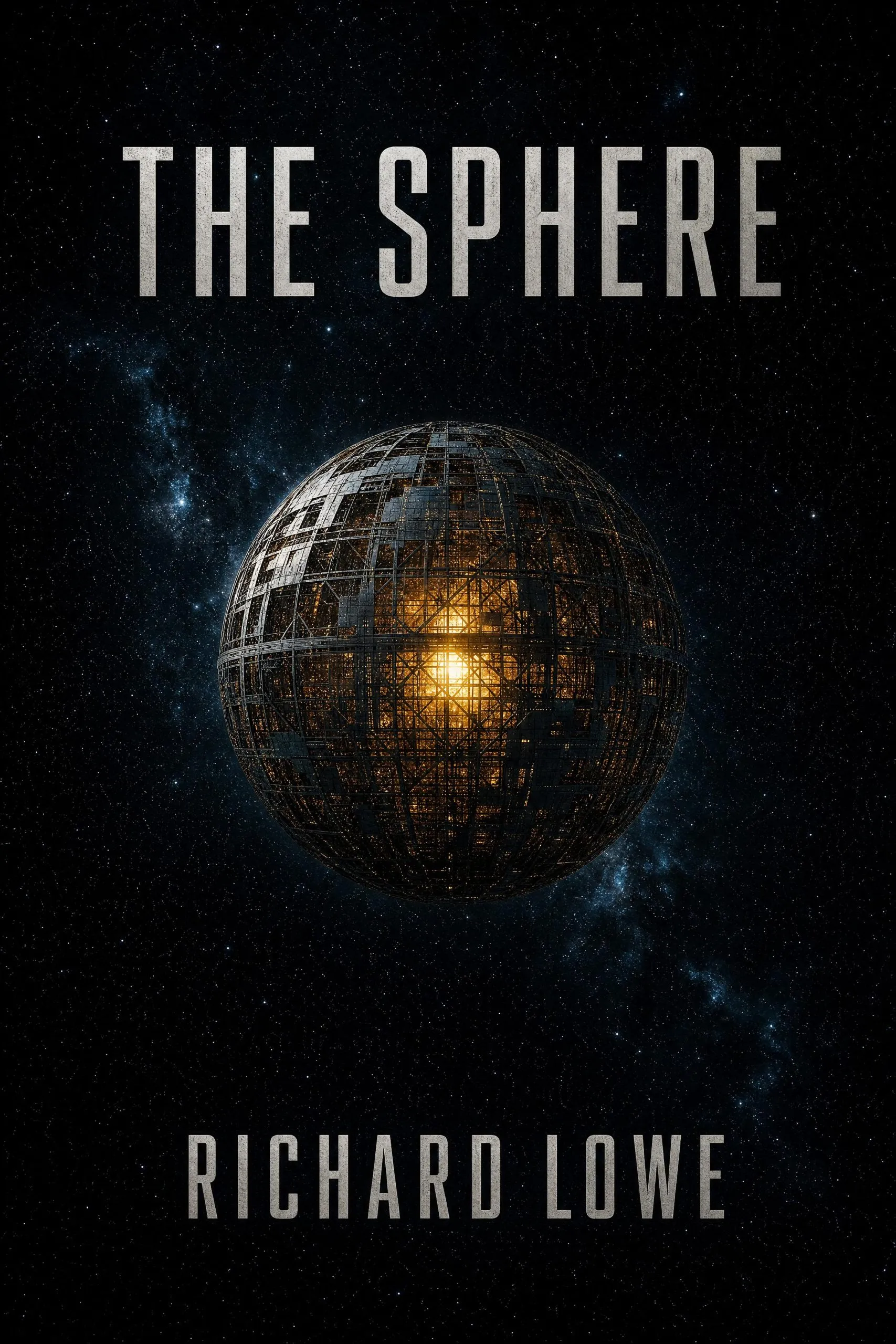
Earth is dying now, while the man at the podium is still speaking. Humanity’s answer is the largest thing any species has built: a shell enclosing the sun, its inhabited surface sixteen million times the area of the world being quarried to make it. Generations are born onto the project, work a lifetime, and die with it at five percent.
Two thousand light years away, an old and careful species points its instruments at the galactic center, sees what’s being assembled, and feels fear for the first time in its recorded history. Orin, born in the eighth year of the surface, tells most of what happens after. There’s no faster than light travel in this book, and every consequence in it comes out of that.
For readers of Larry Niven’s Ringworld and Fred Saberhagen’s Berserker books.
How does The Sphere open?
PRELUDE
The First to Look
On a planet which circled a star some 2,000 light years from Earth, there lived a race of creatures. An extremely old and wise species. They bore no resemblance to humanity.
Their thought patterns were totally different. Their motivations, hopes, and desires would have baffled a human psychologist. Human scientists would have had difficulty determining that they were even living beings, much less intelligent.
One day one member of this species was studying the stars, and happened to align its instruments toward the galactic center. Within a short time it was gasping uncontrollably. For the first time in its life, this creature felt fear.
After it communicated its findings to the government of its planet, the entire species became gripped with that unfamiliar emotion. They were afraid. Something would have to be done, and soon.
Fifty Years Later
On a planet about 1,550 light years from Earth, a young and aggressive species suddenly ceased a millennia-long war of extermination. One of their observation platforms had accidentally oriented upon an object far in the depths of space.
Suddenly, this species felt the cold stab of fear. They quickly settled their disagreements and began working together for the first time in their history.
Seventy-Five Years After That
On another planet, roughly 2,400 light years from Earth, another species turned its eyes toward the heavens. When they examined one particular patch of sky, the entire species recoiled in anger.
Sacrilege, they cried in unison. They must be punished.
A Century Later
On yet another planet, a species observed the strange happenings in the sky with fear and foreboding. They knew something must be done. They didn’t have anywhere near the power necessary to meet the challenge.
Thus, they began searching the skies for allies.
Two Thousand Years On
For the first time in the history of the galaxy, hundreds of different species from thousands of planets worked together toward a common goal. Virtually every space-faring species was represented, and all were determined to see that the conference was successful.
It had taken lifetimes to find them all, and lifetimes more to learn to speak to one another. Once the danger was made clear, every species, without exception, agreed to take part.
The greatest minds in the galaxy cooperated, examined all available data, and came to a decision. This decision changed the course of galactic history forever. Nothing would ever be the same again.
This is being written by a man who has been alive for almost as long as the thing it’s about. I don’t say this to claim authority. I say it so that you know, from the start, who’s putting the words down.
I’m Orin. I was born in the eighth year of the surface, on a settlement that no longer exists in a sector that’s been reorganized four times since. My mother grew the grass that bound the soil that held what came next.
My father came down from a construction platform and learned to work the ground. I was a child when the surface was a child. I’ve lived everything that follows.
What follows isn’t a history. Histories are built by people who weren’t there, working from records made by people who couldn’t see what they were recording. This is something else.
I’ve read the records too. I’ve spent more years inside the archive than most lives last. I’ll tell you what was in the records and what wasn’t in the records and what I was told, late, by people who had carried things they didn’t write down.
I’ll tell you what I did and didn’t do. I won’t pretend to a distance I don’t have.
The thing humanity built was the largest thing any species has ever built, by any measure that means anything. It cost something to build it. It cost more to keep it.
What it cost in the end, the part this book is finally about, is a debt that was paid by other people, in other systems, who had no say in any of it. I’m one of the people who said yes when the bill was presented. I’ve lived long enough to be ashamed of the yes, and long enough to understand why I gave it, and long enough to know that the second understanding doesn’t erase the first.
* * *
Before I tell you what we built, I want to tell you what was already there.
The galaxy, when humanity arrived in it with this kind of ambition, wasn’t empty. It wasn’t young. Civilizations had been rising and arranging themselves and falling and arranging themselves again for longer than our species had been a species.
By the time we understood that we weren’t alone, the others had already developed protocols for being not alone. They’d agreements. They had a coalition, which wasn’t a government but was something they used in the place of one when they had to act in concert.
They had a long memory.
They watched us. They’d watched us for a long time before we knew they were watching, the way one watches a child who has just discovered fire and not yet discovered burning. When we began the construction, they convened.
When the construction continued, they convened again. They were patient. They tried to understand what we were doing.
They concluded eventually that they did understand, and they were correct in that conclusion in most respects but wrong in one, and the one they were wrong about turned out to be the one that mattered.
The chapter keeps going.
Who should read The Sphere?
|
Read it if
|
Not for you if
|
► Behind the Book: The Sphere
How this one got written, what went wrong, and what got cut.
How did The Sphere come about?
Richard Lowe, the Writing King
I read Ringworld in high school and it never left. The sequels did nothing for me. The first one, the sheer nerve of building something that big and then walking around on it, that was the thing. Saberhagen’s Berserkers are under this book too, machines built to end life everywhere that keep going because going is what they were built for.
I don’t borrow anything without arguing with it. A ring is a beautiful idea and an unstable one, so I built a sphere. It holds the star, holds the heat, holds the people, and it doesn’t want to drift off center. I gave it a day and a night, because plants need the dark and a world with the lights on all the time is a warehouse.
Niven said somewhere that they wouldn’t bring the mosquitoes to the Ringworld. I disagreed the second I read it. If you build a world and call it a world, you bring all of it, the things that bite and the things that rot. A complete ecosystem is complete or it’s a garden, and a garden dies the first time something it wasn’t expecting shows up.
What do people ask about The Sphere?
Also in Far From Earth
|
Seventeen million years, one family, and a galaxy that means well |
A survival epic told by something that’s never seen a solid surface |
|
Heaven and Hell, run with real targeting doctrine |
Five percent, after a lifetime
That was the whole career of everyone born into the first eight thousand years.
BUY FROM INGRAMSPARKAMAZONKOBOREAD A CHAPTERTABLE OF CONTENTS
Paperback and ebook.
The Quarry
The Sphere
Read the disassembly logs today. They’re dry. They’re the driest documents in the archive and they’re about the largest thing that was ever done to a world.
I’ve read them many times. I read them again today because I wanted to remember that it was decided by people, in rooms, with numbers, and not by a force of nature. It’s easier to bear if you believe it was a force of nature.
It wasn’t.
[Later: My mother was born on the surface of the Sphere, which was made of the surface of the Earth. That means in the only way that matters she was made of the Earth, the way I am, the way everyone now alive is. We’re all the Earth. We just stopped being it in the shape of a planet and started being it in the shape of a shell.
I don’t know whether that’s a comfort. I’ve decided to treat it as one. It’s the kind of thing a person decides, not discovers.]
It didn’t look violent from a distance. That was the thing the witnesses always said, the few who watched it from the relay platforms instead of from the work. From far enough out it looked like a slow undressing.
The planet turned, and along the terminator where day became night, a line of machines moved across the surface and the surface wasn’t there behind them.
The crust came up in sheets. The lifters were the largest machines humanity had built to that point, and they took the crust in panels a hundred kilometers on a side, and the panels rose without drama, slowly, the way a thing rises when the force lifting it’s enormous and patient and in no hurry. From orbit a panel lifting looked like a page turning.
The mantle beneath it was exposed to the sky for the first time in four and a half billion years and then it too was taken, in its turn, on the schedule, because the schedule had a place for the mantle.
A woman named Tef Ansar ran a lifter line in the third millennium of the disassembly. She’d grown up in a cylinder habitat and had never stood on the Earth, and she ran the machines that were taking it apart, and she didn’t think this was strange because everyone she knew did some version of it. The Earth was the quarry.
The quarry was the job. You didn’t stand in a quarry and grieve the rock.
She told the interviewer, decades later, that there had been one thing. Her line had been working the old equatorial landmass, and the survey had marked a sector for priority lift, and when her crew brought the panel up there had been, on the underside of the crust where no human had ever had reason to look, the fossil bed. A seam of it, kilometers of it, lit suddenly by the work lamps after a hundred million years in the dark.
Bones in stone. Things that had lived here when here was a place to live.
She held the line for four minutes. This wasn’t in the schedule. The schedule didn’t have a place for four minutes.
She held it anyway and looked at the fossil bed through the lifter cameras, the long bones and the curled small ones and the impressions of leaves from forests that had no name because everything that could have named them had also become stone, and then she ran the numbers in her head the way you did and understood that the fossil bed massed about what the schedule needed it to mass, and the schedule didn’t distinguish between a bone and a tonne of carbonate because to the schedule they were the same thing, which they were.
She lifted the panel. The fossil bed went up to the smelters with the rest of it and became, in time, a load-bearing section of inner shell somewhere in a sector that wouldn’t be inhabited for thirty thousand years. There are people alive now who live on it.
They don’t know they live on it. The bones are in the wall of the world and the world is built and the bones are holding part of it up.
Table of contents
The Sphere
- Prelude: The First to Look
- Part One: The War
- Part Two: The Building
- Part Three: The Siege
- Part Four: The Sphere War
- Part Five: The Peace
- Part Six: The Project
- Timeline