
Free book marketing isn’t free. You pay for it in hours.
An infographic that’s been making the rounds lists seven free ways to market a book: author events, collaborating with other authors, blogging and podcasting, guest content and interviews, being your own PR department, email marketing and social media. It’s a good list. Every item on it can sell books.
What the list doesn’t tell you is the price tag. Each of those seven eats a different amount of your time. Each one also gets you a different distance toward a stranger deciding to buy your book. Some take fifteen minutes and do almost nothing. Some take a year and slowly build a career. One of them, the one that works best for me, takes a day and puts the book in somebody’s hands.
I’ve published 113+ books under my own name and ghostwritten 54+ for clients, and I’ve tried most of these at one time or another. This is how they stack up in my own experience.
Do author events sell books?
Yes, and in my experience better than anything else on the list.
The marketing that has sold my own books has always been direct. A table at a live event, selling books in person. A LinkedIn Live session where I talk about the book with people who showed up to hear it. Reaching out to one person at a time and talking with them about it. I’ve never sold huge numbers that way, but it’s been the primary way my books have moved.
Every one of those methods has the same thing in common: a real person, paying attention, with the book or the author right in front of them. That’s the closest marketing ever gets to a sale.
The reason is simple. At a table, a reader can pick up the book, flip through it, ask you a question and buy it on the spot. Nothing stands between the interest and the sale. Online, every one of those steps is a place for the reader to wander off.
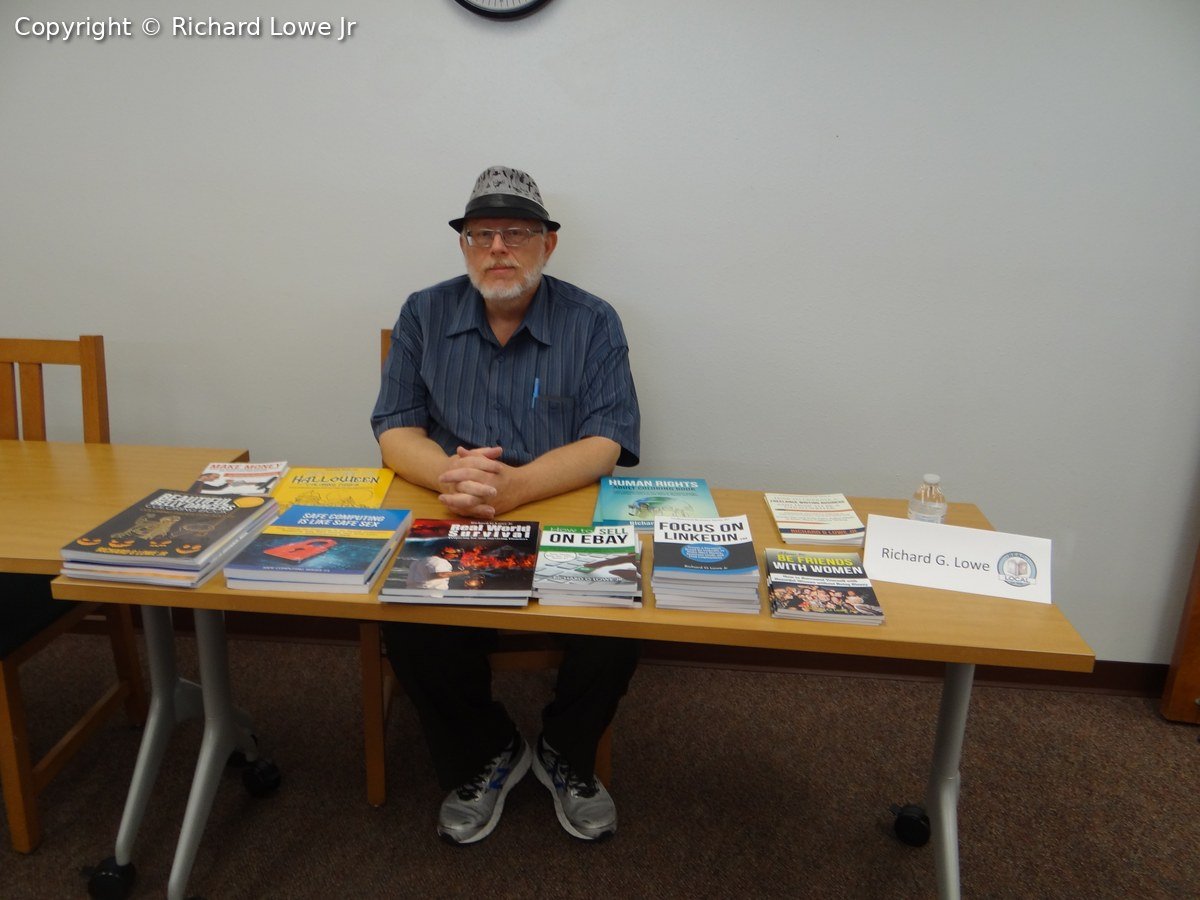
Selling my books at a local author event, September 26, 2017. Copyright © Richard Lowe.
Writers’ conferences, bookstore signings, library talks, workshops, school groups, local festivals and fairs all count. Start local, because local is where people will come out for someone they’ve never heard of. Bring more books than you think you’ll sell, a way to take cards, a sign with the title big enough to read from across the room and something to say in one sentence when someone stops. The sale happens in the first ten seconds of conversation, or it doesn’t happen.
Is collaborating with other authors worth it?
Yes, as long as your readers overlap with theirs.
The infographic lists joint events, hashtag challenges, box sets, blog tours, shared giveaways and multi-author series. All of them work on the same principle. Another author’s readers already like books like yours, and a joint project introduces you to them without either of you paying for it.
Fit decides it. A box set with a romance writer won’t help a thriller. A blog tour among writers whose audiences are mostly other writers mostly reaches people who are busy selling their own books. Pick partners whose readers would buy your book if they knew it existed, and keep the project small enough to finish.
Agree up front on who does what, who pays for anything that isn’t free and how long the promotion runs. Joint projects die over the boring details. A half-finished box set helps nobody.
Should authors start a blog, YouTube channel or podcast?
Only if you’ll keep it going for years, because that’s how long it takes.
This site is my version. It carries a large library of articles, and I keep them because I love to write and share ideas, and because people will link to an article when they’d never link to a sales page. Over time the articles became the proof that I know my subjects. When someone wonders whether I can write their book, they can read what I’ve written on their subject first, before we ever talk.
But none of that happened in a month. A blog, a channel or a podcast pays off slowly, then all at once if you’re lucky, and it only works if the content is good enough that someone would read it with no book attached.
Choose the format that suits you. If you hate being on camera, don’t start a YouTube channel because someone said video is hot. If you’d rather talk than type, try a podcast. If you write faster than you speak, a blog is the obvious choice. Whatever you pick, stay on the subjects your book covers, so the people who find you are the people who would want it.
Free book marketing isn’t free. You pay for it in hours, and the best hours I’ve ever spent were at a table with the book in a reader’s hands. – Richard LoweShare on X
Do guest posts and podcast interviews help sell books?
They help people remember your name, and every sale starts there.
I’ve done 100+ guest podcast appearances. Few things on this list give back more for the hours, because the host has already built the audience and you just have to show up and be interesting. A good interview introduces you, your book and how you think to people who would never have found you otherwise. Listeners spend half an hour or more with you. No ad or post can buy that. Come with two or three stories you can tell well, and mention the book once, naturally, near the end.
There’s a lesson in there, too. Plenty of shows never promote their own episodes, and I’ve seen recordings stuck at a handful of views. So I download my interviews and put them on my own site, where they keep working. Don’t count on the host to do your promotion. Share every interview yourself, everywhere you can.
Guest blog posts work the same way. Write something useful for a site whose readers would want your book, and let your bio do the selling.
Can a self-published author do their own PR?
Yes, but go in with realistic expectations.
A press kit is cheap to put together: a short bio, a good photo, the cover, a one-paragraph description and a few interview questions. Then you pitch local newspapers, radio stations, TV programs, podcasts and online outlets. Local media is the most likely to say yes, because “local author” is a story they can use.
A hook tied to something happening this week, a holiday, an anniversary or a local event makes the pitch far easier to accept. Keep the kit on a page of your website so a producer can grab everything in one place without emailing you back.
National press is a long shot for almost every author, and a press release sent out to nobody in particular rarely reaches a reader. Pitch a named person at an outlet you’ve read. Tell them why their audience would care, in two sentences, and make it easy for them to say yes.
Is email marketing worth it for authors?
For authors whose readers want to hear from them, it’s the one channel they own. Nobody signs up by accident.
My own experience is grim. I ran a signup card on this site for nine months and got zero subscribers. Not a handful. Zero. So I shut it down and stopped pretending it was working. My readers find me through articles, interviews and conversations, and that’s fine.
Email still works for plenty of authors. Novelists with a series and readers waiting for the next book can build lists that move real copies on launch day, year after year, without paying a platform for the privilege. The difference is the offer. People sign up when you give them something they want: the first chapter, a bonus story, early access, a reason. A box that says “join my newsletter” gives them none of that.
Does social media sell books?
Once in a while it sells them by the thousands. Then the platform changes and the sales stop.
When I launched Focus on LinkedIn, I promoted it hard on LinkedIn, priced it at 99 cents, and sold 15,000 copies in three days. That was the right book on the right platform at the right moment, and I’ve never forgotten it. The book was about LinkedIn, the readers were on LinkedIn and the price made buying it a reflex. Most books don’t line up that neatly with a platform, and most launches won’t either, so don’t plan your career around a lightning strike.
It’s also why I’m careful about advice that treats social media as a sure thing. Platforms change. Reach that worked one year disappears the next, and I’ve written about what happened to LinkedIn since. The infographic’s advice to keep social media social is right. Talk to people. Share things worth reading. Post about the book now and then. Once a day is plenty.
And stay out of the writers’ groups with your sales pitch.
Posting “buy my book” in a group of other writers takes a minute and reaches nobody, because everyone in the room is selling a book too.
Which free marketing should you do first?
Pick two or three and do them for a long time. That beats doing all seven badly for a month.
Start with what puts the book in front of a person. If you can get to an event, go. If a podcast will have you, say yes and share the episode. Then add one long-term project, a blog, a podcast or a list, only if you’re willing to keep it running for years. Everything else is a supplement.
Track what each method brings in, even roughly, and drop the one that eats the most hours for the least result. After six months you’ll know where your readers are, and you can put more of your time there.
And be honest about the hours. Every one of these methods is free in money and expensive in time, and time spent marketing is time not spent writing the next book. The next book is still the best marketing there is.
Free costs hours
The seven free ways on that infographic are real, and every one of them can sell books. They just don’t sell them at the same rate per hour. Spend your hours where readers are close enough to touch the book.
The publishing and marketing hub has more on what works and what wastes your time, including what I learned publishing 113+ books. If you’d like help planning a launch around your strengths, my book coaching covers that too.
