
The morning was the most beautiful one Bayeke could remember, which was why it took him so long to notice that the world had changed.
The sun came up clean out of a sky with no cloud in it. The sea lay flat and bright, the color of the inside of a shell, and the light ran across it in long gold lines that moved when the small swell moved. The air was warm already and smelled of salt and flowers and the smoke of the cookfires waking in the village behind him. Birds worked the shallows. A good day. A day for the far reef, for diving in the clear water where the big fish were, the kind of day a man remembered in the lean season and held onto.
He stood on the beach and let the morning soak into him before he started his work, the way he did every day, and that was when he saw them.
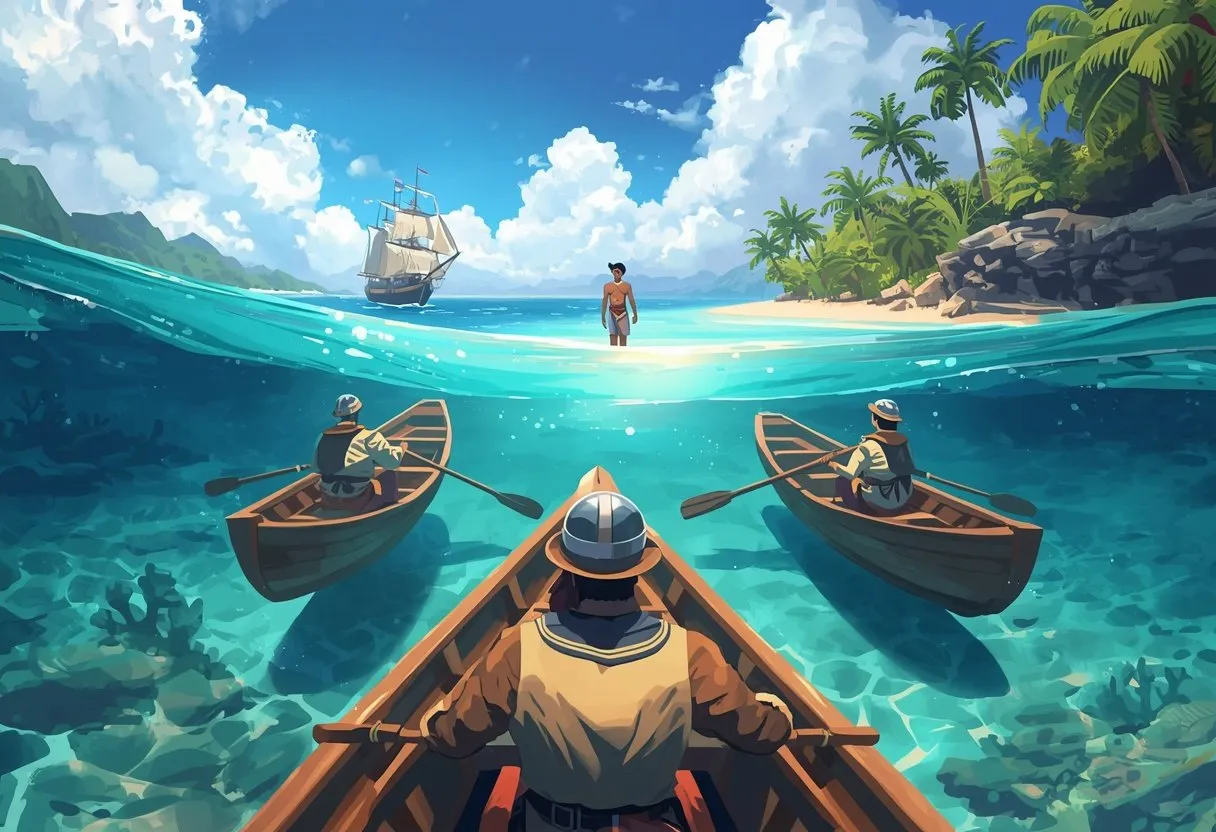
Three great shapes on the water, out past the reef, that hadn’t been there the night before.
He went still. He looked at them for a long time, and the beautiful morning went on around him, the gold light and the warm air and the birds, while the thing he was looking at refused to fit into any of it.
They were the size of small islands, but they weren’t islands. No island had that shape, tall and narrow, with great white wings spread above it that filled and shone in the sun and fell slack and filled again as the wind touched them. And no island moved. These moved. Slow as turtles, but moving, sliding across the bright water with the purpose of a thing that was steered. They were made. Bayeke knew a made thing when he saw one, the way he knew his own canoe from a log, and these were canoes the way the sky was a puddle, past anything he had words for, with wings whiter than a seabird and big as the sails of heaven.

His chest filled with wonder. For a long moment that was all there was, a man on a perfect morning looking at a beauty he had no name for, and it was good, the way the best things were good, too big to hold.
Then he saw the people.
Small shapes at the edges of the great vessels, moving the way people move, upright and busy, going about work he couldn’t see. And the wonder in his chest turned, the way the light turned on the water, into something with an edge to it.
He’d known the things were made. Now he knew the makers, and the makers were doing something at the side of the nearest one. Small shapes going down. And then, on the bright water below, little boats. Boats putting out from the vessel, low and dark on the gold sea, with the small shapes in them, coming toward the gap in the reef. Coming toward the beach. Coming toward him.
Bayeke stayed where he was and watched the little boats come, and his heart went two ways at once.
They were different. Even at this distance he could see that the people in the boats weren’t made like his people, that they were wrapped in something, that they shone here and there as if pieces of them were hard and bright. Different. And different was the question that mattered now, the only question, the one the beautiful morning had hidden behind its gold light until this moment.
Would they be good?
He turned it over the way he turned a strange shell in his hand. They’d crossed water no canoe could cross, in vessels with wings, which meant they were clever, or strong, or favored by something. Such people might come as friends. They might come the way a visitor comes, with curiosity and open hands, wanting to trade and to look and to wonder at his people the way he was wondering at them. The thought warmed him almost as much as the sun.
Or they might come as warriors. Clever and strong were the words for a friend and they were also the words for an enemy, and the same boats that carried a guest could carry a war party, and Bayeke had no way to know which sat in the little boats now sliding toward his reef. They might want his island. They might want the fish, the fresh water, the people themselves.
Or it might be worse than either, some third thing he had no word for, because the morning had already shown him that the world held shapes he’d never imagined, and a world where vessels grew wings and crossed the open sea overnight was a world that might hold anything at all.
The little boats came on. The sun was warm on his back. The sea was still the color of the inside of a shell, still beautiful, more beautiful maybe than it had ever been, and Bayeke understood that the beauty and the not-knowing were going to live side by side in him now, the way they’d since the first shape rose over the reef.
He should call the others. He’d call the others. But for one more breath he stood alone on the perfect morning, a young man on a bright beach, watching strangers row toward his life across the most beautiful water he’d ever seen, not knowing if what came with them was a gift or a grief, knowing only that it was coming, and that nothing after this morning would be the same.
Then he filled his chest with the warm and flower-smelling air, and turned toward the village, and called out for them to come, come quickly, come and see, there are people on the water, and they’re coming in.
