
A finished movie sat in a vault at Warner Bros. for almost two years because somebody decided it was worth more as a tax loss than as a film. Hundreds of people made it, and a tax calculation decided its fate. I love movies, and the decision still makes me angry.
A builder finishes a house. The doors are hung, the trim is painted, and the house keys are cut and sitting on the kitchen counter. Then the owner has it bulldozed, because a demolished house looks better on this year’s tax return than a sold one. You’d call that owner crazy, and Hollywood calls the same move a strategic review.
What happened to the finished Coyote vs. Acme movie?
Dave Green directed this live-action and animated comedy, in which Wile E. Coyote sues the Acme Corporation for selling him products that keep blowing up in his face. Will Forte plays his lawyer and John Cena plays the lawyer for Acme. The premise goes back to a 1990 humor piece Ian Frazier wrote for The New Yorker, and I can’t believe nobody filmed it sooner. Every Road Runner cartoon is a product liability case.
Warner Bros. Discovery finished the film. Then, in November 2023, the studio announced it would not release it and would take a tax write-off instead, reported at about $30 million. The crew found out the film was dead after they’d delivered it.
How would you feel?
On a call in the spring of 2024 I raised it as Looney Tunes trivia, and I was furious. My words then: “They finished the movie, and it’s all ready to go. And then Warner Brothers got bought by somebody, and he decided to just destroy it, for tax purposes.” I called it a $60 million movie “literally thrown into the trash as an income tax write off.” Most reports put the budget closer to $70 million. Either number makes me sick.
Fans were furious too. So were plenty of the people who made it.
Then the story turned.
Ketchup Entertainment, a small independent distributor, closed a deal for the worldwide rights in March 2025 for a reported $50 million, and it released the film in theaters on August 28, 2026. It opened in second place at the domestic box office, critics gave it some of the best reviews of any Looney Tunes feature, and audiences gave it an A.
My Coyote vs. Acme review covers the film itself. The long history of how the studio treated these characters lives in How Warner Bros. Dismantled a $17 Billion Cartoon Empire, so I won’t retell it here.
Watch: Coyote vs. Acme (2026) Behind the Scenes: How the Shelved Looney Tunes Movie Was Saved, SBNEnter
I was wrong about the print, and I’m glad
On that call in 2024, I said there wasn’t a print anywhere and that it had been destroyed. I guessed somebody had gotten smart and kept a copy in a vault, and I was surprised it hadn’t leaked. “If it had been me, I’d have been on the Internet,” I said. “I would have been pissed.”
Somebody did keep it. The film survived, it found a buyer, and it’s out in theaters where it belongs. I’ll happily eat my words on the print.
Everything else I said stands. A studio looked at a finished, funny, well-made movie and decided its best use was as a line on a tax filing. Back then I read that as proof they didn’t think it would make its money back, and I said they’d tried to sell it and nobody would buy it. The second part turned out to be more complicated. Reports through 2024 said buyers came forward and made bids, and the studio kept turning them down as too low.
Who does that with something they’ve already written off? Would you turn down a buyer for a car you’d already junked? A studio that cares more about the accounting than the audience would.
A studio looked at a finished, funny, well-made movie and decided its best use was as a line on a tax filing.
And the audience showed up. Critics and moviegoers liked the film. The judgment that it wasn’t worth releasing was wrong, and it was wrong about a movie the people making the call could have watched any afternoon they wanted. Did any of them bother? Did anybody in that meeting sit through ninety minutes of a coyote suing a company before signing away the work of hundreds of artists, or did a spreadsheet make the decision for them?
Why do studios shelve finished movies for a tax write-off?
Studios do it for dull reasons, and the dullness is part of what makes me mad. A studio spends money making a film and carries that cost on its books as an asset. If the studio decides the film will never earn enough to cover its costs, it can write the asset down and take the loss against its taxes. The write-off turns a film into a deduction. The studio gets part of its money back from the tax bill, and it never has to spend another dime on marketing, prints or distribution.
Marketing is the piece outsiders forget.
A wide theatrical release can cost tens of millions of dollars on top of the production budget. If the people with the spreadsheet believe the film will lose money after that spend, killing it looks cheaper than releasing it. The catch, as widely reported in the Batgirl case, is that a studio taking that kind of write-down is expected to stop trying to make money from the film. Once it’s a loss on paper, it’s supposed to stay dead.
Warner Bros. Discovery was formed in April 2022 when WarnerMedia merged with Discovery, and the new company came out of the deal carrying an enormous pile of debt. I said on that 2024 call that they were looking for write-offs everywhere, under every seat cushion. The pattern bears that out. Within months of the merger, finished and nearly finished films started disappearing.
Is any of that illegal? No. Is it a crappy way to treat the people who made the work? You bet it is, and I’ll keep saying so as long as studios keep doing it.
Batgirl and Scoob! Holiday Haunt went first
Coyote vs. Acme was the third film Warner Bros. Discovery killed this way, and the first two went in August 2022.
Batgirl had a budget of about $90 million. Filming wrapped at the end of March 2022, and the movie was in post-production when the studio cancelled it on August 2. Guinness World Records lists it as the most expensive abandoned film. Leslie Grace played the lead, Michael Keaton came back as Batman, and J.K. Simmons returned as Commissioner Gordon. The directors found out the film was dead while they were traveling, and they’ve said the studio blocked them from the servers holding their own footage.
Scoob! Holiday Haunt was a $40 million animated sequel that was almost finished and headed for the streaming service. It went into the same hole on the same day.
Neither has been released.
As of 2026, neither one has a buyer the way Coyote vs. Acme did, and the reported terms of the write-downs make that unlikely. Two finished or nearly finished films, roughly $130 million of work between them, and nobody will ever see either one unless the rules change.
I hate that.
A studio that kills a finished movie to save on taxes has decided a quarterly report matters more than every person who made the film. – Richard LoweShare on X
Does a box office bomb mean a movie is bad?
No, and the shelving decisions prove it. Executives decided these films weren’t worth the cost of a release before any paying audience had a chance to vote. When one of them finally reached theaters, it opened strong and the reviews were glowing.
Why did a good movie bomb? I like to look at films from that angle.
Sucker Punch is one of those movies. It bombed at the box office, and it’s not a bad movie. The fantasy segments are cool, and it’s a reasonably good film right up until the ending. The choices sank it, especially killing off the character the audience had spent the whole film rooting for. What the hell did they do that for? My Sucker Punch review goes through them. You can learn more from a good film that failed than from a hit, because the failure shows you where the story broke its promise.
Box office tells you how a film was marketed, when it opened, and what it opened against. It tells you very little about whether the film is any good. A studio that shelves a movie because a spreadsheet says it will underperform has skipped the only test a movie ever needs. Put it in front of people and find out. Why is that so hard for these so-called creative executives to understand?
Studio meddling wrecks more good films than bad scripts ever did. My list of films that would have been great if the studio had stayed out is full of movies hurt by somebody who was afraid. Shelving is the same fear taken to its end. At least a butchered film still gets seen.
Streaming lets them do it to the movies you already paid for
I’m sad about the fall of the DVD and the Blu-ray. Streaming is not good for us, and these write-offs show why.
I do everything physical. I don’t stream.
Look at what the streaming services did in the same stretch. HBO Max pulled Westworld, a series it had spent years promoting, in December 2022, along with a stack of other shows. Disney+ pulled its Willow series in 2023 during a round of content write-downs. Shows people had watched and planned to watch again vanished overnight. Did you get a refund when your show disappeared? Of course you didn’t.
Late in 2023, Sony announced that more than a thousand seasons of Discovery shows that PlayStation customers had paid for would disappear from their libraries when a licensing deal expired. After the outcry, Sony reversed course. Do you see what that announcement told every customer? The thing you bought was never yours. You rented it, and the landlord can change the locks.
A disc on my shelf can’t be written off by an accountant in Burbank. Nobody can reach into my house and delete it because a licensing deal ran out. I don’t buy many discs anymore, and when something comes in, two have to go out. But I still buy the deluxe editions, the ones with the booklets and the extras. They’re expensive as hell and they’re gorgeous. The deluxe Fifth Element is one of mine, and no streaming service can reshuffle it out of my house.
What should writers learn from shelved movies?
Whoever controls the rights controls whether the work exists. The people who made Batgirl did their jobs. They have no say over whether anybody sees it, because they never owned it.
Publishing works the same way. When you sign a traditional publishing contract, you’re licensing your book to a company that decides when it comes out, how hard it gets pushed, and when it goes out of print. A publisher can sit on a manuscript for years. It can let a book die slowly with no marketing at all. If you don’t read the contract carefully, you can watch years of your work sit in somebody else’s drawer with no way to get it out.
Would you sign a lease without reading it? Then why would you sign away your novel that way?
Read the rights clauses before you sign anything.
Look for a reversion clause that returns your rights if the book goes out of print, and make sure “out of print” is defined by a real sales threshold over a set period. Without that definition, a publisher can keep an ebook technically available and hold your rights forever. My page on copyright law for writers covers the basics of who owns what. If anything in the contract confuses you, have a publishing lawyer read it before you sign.
Self-publishing doesn’t make you safe either.
Amazon terminated my KDP account after I followed its own instructions for changing a subtitle, and I couldn’t reach a human being to fix it. You can read that whole mess in Why Amazon KDP Sucks. My books moved to IngramSpark, and they could make that move because they were mine.
Who controls a book if a publisher shelves it?
The publisher controls it for as long as the contract says it does. You only get it back through whatever exit the contract provides.
The Coyote vs. Acme crew learned that lesson the hard way. They made a great film, and their only hope was that a company that owed them nothing would change its mind or sell it.
They got lucky. The Batgirl team hasn’t, and you won’t either if you sign the wrong contract.
Fiction writers need to plan for this from the first contract. A novel is years of your life. What happens to it if your publisher loses interest, gets bought, merges with somebody, or decides your book is worth more as a loss? Mergers happen in publishing too, and new owners clean house. You don’t want your book to be the house.
My take
Own your copy, and read the exit clause before you sign. Warner Bros. Discovery shelved a finished Coyote vs. Acme for a tax write-off, and the crew could only hope somebody bought it. Batgirl is still locked away. A publisher can do the same to your novel for as long as the contract allows. Keep every file you make. My books could move to IngramSpark after KDP terminated me because they were mine.
Keep your own copy of everything you make
Batgirl’s directors got locked out of their own footage. I can’t imagine anything worse for somebody who makes things for a living.
Where are your manuscript files right now? Could you get to them tonight if your publishing account vanished?
Keep the master files of every manuscript, cover and audiobook you create, in more than one place, and keep at least one copy off the platform you publish on. If a platform closes your account, you should be able to republish somewhere else in a week. If you want a wider plan for protecting the computers in your house, my book Family Cybersecurity is a good place to start. Back up your drafts. Keep the signed contracts, and save copies of the final files your publisher approved.
And if you love a movie, buy the disc. Studios and streaming services have shown you how much your access means to them when the tax bill comes due.
I’m glad I was wrong about Coyote vs. Acme. Somebody saved the house before the bulldozer got to it, and people are walking through the front door and laughing. Batgirl and Scoob! Holiday Haunt are still rubble, and the people who made them have nothing to show for the work but a credit on a film nobody will see. Damn the accountants who made that call.
If you’re writing a novel and want to make sure it gets read, start with the Entertainment Hub for more on how stories get made and lost, and see how I work with novelists on my fiction process page. Your book belongs in readers’ hands. A tax filing is no place for it.
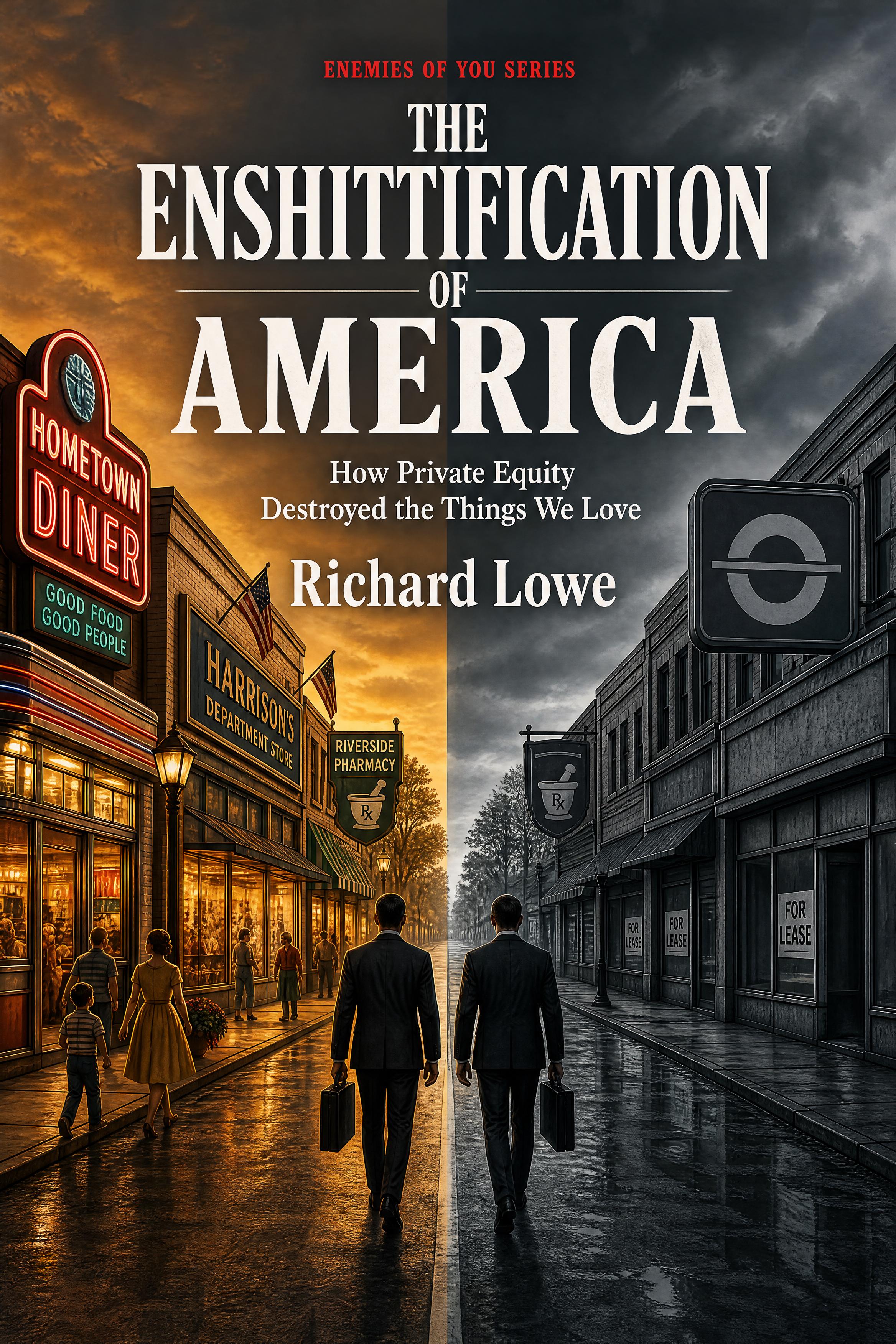
Studios shelving finished films fits a pattern I trace in The Enshittification of America, my book on how good businesses were taken apart across thirteen industries.
