
Bugs Bunny deserved better than this. Warner Bros. took the most valuable cartoon library in history and treated it like a tax write-off, and that’s what happens when accountants run a creative company.
I grew up on these cartoons. So did most people my age, and so did a lot of people much younger, because they never really went away until somebody made a decision that they should.
I want to say the unpopular part first.
Looney Tunes was better than anything Disney made, and it’s not close. Disney made things that were beautiful and sincere and often very good. Warner Bros. made things that were funny. Mechanically, repeatably funny, which is much harder, and which nobody at the time thought was worth much.
The short version is sixty years of a studio owning the funniest work in animation and treating it as a line item. A YouTube video called How Warner Bros. Killed a $17 Billion Cartoon Empire pulls the whole timeline into one place, and it’s worth the twenty minutes:
Looney Tunes was better than anything Disney made, and it’s not close.
I went and checked the parts I could check, and the record is worse than a single villain story. It’s a case study in something I wrote a book about. That’s what happens when people who can read an asset’s revenue but not its value manage it.
How big was Looney Tunes at its peak?
The weekly audience for these cartoons ran to 37.7 million people in the early nineties. Put that against a modern hit and it stops being a number and starts being an era.
ABC’s Saturday block sat at number one for 32 straight years and threw off an estimated $8 to $10 million annually, call it $25 million in today’s money. Valuations of the franchise around that time landed near $17 billion. When TV Guide ranked the fifty greatest cartoon characters, close to a third of the list came out of this one studio, and no cartoon character has appeared in more films than Bugs Bunny.
Between 1930 and the early 1960s the studio produced around a thousand theatrical shorts. They were made in a rundown bungalow on the Burbank lot that everyone called Termite Terrace, and the reason they’re good is boring and important. Leon Schlesinger cared about the budget and not the content, so the directors were left alone. Tex Avery, Chuck Jones, Bob Clampett, Friz Freleng and Mel Blanc developed completely separate styles inside the same building and improvised gags into the work.
What came out was political satire, pop culture parody, and a kind of controlled anarchy that animation hasn’t matched since. Chuck Jones built an entire short around Daffy Duck’s own animator torturing him. Bugs appeared in drag something like forty-five times in an era when that was a real choice. These cartoons ran before the main feature, and audiences frequently cared more about the seven minutes than the ninety.
In the Second World War, Bugs Bunny was painted on the nose of American bombers. That’s the level of cultural saturation we’re talking about.
When did Warner Bros. start dismantling Looney Tunes?
The decline started with the 1963 studio closure, decades before the current owner.
In 1963, decades before anyone in today’s management got near the building. I think the people who pin all of it on one executive are missing most of the story.
Cinema attendance was falling, television was rising, and most of the shorts were losing money. Warner Bros. didn’t adapt. It closed the animation studio.
Chuck Jones, the director behind What’s Opera, Doc? and Duck Amuck, had already been fired for working on an outside project in breach of his contract. Production moved to cheap outsourced shops on television budgets and the quality fell off a cliff immediately.
This is what shaped everything after. Closing the studio didn’t hurt the business at all, because Warner Bros. had been licensing the old shorts to television since 1955 and children who had never seen them in a cinema were watching them every afternoon. The library kept paying. So the company learned the wrong lesson, permanently: the cartoons generate money whether or not anybody makes new ones.
They made almost no new animation for close to thirty years. The characters became a licensing engine. By the mid-1980s they were in Nike, McDonald’s and KFC commercials constantly, and by the early nineties a generation knew Bugs Bunny primarily from advertising instead of from cartoons.
One detail captures the whole mindset. When Who Framed Roger Rabbit was made in 1988, Warner Bros. licensed its characters for $5,000 each. That’s less than some influencers charge for a single post. There was one non-negotiable condition: Bugs and Daffy had to get exactly the same screen time as Mickey and Donald. The contract cared about minutes on screen and had nothing to say about whether those minutes were any good. The competitive instinct was intact and the creative one was gone.
What did the mergers do to the franchise?
The 1996 Turner merger should have been the best thing that ever happened. Cartoon Network came into the same company that owned the shorts, and for a while it ran proper Looney Tunes blocks and made the classics more available than they had been in years.
Then the internal accounting took over. Warner Bros. made Cartoon Network pay to air the shorts. Same company, same corporate parent, one division billing another for the crown jewels. When the network later needed to cut costs, guess which line was easy to cut.
The AOL Time Warner merger in 2001 did the most damage. It arrived at the top of the dot-com bubble, loaded the company with debt, and forced sales of anything that could be sold.
All 85 domestic Warner Bros. Studio Stores closed inside twelve months, taking about 3,800 jobs with them. The reported reasoning from the top was that the company doesn’t do real estate. The New York flagship had been drawing 20,000 people a day, more than seven million a year, and it was one of the last places the characters existed as characters instead of as a licensing category.
Space Jam: Back in Action bombed in 2003. Inside twelve months the classic shorts had all but vanished from the Cartoon Network schedule, shunted over to Boomerang. Between roughly 2004 and 2009 there was almost no Looney Tunes on mainstream American television. An entire childhood cohort grew up with almost no exposure to the characters at all.
By 2010 the merchandise gap had become absurd. Disney was pulling roughly $5 billion a year from Winnie the Pooh alone. Looney Tunes had fallen to about a billion. A honey-obsessed bear was out-earning Bugs Bunny five to one. Management wrote that verdict, and the market only reported it.
Did Warner Bros. ever try to fix it?
Repeatedly, and badly. That’s its own kind of tell.
The New York Times reported a five-alarm rescue effort in 2010. It started from the discovery that the characters ought to look and act the way they did when people first loved them.
It took a corporate rescue team to establish something any kid with a television could have told them. The studio hung art from the failed Loonatics Unleashed reboot on the wall as a reminder of what not to do.
The Looney Tunes Show arrived in 2011 with a decent premise, Bugs and Daffy as suburban roommates, and stripped out the chaos that made them work. Two seasons. A set of 3D Wile E. Coyote shorts ran ahead of family films around then, and stopped without a word of explanation. Wabbit came in 2015 and went quickly.
Then in 2020 they got it right. Looney Tunes Cartoons went out as one of the launch originals on HBO Max: short-form, hand-drawn, different artists working in different styles, closer to Avery and Clampett than anything in fifty years. Strong reviews. Among the most watched things on the platform in its opening weeks, reportedly beating Game of Thrones.
And then almost nothing. No marketing push, no strategy to convert the audience, six seasons fading into a library nobody was told about. They solved the creative problem and then declined to solve the distribution problem, which by then was the only problem that mattered.
What did David Zaslav do to Looney Tunes?
Discovery merged with WarnerMedia in April 2022 and David Zaslav took over a company carrying enormous debt. Neglect is passive, and what followed was a sequence of decisions, each one signed by somebody who could have said no.
In October 2022, Warner Bros. Television Group cut 82 staff and left 43 posts unfilled, 125 positions in total, 26 percent of the workforce across those units. Animation absorbed the worst of it, and in the same memo Cartoon Network Studios was folded into Warner Bros. Animation. Cartoon Brew’s read at the time was that Cartoon Network Studios had gone from a functioning studio to a brand name.
That December, 256 Looney Tunes and Merrie Melodies shorts made between 1950 and 2004 came off HBO Max. The license had expired and Warner Bros. Discovery chose not to renew it, on its own property. What’s Opera, Doc? and Duck Amuck went with them.
In November 2023 the company shelved Coyote vs. Acme, a finished film that had tested well, for a tax write-off, alongside Batgirl and Scoob! Holiday Haunt. The crew found out after the fact. The backlash was severe enough that the company reversed course on shopping it within four days. Netflix and Sony were reportedly interested and Warner Bros. wouldn’t come down on price. Representative Joaquin Castro asked the Biden administration to look into the practice of deleting completed films for tax purposes.
Shelving a finished film for a tax break is the most cynical thing I’ve seen a studio do to its own people. A crew of artists spent years on that picture, and the company that paid them decided their work was worth more as a deduction than as a movie. They didn’t get a vote, and they didn’t even get told first.
Boomerang was shut down. CartoonNetwork.com was stripped and visitors were pushed to Max. The Sesame Street deal wasn’t renewed in December 2024. The studio that paid for The Day the Earth Blew Up, the first fully animated Looney Tunes feature ever made, refused to distribute it and sold it to Ketchup Entertainment.
In March 2025 the remaining 255 original shorts, made between 1930 and 1949, came off Max.
Every classic Looney Tunes short was now absent from the streaming service owned by the company that owns them. The stated reason was a shift toward adult and family programming. That doesn’t survive ten seconds of thought, since those shorts were made for general theatrical audiences and Max kept the later series that were made for small children.
The timing is the part I can’t get past. The deletion landed on the release weekend of The Day the Earth Blew Up. It was the first Looney Tunes feature to reach a cinema in twenty years.
Buy a ticket to meet these characters. Also, the work that made them worth meeting has just been taken off the only platform we run.
Then they announced the demolition of Building 131 in Burbank, the purpose-built home of Warner Bros. Animation from 1955 until its closure, where hundreds of shorts including What’s Opera, Doc? were produced. Torn down for base camp space for HBO shoots, with nothing replacing it. Cartoon Brew described a systematic crusade carried out with a thoroughness bordering on obsession, and I’ve read that sentence several times looking for the exaggeration in it.
Why does Warner Bros keep mishandling Looney Tunes?
Because the company has never understood what it owns, and that failure predates every executive currently blamed for it.
Per Chuck Jones, Jack Warner spent three decades treating the shorts as padding, something cheap to run ahead of the picture people had paid to see.
That belief never left the building. Every engagement with the franchise since the nineties has been to sell merchandise or rent nostalgia. Almost none of it’s been creative investment.
This is the mechanism I spent a book on in The Enshittification of America. People who can read the revenue line and can’t read the thing generating it acquire an asset.
They squeeze it, the quality drops, the audience notices, the numbers fall, and then the executives point at the numbers as proof the thing was never worth much. It’s a con, and they run it every time. The reasoning is circular and it’s almost never caught, because by the time the decline shows up in a quarterly report the people who caused it have moved on.
There’s a measurable version of that failure here. Looney Tunes was built for short-form video. Seven minute units, visual gags, no dialogue required to get the laugh. It’s the most natively suited catalog in Hollywood for the way people watch things now, and most of its official social posts struggle past a hundred thousand views. The catalog is a ready-made feed and nobody is feeding it.
The other failure is nerve. The original shorts were sharp, rude and occasionally cruel, and that’s why they still work. Three decades of sanding that down to something inoffensive produced characters who look like Bugs Bunny and behave like a mascot. You can’t Disneyfy Looney Tunes, because the entire point of Looney Tunes was that it wasn’t Disney.
Is Looney Tunes doing better now?
Yes, and mostly because other people picked up what Warner Bros. put down.
Start with the audience, because the audience never left. When the shorts came off Max they landed on Tubi, free and ad-supported, where nearly 800 of them now sit and where they went into the top ten by viewing time almost immediately. MeTV Toons has been running them over the air since June 2024, free to anyone with an antenna.
Parrot Analytics puts the franchise at more than $300 million in global subscriber revenue between the first quarter of 2020 and the second quarter of 2025, and $250 million of that came from HBO Max, the service that removed it.
In January 2026, Turner Classic Movies signed a six-year deal making it the ongoing television home for more than 750 classic shorts, starting on 2 February with Tex Avery’s A Wild Hare and Bugs Bunny as Star of the Month. That’s a Warner Bros. Discovery channel, so the company has effectively licensed the library back to itself so that somebody will treat it properly.
Coyote vs. Acme finally reached theaters on 28 August 2026 through Ketchup Entertainment. It paid around $50 million for a film written off at $70 million. It’s 96 percent on Rotten Tomatoes, opened to $15.9 million, fell only 28.8 percent in its second weekend, and stands at $44.2 million worldwide. Third at the global box office. It’ll clear what Ketchup paid for it. That means the market answered a question the write-off claimed was already settled.
And there’s a real creative operation again. Warner Bros. Pictures Animation was rebuilt under Bill Damaschke, hired in 2023 as president and chief creative officer. At Annecy in June he premiered Daffy Season, the first theatrical Looney Tunes short since 2014, directed by Todd Wilderman and Hamish Grieve, attached to The Cat in the Hat on 6 November. He announced seven features through 2028, including a Speedy Gonzales film from Jorge Gutiérrez. He called Looney Tunes the soul of the studio and named the studio patio Termite Terrace.
Asked about the two films that were sold off, Damaschke said the decision had been out of his purview. Four words, and they contain the whole argument. The people who understand the characters have never been the people deciding what happens to them.
My take
Warner Bros. had a franchise worth around $17 billion and treated it like a spreadsheet row for thirty years. The owner who deleted 511 classic shorts and knocked down the building where they were made committed vandalism with a budget. The recovery is coming from a division president who calls the characters the soul of the studio. The sale of two finished films was out of his hands. If you own something valuable, put the people who understand it in charge of it.
What does Looney Tunes teach about owning something valuable?
The good news has limits. David Zaslav is still there. The April 2026 split handed him the studio and streaming company, which is the half that owns Looney Tunes, and Gunnar Wiedenfels took the networks. Damaschke runs a division inside that structure. Announcements aren’t releases. This company has made the same commitment in the past and let it lapse.
But the durable lesson isn’t about one executive, and treating it that way lets the pattern off the hook. Zaslav accelerated something that started in 1963 and ran through four ownership changes. The consistent factor across all of them was an inability to distinguish a revenue stream from an asset. The difference between a revenue stream and an asset applies well beyond cartoons. A revenue stream can be optimized. You can raise the price, cut the cost, reduce the quality slightly and watch whether anybody leaves. An asset has to be maintained, and maintenance looks exactly like waste on a spreadsheet, because you’re spending money on something that’s already working. Every executive who damaged Looney Tunes was optimizing. None of them thought they were destroying anything, because the numbers kept arriving right up until they didn’t.
Ninety-five years of one of the great comic bodies of work in any medium survived that. It survived a studio closure, a licensing era, two catastrophic mergers, five years of near-total television absence, a deliberate deletion from its owner’s own streaming platform, and the demolition of the building where it was made. It survived because the work is good enough that people went and found it on a free ad-supported app when the company that owns it stopped offering it.
That’s the case for making things well. Quality frequently doesn’t get rewarded, and I won’t pretend it does. What it buys is survival: it’s what’s left when the people who were supposed to protect the work have finished failing at it, and that’s the reason I’ll keep arguing for doing the work properly.
No executive who ever mishandled him has outlasted Bugs Bunny. I’d put money on him outlasting this batch too. If you want the longer argument about how good things get hollowed out by people who can’t see what they’re holding, that is The Enshittification of America, and there’s more on this pattern across the Entertainment Hub.
Every owner in this story blamed the audience for losing interest, and that excuse is bunk. The audience got handed cheap, outsourced garbage and walked away, like any sane person would, and the executives who served it have only themselves to blame.
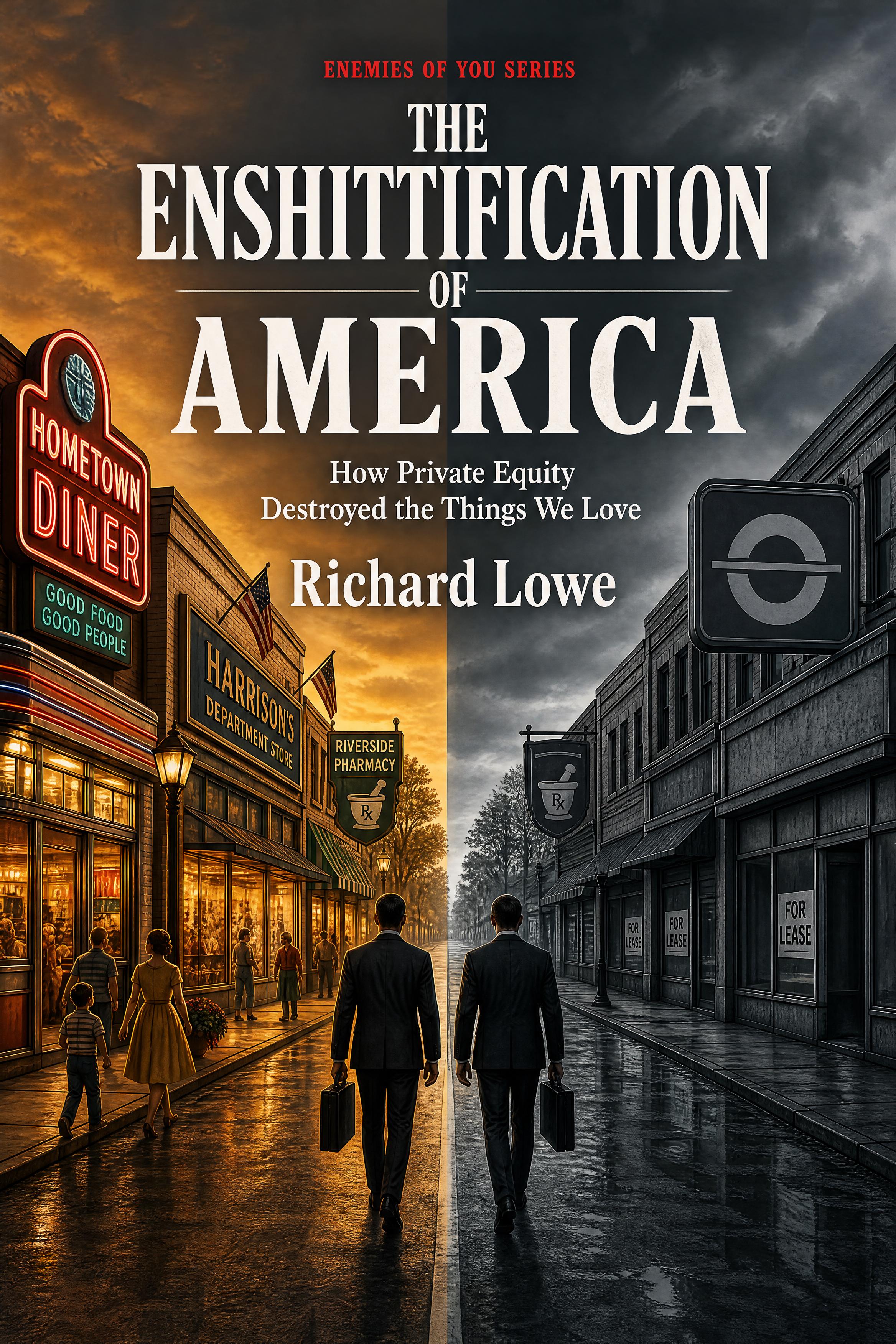
Thirty years of owners treating a franchise as a line item is the pattern I traced through thirteen industries in The Enshittification of America.



