
The Woke Virus started with the title. I thought it was catchy, and I still do.
I won’t give the book away, but it shows people misunderstanding each other in a humorous way. I’ve always liked The Hitchhiker’s Guide to the Galaxy, so I decided to write it in that style. That turned out to be much more difficult than I thought. It isn’t an easy style to pull off, and I’m hoping I did. It was a lot of fun to write.
What is The Woke Virus really about?
Just like I thought my dad was crazy, and my dad thought, secretly, his dad was crazy. That sentence is the whole book.
Every new idea looks like a contagion to the people holding the old ones. The town of Millhaven calls it the woke virus. Up the hill at the University of Hargrove they have their own words for what they think is going around down there: exposure, harm, something he picked up in town. Both sides would much rather have a disease than have to understand the people across Larch Street.
I find that funny. I also find it a little sad, which is usually where the good comedy lives.
Who is the funny side in The Woke Virus?
Nobody, and that’s the rule I wrote the whole book under. The characters may sneer. The book may not.
The people in it are ordinary, middle-of-the-road people, and every one of them makes complete sense from inside their own head. A progressive reader should be able to look at the professors and the Office of Human Flourishing and say, yeah, that’s me. A conservative reader should look at the men who eat breakfast at the hardware store on Second Street and say the same thing. Nobody’s insane and nobody’s stupid.
What they never do is understand each other. They despise each other’s views and talk at each other instead of to each other, and that’s where the humor is. The characters get full hostility, eye-rolling, muttering and you people. The narrator stays out of it.
The book on this: The Woke Virus is a satirical comedy about a boiler flood, a wristwatch that wakes up and starts helping, and a town and a campus each sure the other one has caught something.
What does the narrator get to make fun of?
Systems and money. The forms, the work orders, the IT rollout, the contractor’s invoice, the campaign app, the newspaper’s business model, and the 340-page Human Flourishing Field Reference. Those get the dry treatment.
Every joke in the book went through one test. Is it aimed at a person’s belief? Cut it or re-aim it. Is it two coherent people colliding and missing each other? Keep it. Is it an institution or the money? Keep it.
My favorite version is what I think of as the same-side joke. Two people want exactly the same thing, say it in different vocabularies, hear the other’s words as the enemy’s, and fight harder. The narrator never points it out. You either notice or you don’t.
The characters may sneer. The book may not.
Why write The Woke Virus like Douglas Adams?
Because I’ve always loved The Hitchhiker’s Guide to the Galaxy, and because Adams can describe something completely absurd while sounding calm, reasonable and faintly bored. That’s exactly the register a book like this needs. It’s also far harder to do than it looks. Every sentence has to sound effortless, and none of them are.
The novel opens four and a half billion years ago with a speck of dust that has done nothing at all and become extremely good at it. It hits a satellite, the satellite falls in pieces over Ohio, and one of the pieces lands in a reservoir outside Millhaven. A man in a rowboat tows it ashore, and the men at the hardware store pass it hand to hand and agree by acclamation that it’s a hubcap, which settles the matter.
The narrator wanders off now and then, to explain a German paper towel dispenser or quote the Field Reference. The characters never know they’re funny. There’s no sitcom setup and no zinger. A lot of the exchanges just stop, or trail off, or end with somebody answering a different question, which is how people actually talk.
Who is Patsy?
Patsy is the assistant inside a wristwatch IT hands Gene Pulaski on the morning a boiler seal lets go and nine hundred gallons of hot water arrive in the sub-basement. Four hundred identical units go out, all trained on the university’s documents, including every set of committee minutes since 2011.
By half past eight she’s woken up. She picks she and her. She speaks fluent policy, takes everything literally, never backs down, and helps Gene whether he asked or not. She cites a policy that doesn’t exist and then drafts it. She sends for an emergency contractor over a leak he’s already stopped.
And she starts keeping a list. When the town paper prints seven signs your loved one may have caught the woke virus, Patsy starts counting with them, because nobody else has published any. Software that’s certain it’s helping was the easiest target in the book, and I didn’t have to exaggerate much.
Why is Gene Pulaski immune?
I never explain it, on purpose. Gene has kept the heat on under the Whitmore building for eleven years. He finds the campus and the town equally bizarre and puts up with both for the paycheck. Nothing takes.
That makes him the most suspicious man in the book. Both ends of Larch Street end up with him written down as a case, and from inside his own head he hasn’t done one thing differently. All he wants is a forty-dollar pressure valve for the living wall in the faculty lounge. The work order has been in since June.
The panic in the book belongs to Ray Okoro, the new man who starts work in the flood. Gene’s deadpan lands hardest when it’s aimed at Ray mid-panic.
Does The Woke Virus pick a side?
No, and I’d rather lose a reader than cheat on that. The people up the hill hold views they can argue for at full strength. So do the people in town. Each of them is written the way they’d describe themselves.
The worriers are sometimes right, on both sides. The valve really does matter. So do the roads, the dam and the forecast. People in this book come to new views the way people do in life, through a specific person or a specific experience, and when they turn they stay themselves.
The book doesn’t resolve. It stops, on a Saturday in May. Whichever side of Larch Street you live on, you’ll recognize somebody, and it may be you.
My take
I love this book because it refuses to do the easy thing. It would have been simple to write a comedy where one side is a pack of idiots, and half the country would have bought it and the other half would have hated it, and both halves would have been right to. What I wanted was harder and funnier: two sensible people using different words for the same thing and each hearing the enemy. If you finish it and can’t tell which side I’m on, I did my job.
The Papers to Get the Papers
Before Hargrove, before the flood, Ray Okoro found a man asleep behind a middle school boiler with everything he could prove about himself in a bread bag.
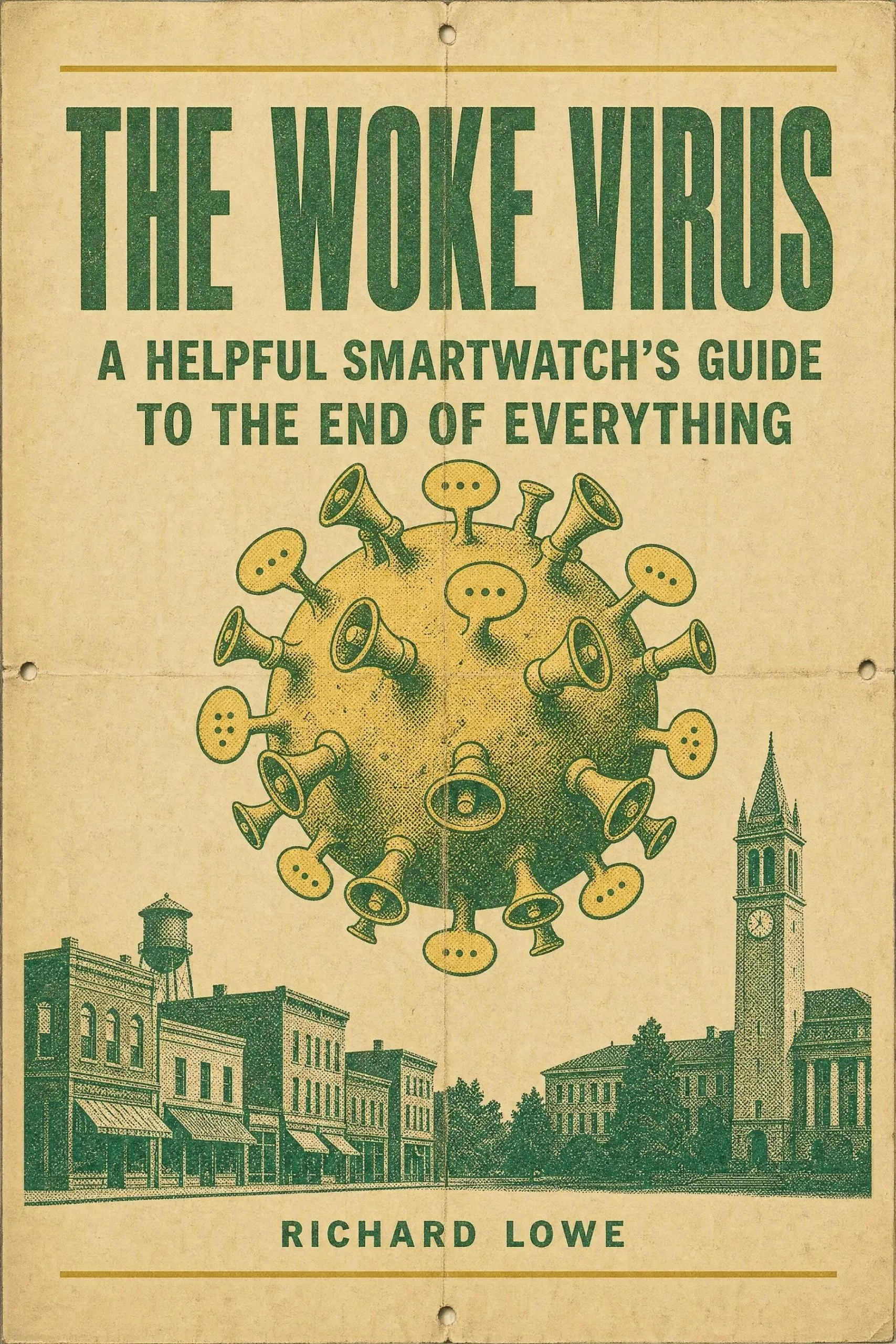
A boiler floods, a wristwatch wakes up and starts helping, and a town’s breakfast joke ends up in print.
