
Death, Murder, and Zombies
Not rage. Not desperation. Logic, applied to a premise that’s wrong.
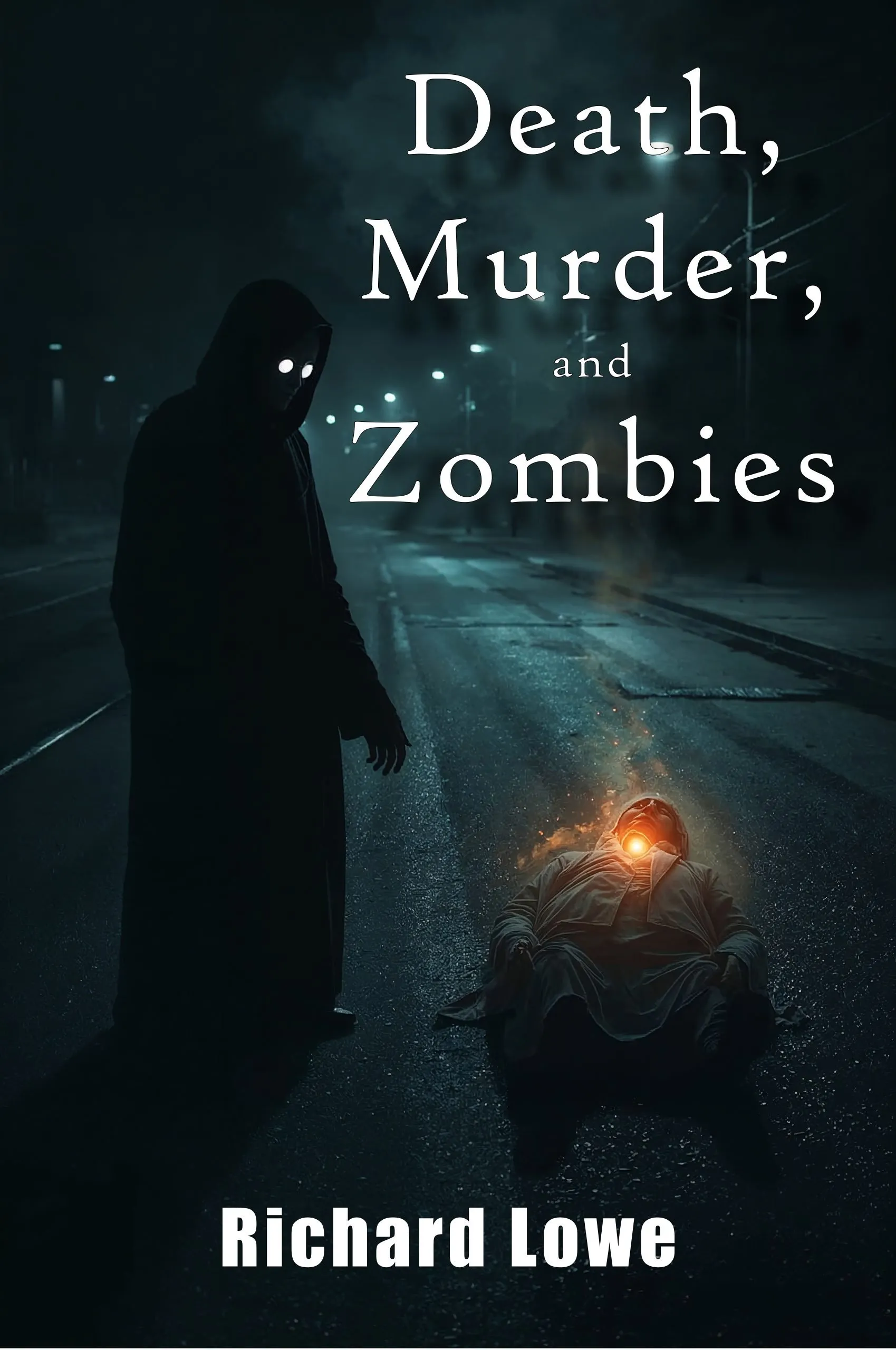 |
What would it take for an ordinary person to become a killer? Standalone · 204 pages · First person, Karl · Adult content BUY FROM INGRAMSPARKAMAZONKOBOREAD A CHAPTERTABLE OF CONTENTS Paperback ISBN 978-1-972810-09-5 · ebook ISBN 978-1-972810-40-8 |
| 204Pages | 1Wrong premise | 1Narrator you can’t trust | 0Excuses offered |
I understood in that instant that everything people believe about life and death is wrong.
Karl, from the novel
Not rage, not poverty, not trauma. Careful, patient, internally consistent logic applied to a premise that happens to be false. Karl works it out step by step, and every step follows from the one before it.
The zombie apocalypse doesn’t arrive until late. Most of the book is the descent, narrated by a man who’s always wrong about himself and always right about the facts. That’s the most uncomfortable combination available.
| Detail | From the page |
|---|---|
| Format | Standalone, 204 pages |
| Narrator | Karl, in first person |
| Genre | Psychological horror with a supernatural structure |
| When the zombies arrive | Late; most of the book is the descent |
| Original title | How to Create Your Own Zombie Apocalypse |
| For readers of | Joe Hill, Paul Tremblay and Thomas Tryon |
| Content warning | Graphic violence, murder, animal cruelty, serial killing |
For readers of Joe Hill, Paul Tremblay, and Thomas Tryon.
How does Death, Murder, and Zombies open?
Meet Death
I stopped dead in my tracks. The wrongness hit me. Something was coming. Something bad.
I’d felt this before, this sense that the cosmic order was about to get royally fucked. Tonight it pressed harder than usual, like a migraine building behind my eyes.
I stood on cracked pavement in the worst part of the city, surrounded by condemned buildings and broken glass. The wrongness didn’t come from any one place. It was everywhere. A sour note in a symphony I’d been conducting for millennia.
Something is coming, I thought. These feelings were never wrong. Just annoyingly vague.
A siren wailed in the distance. Ambulance. Someone was dying. I’d work to do. I pushed the wrongness to the back of my mind and headed toward my destination: a crack house that had been killing people for the better part of a decade.
The building leaned against its neighbor like a drunk needing support. Graffiti covered every surface in layers. Gang tags, love notes, and curses in four languages competed for space on walls that had once been yellow.
I walked through the front door without opening it. Physical barriers stopped mattering to me long ago. The living locked themselves in. Death walked through walls.
The smell hit me first. Sweet approaching death mixed with burned chemicals and human waste. Somewhere in this building, a soul was getting ready to leave, and I felt the familiar pull of duty.
The first floor was a maze of collapsed walls and improvised rooms. Bodies lay scattered on stained mattresses and bare concrete. Some breathed in shallow gasps. Others had fled into chemical oblivion, their minds escaped to whatever landscapes their drugs provided.
None of these were ready for me yet. I could sense the difference. These souls still clung to their flesh, unwilling to let go despite the poison in their veins. They’d die eventually. But not today.
I stood in the hallway. I’d been here long enough for the drug in her arm to do its work. The hunger said it had been too long. The part of me that was still Karl said I should go.
I climbed the stairs. The wood sagged under weight it was never meant to bear. On the second floor the dying was more advanced. Six souls hovered at the threshold, their connections to life growing weaker by the hour.
But the pull I felt came from higher up.
The third floor had been chopped into smaller rooms, each one a private hell where addiction played its final hand. I followed the sensation to a corner room where a young woman lay on a mattress that had seen better decades.
Tina Morrison. Seventeen years old, though her body looked twice that. Born to a mother who sold food stamps for crack and a father whose name appeared on no documents. On the streets since thirteen, trading pieces of herself for escape from a world that never wanted her.
Now the bill was coming due.
I settled beside her, invisible to any living witness. Her breathing had turned irregular, each breath requiring more effort than the last. Her heart fought against the poison she’d shot into her arm. Pure heroin, purer than her tolerance could handle.
This part never got old. Every death was unique, every soul’s departure a singular moment. Some fought to the end, raging against the inevitable. Others welcomed me like an old friend. Most just accepted what they’d always known was coming.
Tina’s eyes fluttered open, pupils pinpoints despite the dim light. For a moment I wondered if she might sense my presence, as a rare few could. But her gaze fixed on something beyond the stained ceiling, maybe seeing the life she might have lived.
Her heart stuttered, paused, then beat once more like an engine running on fumes. Then it stopped.
I waited. Death wasn’t a single moment but a process. The brain would keep trying for several more minutes, firing neurons in chaotic patterns as oxygen ran out.
When the last electrical impulse faded and true death claimed her, I reached into her chest. My hand passed through skin and bone like mist, searching for the essence that had animated this collection of matter for seventeen hard years.
There. Tucked between liver and spine, a sphere of light no bigger than a pearl, pulsing with its own glow. Tina’s soul, ready to continue its journey.
As I extracted her essence, she appeared beside her abandoned body. Not as the ravaged girl who’d just died, but as the bright spirit she’d been beneath all the damage.
“Who the hell are you?” she asked, her voice rough despite being freed from her damaged throat.
A friend. I’m here to help you move on.
“Am I dead? Shit, I’m dead, ain’t I?”
Your body is. You’re not. You can never die, Tina. You’re more than flesh and bone. Now it’s time to burn bright again.
She looked down at her corpse with relief. “Damn thing hurt so bad.”
I know. But that hurt stays with the body you’re leaving. Where you’re going, there’s no pain.
I opened the small pouch hanging from my belt, woven from space itself, capable of holding infinite souls in comfort. You ready for this?
Tina nodded and let herself be drawn into the pouch, where she’d rest until Fate could weave her into a new life, new body, new chances to learn and love.
As I sealed the pouch, the wrongness hit me again, stronger than before. I paused in the doorway and expanded my senses, trying to find the source.
Somewhere in this city, maybe right now, choices were being made that would ripple through time. Someone was planning something that would threaten everything I’d spent eternity maintaining.
The chapter keeps going.
Who should read Death, Murder, and Zombies?
|
Read it if
|
Not for you if
|
► Behind the Book: Death, Murder, and Zombies
How this one got written, what went wrong, and what got cut.
How did Death, Murder, and Zombies come about?
Richard Lowe, the Writing King
This was the third novel I wrote for myself. The original title was How to Create Your Own Zombie Apocalypse, which tells you exactly what I was doing: working out, step by step, how a person would go about starting one.
I came up with an answer, and the answer turned out to be a man reasoning carefully from a premise that’s wrong. No rage, no trauma, no excuse. Just consistency.
Karl's horror comes from reasoning, not rage: sound logic built on a premise that is wrong.
I wrote it snarky and funny at the same time, because a book this dark that takes itself completely seriously is unreadable, and because Karl thinks he’s being reasonable, which is funnier than anything I could put in on purpose.
What do people ask about Death, Murder, and Zombies?
Also in Under Pressure
|
A career criminal, a patrolman, and a desert highway |
The world didn’t end with a single decision |
|
A salon owner, a mail carrier, and a problem that needs solving |
Every step follows from the one before it
The first step is the only one that was wrong.
BUY FROM INGRAMSPARKAMAZONKOBOREAD A CHAPTERTABLE OF CONTENTS
Paperback and ebook.
Attack of the Zombies
Death, Murder, and Zombies
Three days after our whiskey session, Mike returned with pizza and a twelve-pack of beer. The whiskey had been a mistake. Too much too fast. Beer was better for an afternoon of gaming.
I didn’t argue. The hangover from our last session had lasted two days, and I wasn’t eager to repeat the experience. Besides, Mike seemed happy when I agreed to hang out again. It felt good to make someone happy, even if it was just agreeing to waste time together.
The living room looked marginally better than it had during his last visit. I’d cleaned up some of the trash and opened a window to air out the smell. Small improvements, but Mike noticed and said nothing.
“You want to pick up where we left off?” he asked, gesturing toward my gaming setup.
“I was thinking we could try something different. You ever play Dead Rising?”
Mike’s face fell slightly. “The zombie game? I thought we were done with zombies for a while.”
“This one’s different. Co-op mode. We can work together instead of competing.”
“I don’t know, man. Those games are pretty intense.”
“Come on. Trust me. It’ll be fun.”
I’d been thinking about our conversation from the other day, about trying new things and not giving up. Maybe zombie games weren’t the problem. Maybe the problem was playing them alone, using them to escape instead of connect.
Mike cracked open a beer and settled into the chair I’d moved next to mine. “All right, but if this turns into another one of your obsessive gaming marathons, I’m out.”
“It won’t. I promise.”
I loaded up Dead Rising and created a co-op session. Mike’s character spawned next to mine in the middle of a shopping mall overrun with zombies. Unlike my usual solo sessions, where I methodically cleared every area with tactical precision, this felt different. Lighter.
“Holy shit, there’s a lot of them,” Mike said as his character swung a baseball bat at a group of approaching zombies.
“That’s the point. You’re not supposed to kill them all. You’re supposed to survive.”
“What’s the difference?”
“Killing them all is about control. Surviving is about adaptation.”
Mike gave me a look. “Did you just make that up, or is that game philosophy?”
“I made it up. But it sounds good, right?”
We played for an hour, our characters working together to rescue survivors and gather supplies. Mike’s approach was completely different from mine. Where I’d carefully plan each encounter, he charged in swinging whatever weapon he could find. Where I’d memorize zombie spawn patterns, he improvised and adapted on the fly.
It was chaos, but it was fun chaos. The kind of fun I’d forgotten existed.
“Oh shit, oh shit, oh shit,” Mike chanted as his character got surrounded by a group of fast zombies.
“Hold on, I’m coming,” I said, maneuvering my character through the crowd with a shotgun.
The rescue went perfectly. My character arrived just as Mike’s health bar hit critical, blasting away the zombies and clearing a path to safety. Mike’s character limped to cover while mine provided covering fire.
“That was awesome,” Mike said, taking a long pull from his beer. “Like an action movie.”
“See? Teamwork makes it better.”
“Yeah, but what happens when we run out of ammo?”
“Then we improvise.”
Both our characters ran out of ammunition at the same moment. The game forced us to scavenge for makeshift weapons: golf clubs, kitchen knives, a potted plant. Everything became a potential zombie-killing tool.
“This is pretty fun,” Mike admitted after his character killed three zombies with a traffic cone.
“I told you.”
“But don’t you usually play this solo? Doesn’t that get depressing?”
I paused the game and looked at him. “What do you mean?”
“I mean, killing zombies by yourself for hours. That’s got to mess with your head after a while.”
“It’s a game.”
“Is it? Because you talk about it like it’s training for something real.”
Mike had a point. I did think about zombie games differently than he did. For him, they were entertainment. For me, they were preparation. But preparation for what?
“You ever think about what you’d do in a real zombie apocalypse?” I asked.
“Not really. It’s not going to happen.”
“But what if it did?”
Mike set down his controller and looked at me seriously. “Karl, zombies aren’t real. You know that, right?”
Table of contents
Death, Murder, and Zombies
- Meet Death
- Gaming Life
- Family Fractures
- The Accident
- Attack of the Zombies
- Close to Death
- Awakening
- The Theory Forms
- I Want to Shoot Zombies for Real
- Research Phase
- Making Money
- Setting Up Shop
- Animal Experiments
- Mike Returns
- Recruitment
- Gwynn’s Story
- The First Test
- Experiment
- Death’s Patterns
- Building the Cage
- Dad Comes Home
- The Bait
- The Trap Springs
- The Ultimatum
- The Standoff
- Transformation
- Karl’s New World