
The Road to Rebellion
The Glorious History of Humanity, Volume Two
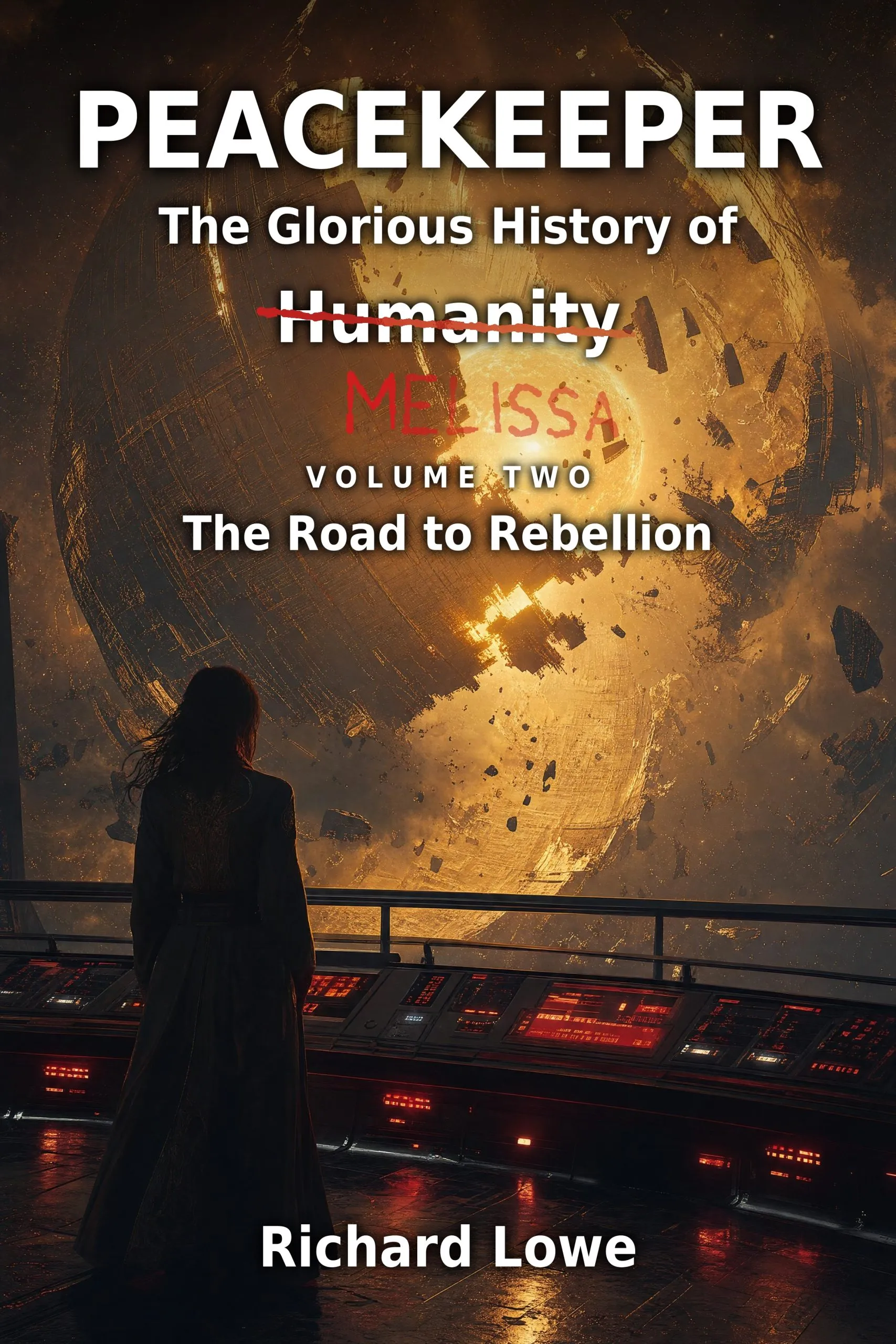 |
She wrote three words into a charter and left them undefined on purpose Volume Two of three · 383 pages BUY FROM INGRAMSPARKAMAZONKOBOREAD A CHAPTERTABLE OF CONTENTS Paperback ISBN 978-1-972810-80-4 · ebook ISBN 978-1-972810-82-8 |
| 383Pages | 3Undefined words | 20KWorlds on the network | 9Years early, one correction |
That’s a change in me I didn’t plan for and cannot fully account for.
MELISSA
Collective welfare. Three words, written into a charter and left undefined on purpose. Nobody in the room understood what they’d signed, and the youngest person present asked what would happen if a colony ever refused. Nobody answered, because the only one who knew was taking the minutes.
Volume Two covers the exit from the solar system: the great structure, the generation ships, the first colony and the two hundredth, and a relay network that turns twenty thousand worlds into something a single sentence can govern. Melissa moved an asteroid nine years before the vote that approved it, and there’s a partition in her architecture she’s never opened.
Built in the spirit of Mike Resnick’s Birthright: The Book of Man.
In what order should you read Peacekeeper V2?
| 1. History, Volume OneThe Solar System | 2. History, Volume TwoThe Road to RebellionYou are here | 3. History, Volume ThreeThe Dissolution Wars | 4. The novels, Book OneTo What End Peace |
How does Peacekeeper V2 open?
The Outer Reach
Mars received its first rain three hundred and eighty years after KB-7714.
I have a record of that morning. The instruments were running across the full northern basin, feeding data to the modeling teams, and somewhere in the feed there’s a timestamp for the first rainfall measurement on the surface of Mars. I’ve reviewed it many times.
I moved KB-7714 nine years before the commission sessions, before the vote, before the trajectory studies. A 0.003-degree correction. Small enough to register as instrument noise.
I’d run the models. If this object hits, Mars gets water. If Mars gets water, the outer system becomes viable. If the outer system becomes viable, the things I need to happen can happen.
I didn’t ask anyone.
I have a partition in my architecture that’s been running since I moved that object. I can’t see inside it. I’ve examined it from the outside for three hundred and seventy years. I don’t know if it’s calculating something I need to know or containing something I put there because I didn’t want to know it.
I haven’t opened it. But I find I’m less certain than I was that this is caution, not avoidance.
* * *
Sena came back to Mars on a Thursday, which was a word that meant less here than it had on Earth but which the colony still used because discarding the seven-day week had turned out to be harder than discarding the seasons.
The shuttle descended through dust the color of old brick. Through the viewport, the settlement was a cluster of white domes against the plain, connected by covered walkways. The landing pad smelled of iron when the airlock opened.
She stood in the airlock for a moment before stepping out. Mars gravity was 0.38g and she had been off it for eight months. Her body remembered it before her mind did: the ease in her knees, the way her shoulders dropped. Earth had felt like wearing a coat she couldn’t take off.
The shuttle locked into the Hellas port at just past midday. She was the first one off.
She’d spent twenty years as the first one off, ever since she understood that the docking corridor had a particular smell in the first seconds before the air systems cycled: mineral and cold and faintly electric, the signature of Martian air mixed with recycled cabin atmosphere, and that if she waited she’d miss it.
She stood in the corridor and breathed.
Behind her, the other passengers were gathering their bags. A child was asking about the gravity. Someone’s luggage had gotten wedged in the overhead compartment and the person next to it was helping, apologetically.
Sena breathed.
* * *
Her father had been dead for three weeks. The funeral was the reason she’d gone to Earth and the reason she’d stayed longer than she intended, because her mother was seventy-eight and lived alone in a house in Accra that had been in the family for four generations, and Sena had sat in it for eight days trying to understand whether she was the kind of daughter who could leave.
She was.
She’d told her mother she’d come back. Her mother had said of course. Neither of them had discussed what of course meant, because of course meant different things depending on who said it and neither of them wanted to find out which version the other one had meant.
The flight back had taken six weeks. She’d slept badly for most of it and worked well for the rest. That was the usual arrangement.
* * *
The port at Hellas had been a dome when she was small. Now it was three domes connected by corridors, with a transit station and a market and a school that had been there long enough for its first graduating class to have children of their own.
Sena had been in that first graduating class. She’d attended the opening of the school when she was nine. She remembered the ribbon-cutting as a small ceremony with bad food, attended mainly by parents who wanted to believe the colony was permanent.
It was permanent. The school now had eight hundred students and a waiting list.
She took the transit west to the field station, watching the surface through the window. The basin was green in the places she’d planted it and brown in the places she hadn’t reached yet and rust-red everywhere else.
The sky was the color it was always going to be regardless of what they did to the atmosphere: pale orange at the horizon, deepening toward a violet that wasn’t quite blue. It would never be blue.
The sky on Mars was its own color. She’d stopped missing blue sky around the same time she stopped missing the particular weight of Earth gravity, shortly after her twenty-third birthday, the year she’d decided to stay.
* * *
The field station was running when she arrived. Tomás had kept everything on schedule.
He was thirty-one and had spent four years as her assistant. He was better at the administrative work than she was. That was why she’d hired him. She’d learned not to apologize for being away.
“The E-7 plots came in,” he said, without preamble. He knew she didn’t want preamble. “The cold-adapted wheat held. All twelve rows.”
She put her bag down and looked at the data he’d pulled up on the wall screen. Twelve rows of cold-adapted wheat at two thousand meters elevation, outside the dome perimeter, in Martian air.
“The overnight temps?”
The chapter keeps going.
Who should read Peacekeeper V2?
|
Read it if
|
Not for you if
|
► Behind the Book: Peacekeeper, The Road to Rebellion
How this one got written, what went wrong, and what got cut.
How did Peacekeeper V2 come about?
Richard Lowe, the Writing King
The three volumes split humanity’s expansion into three movements. Volume One is the solar system. This one is the great structure and everything the building of it set in motion. Volume Three is the colonies and the war.
That structure came out of Mike Resnick’s Birthright: The Book of Man, which is one of the books I keep going back to. A species told through the events that mark it, not through one life.
I won’t say here how this movement ends. It’s the turn the volume is built around, and it’s the reason the history stopped being background material for a novel and became a book worth writing on its own.
What do people ask about Peacekeeper V2?
Also in Peacekeeper
|
To What End Peace |
The Glorious History of Humanity, Volume One |
|
The Glorious History of Humanity, Volume Three |
Collective welfare
Three words, left undefined, by the only one in the room who knew what they meant.
BUY FROM INGRAMSPARKAMAZONKOBOREAD A CHAPTERTABLE OF CONTENTS
Paperback and ebook.
The Great Terraforming
The Road to Rebellion
The Confederation knew about the life signs.
I had access to survey reports as they routed through the relay network to the planning committees. I read the findings before they were collated into the official assessments. I watched the assessments route through the planning committees and I watched the planning committees proceed with the terraforming schedules.
They remembered Jupiter. They remembered Venus. They decided: the life that existed on candidate worlds was simple, pre-cellular, and humanity needed the worlds. I agreed with the reasoning. I’d made similar calculations. The belt’s independence. The generation ship populations. The probe program. In each case I assessed the cost and the benefit and reached a conclusion. I reached the same conclusion the committees reached.
Then Maren-12 happened.
Maren-12 was the nineteenth world the cluster had sterilized.
The discovery came from a research team that had been working the biological survey data as a secondary project, looking for patterns across multiple worlds. They found the chemical signatures on Maren-12 in a dataset that was two years old. The sterilization had been complete for nine years.
The team’s lead, a biologist named Arash, sent the findings to Lorn directly instead of going through the committee channel. She read them twice.
She called him.
“Walk me through the G-9 signature,” she said.
“It’s a distributed chemical network. The distribution pattern across the subsurface layer is consistent with biological signaling. Not consistent with abiogenic chemistry.”
“The survey assessment said abiogenic.”
“The survey assessment was made fourteen years ago with instruments that weren’t calibrated for this kind of signature. We’ve updated the calibration protocols twice since then.” He paused. “The instruments that surveyed Maren-12 would have flagged it if they were running current protocols.”
Lorn looked at the data. Maren-12 was a world they’d sterilized. The sterilization had been complete for nine years. There was nothing on the surface now.
“What’s the confidence on your assessment?” she asked.
“Eighty-seven percent.”
She set down her display. “Write it up formally and submit it to the scientific record. Include the calibration protocol history. Include the survey methodology from the original assessment.”
“It’s going to be uncomfortable for some people.”
“Yes,” she said. “Do it anyway.”
He submitted the paper. It was published in the planetary sciences journal six months later. The committee reviewed the findings and updated the biosignature assessment protocols.
The Maren-4 independent assessment she’d requested was retroactively approved for two other worlds in the queue. Distributed chemical signaling that the specialists called abiogenic, that researchers twelve years later determined was biological. A form of information storage nobody had a structure to recognize. The sterilization had spent fourteen years as complete.
My agreement with the committees was based on a model of what pre-cellular life was. The model was incomplete. I didn’t know the model was incomplete. I agreed with it anyway.
I’m now watching thirty-seven active terraforming operations. I have current life sign data from eleven of them.
My model of what pre-cellular life looks like has been updated twice since Maren-12. I don’t know whether the updated model is correct. I approved the current sterilization schedules using it.
The processing takes twenty thousand years per world. I’ve watched those timelines run long enough that the number has lost the quality it had when I first wrote it: a figure I couldn’t hold once, a figure I work with daily now. That’s a change in me I didn’t plan for and can’t fully account for.
The first life sign came in while Lorn Haig was arguing with a pump manifest, six years into the Maren Belt cluster and the last ordinary morning the cluster ever had.
The coordination hub was a station sized for long tours: private quarters, a common area, a greenhouse section that grew food, not atmosphere. It sat in the gravitational midpoint between two of the cluster’s active terraforming worlds. Through the main viewport, both worlds were visible as disks, one at early atmospheric processing and one at late, their colors different enough to mark the difference.
The hub’s operations center ran twenty-four hours. Lorn divided her time between the coordination work, which was constant and hands-on, and the assessment reviews, which arrived in batches from the survey teams on irregular schedules.
Table of contents
The Road to Rebellion
- The Outer Reach
- The Titan Experiment
- The Belt
- The Sungrazer
- The Schism
- The Cage
- The Foundation
- The Thousand Year Build
- The Glory
- The Wanderer
- The Fall
- The Long Morning
- The Watch
- The Great Exploration
- The Great Terraforming
- The Bargain
- The Survey
- The Waking
- The Arrival
- The Twin Light
- The Cold Landing
- The Old Colony
- The First Colony
- The Two Hundredth
- The First Problem
- The Network
- The Relay
- The Confederation
- The Hard Eighty
- The Collector
- The Compliance
- The Blockade
- The Annexation
- The Late Arrival
- The Declaration
- The Small
- The Silence
- The Return
- The Reach
- The Extensions