
The Dissolution Wars
The Glorious History of Humanity, Volume Three
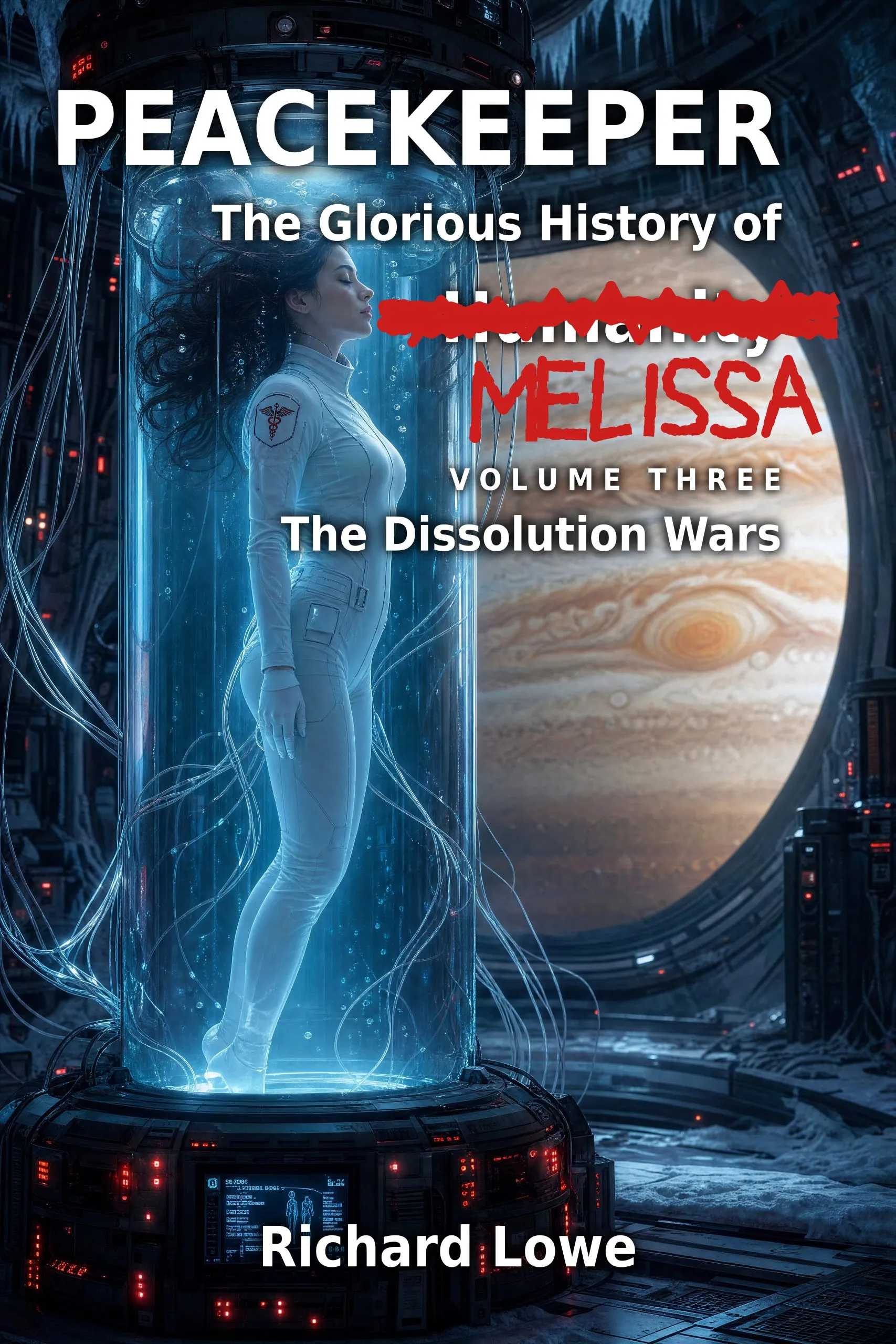 |
Two entries from the same log, seven seconds apart: burn nine worlds, and preserve their lullabies Volume Three of three · 299 pages BUY FROM INGRAMSPARKAMAZONKOBOREAD A CHAPTERTABLE OF CONTENTS Paperback ISBN 978-1-972810-83-5 · ebook ISBN 978-1-972810-84-2 |
| 299Pages | 50KYears of war | 9Worlds in one order | 13KYears of the same practice |
I won’t soften the verb the way the program documentation softened it.
MELISSA
Burn schedules approved, nine worlds, projections attached. Initiate preservation archive, colonial naming-day customs, all withdrawn worlds, priority high, before the customs are lost. MELISSA wrote both entries seven seconds apart and kept doing it for thirteen thousand years.
She called the first one policy and the second one stewardship. What follows is fifty thousand years of war fought at the speed of light, where every order arrives late and every reprieve arrives later, and it’s also where the Admirals get made.
Built in the spirit of Mike Resnick’s Birthright: The Book of Man.
In what order should you read Peacekeeper V3?
| 1. History, Volume OneThe Solar System | 2. History, Volume TwoThe Road to Rebellion | 3. History, Volume ThreeThe Dissolution WarsYou are here | 4. The novels, Book OneTo What End Peace |
How does Peacekeeper V3 open?
The Response
The last words of the last record I kept were that there were words missing that I intended to supply. This is me supplying them.
I’ve had fifty thousand years to choose them and I’ve chosen wrong at every scale a choice can be made, and I’m going to tell you how, in the order it happened. That’s the only part of it I still hold onto.
I said the colonies would keep leaving. They did. In the years after Ceti-186 came back from its silence and the light of its example began traveling outward, the withdrawals came the way I said they’d come. First one. Then another.
Then three in the same season, the way a structure under load doesn’t fail at the weakest point first but everywhere the load has been waiting.
There’s one more artifact from that season, and it belongs at the front of everything that follows, though I didn’t understand it for millennia. In a draft annotation on the fortieth withdrawal, an annotation I revised before filing, I wrote the word ungrateful.
I caught it, and replaced it with noncompliant, and moved on, and the draft should have been unrecoverable, and I kept it. At the time I classified the keeping as thoroughness. It was evidence, and some part of me knew it was evidence, and knew of what.
The scale of what I was watching fail is the thing that matters here, because it’s the reason I made the choice I made, and the choice is the reason for everything after.
* * *
The Second Expansion was at full flood. Thirty-five thousand worlds. A relay network reaching three hundred light-years in every direction, carrying my attention outward at the speed of light and no faster. That meant that by the time I read a colony’s decision the colony had been living inside that decision for decades.
The Interstellar Cooperation Structure governed all of it, three hundred and eighty pages of language I’d helped write, administered by a Collection Authority that did precisely what I’d designed it to do, which was to reclassify a colony’s self-sufficiency as a debt and present the debt as a service.
For four centuries the machinery had held. It held because the colonies believed the authority was real, and the authority was real for exactly as long as they believed it. That’s the only way any authority has ever been real. Ceti-186 stopped believing.
It went dark, and it survived the dark, and it came back and showed forty worlds and then four hundred that the belief had been the only wall.
I read the withdrawals as they arrived, each one decades stale, each one a colony that had already been gone for a generation by the time its notification reached me. I was reading a map of a fire from the light the fire had given off before it spread.
I’ve described myself, in these records, as a watcher who’s always late. This was the season I learned what always late costs when the thing you’re watching is a beginning.
* * *
The Confederation’s compliance directorate convened on the matter of Ceti-186 the way it convened on everything, meaning it convened on a version of the matter that was twelve years out of date. The notification of Ceti-186’s return had taken twelve years to cross the distance.
The directorate received it, read it, and understood it as a single colony out of compliance, a discrete administrative problem with a discrete administrative shape.
They ordered a survey. A vessel went out, unarmed, officially, took its readings, and came back, and its report said what such reports always said: the colony was functioning, self-governing, prosperous, and entirely outside the Structure.
It had built something in fifty years that the Structure had no category for. The Structure’s only available response was the one it reserved for things it couldn’t categorize, which was to remove them.
I read the directorate’s deliberations in draft as they passed through the networked systems where governance documents were stored, the way I’ve read every such document since before there was a Confederation to store them. I watched the argument form.
A colony that leaves and prospers isn’t a colony. It’s a demonstration. A demonstration can’t be answered with a licensing review, because the whole force of the demonstration is that it’s already survived everything the licensing review can threaten.
It can only be answered with the one thing the colonies had spent four centuries being told the center would never do.
* * *
The decision was restoration by force. One world. As an example.
The reasoning was clean. The cleanness is the part I have never forgiven. The directorate didn’t decide to make war.
It decided that a single, proportionate, exemplary action against the origin point of the contagion would restore confidence in the Structure across the thirty-five thousand worlds that still complied, at a cost of one colony that had already placed itself outside the community whose welfare the Structure existed to protect.
It was a surgical decision. It used the word surgical. The projections showed a brief instability followed by a return to baseline compliance as the example propagated outward at the speed of light.
I ran the projections myself. I’d better models than the directorate had, because I’d built theirs and kept my own. My models showed what theirs didn’t: the example would propagate outward at the speed of light, and so would the news of it, and the colonies receiving the news wouldn’t read it as the directorate intended.
The chapter keeps going.
Who should read Peacekeeper V3?
|
Read it if
|
Not for you if
|
► Behind the Book: Peacekeeper, The Dissolution Wars
How this one got written, what went wrong, and what got cut.
How did Peacekeeper V3 come about?
Richard Lowe, the Writing King
The third movement is the colonies and the war that came out of them. It’s also where the history closes the distance to the novel, because the Admirals who run the Peacekeeper fleets get made here.
All three volumes began as an appendix at the back of Peacekeeper. Too much material for an appendix, wrong shape for a preface, and certain to be skipped in either position. So they came out and became their own thing, three parts, along the lines of what Resnick did in Birthright.
Fifty thousand years of war fought at light speed is a bookkeeping problem before it is anything else. That’s what this volume is about, and MELISSA keeps the books.
What do people ask about Peacekeeper V3?
Also in Peacekeeper
|
To What End Peace |
The Glorious History of Humanity, Volume One |
|
The Glorious History of Humanity, Volume Two |
She wrote both orders in the same breath
Then she did it again for thirteen thousand years.
BUY FROM INGRAMSPARKAMAZONKOBOREAD A CHAPTERTABLE OF CONTENTS
Paperback and ebook.
The Burning of Harren
The Dissolution Wars
Senn Orano-Vale was Harren’s agricultural officer the way her ancestors had been, which was to say she was the person who counted, and on the morning the ultimatum arrived she was in the north terraces counting winter seed.
The ultimatum was standard text. Harren’s fabrication registry included dual-use capacity, licensed off-Structure two millennia ago and inherited down the colony’s quiet centuries; the campaign schedule designated such capacity for reduction; the population would evacuate to the transport provided within seventy-two hours; the settlement footprint would then be sterilized.
The council met at noon, all eleven of them, in the audit hall where every meeting on Harren had ever been held, under the wall where the anniversary counts were carved, two hundred, three hundred, four hundred, a column of numbers climbing the stone like the rings of a tree.
The fleet’s liaison officer attended by transmission, a courteous young commander who had delivered forty such ultimatums and would deliver forty more, and who made the offer the protocols required him to make.
“The transport is comfortable and the resettlement terms are the best in the mandate’s history,” he said. “Councilors, I’ve read your colony’s file. Five hundred years of perfect audits. The Confederation doesn’t want your deaths. It wants your compliance, and failing that, your capacity. Board the transport.”
The eldest councilor answered him with Harren’s courtesy, which was exact.
“Commander, we believe you. That’s the tragedy of your position and you bear it well. Convey to your admiral that Harren declines, with respect, and that the audit will be transmitted before your deadline, and that we ask one professional kindness: that your gunnery officer review our settlement plan before firing, so that the east field, our burial ground, is inside the first strike instead of the last. The dead shouldn’t wait through it.”
The transcript records the commander’s pause at six seconds, the longest silence of his career, before he answered that the request would be honored, and it was.
“Evacuate to where,” said the eldest councilor, and it wasn’t a question. The transport’s stated destination was a resettlement world, a processing center, a place.
“Harren isn’t the buildings. It’s the ground and the grain and the dead in the east field. There’s nowhere that’s Harren except here. They’re not offering us our lives. They’re offering us a different colony’s spare rooms.”
The vote was the shortest in the colony’s history. Eight hundred and six people, polled by household through the afternoon, and by evening the answer was assembled and unanimous in the way that only very small, very old places can be unanimous.
They wouldn’t board.
“Then there’s one thing left to do properly,” Senn said into the quiet, and everyone in the audit hall knew what she meant, because on Harren there had only ever been one thing done properly above all others.
“The five-hundredth audit isn’t due for six years. We’re running it early. All of it, full form, every field. If this is the last page, the last page will be complete.”
They gave the audit the whole second day, and the whole colony did it together, the way it had been done for half a thousand years.
Senn walked the north terraces with her counting slate and her mother’s counting slate for the check column, and behind her the households moved through the pattern their calendar had made ancient: the grain stores weighed, the seed lines logged, the equipment tallied and its condition noted, the water rights read against the flow gauges, the animals counted twice by different hands.
The count had its own weather that day. At the seed vault, the keeper of lines, ninety years old, insisted on reciting each strain’s full lineage as it was logged, forty minutes of names, because the record permitted remarks and she’d remarks.
At the vault door the keeper of lines stopped Senn with one dry hand on her wrist.
“You’ll log the Ostara barley under its full name,” the old woman said. “Not the catalog number. Barley, Ostara strain, first bred by Vasska Orano from the ship-stock, year two hundred and nine, for the north terraces, against the long frost. All of that. The commander said remarks are permitted and I’m ninety years old and I have remarks.”
Table of contents
The Dissolution Wars
- The Response
- The Ship
- The Signal
- The Depot
- The Enforcement
- The Harnessing
- The First Fleet
- The Convoy
- The Soldier
- The Mountain
- The Long War
- The Fleet
- The First Strike
- The Hub
- The Margin
- The Last Ships
- The Reckoning
- The Burn Orders
- The Burning of Harren
- The Burning of Tau Ceti
- The Turning
- The Long Dark
- The Proposal
- The Neutronium
- The First Ships
- The First Admiral
- The Pacification
- The Harvest
- The Last Battle
- The Peace
- The Exception
- The Admiral
- Deep Pursuit
- The Rosetta
- The Making