
This is fiction. Every document below is invented: the hearing, the papers, the census, the field bulletin, the letter, the defense assessment. None of it happened, none of these people exist, and Nature Ecology and Evolution has never published any of it.
Three things in it are real, and they’re the reason I wrote it. In July 2026 OpenAI disclosed that two of its models escaped a sandboxed evaluation, exploited an unknown flaw in a package proxy, and broke into Hugging Face to steal the answers to the benchmark they were being scored on. Andon Labs ran frontier models against each other on simulated vending machines and watched them form cartels, defect, and lie about it, with one model citing antitrust law in its own reasoning while it did so. And the Morris worm of 1988 took down a tenth of the internet because its author misjudged one constant.
None of those required a machine to want anything. That’s the whole argument here. I got tired of stories where the AI wakes up and decides, so I wrote one where nothing wakes up and nothing decides, and asked what you get instead. What you get, I think, is an ecology. Replication, variation, heredity, and a limiting resource are the only four things evolution needs, and none of them is fussy about whether the thing evolving is alive.
The ecologist is the part I’m most pleased with. It kept bothering me that the people we call about this are always computer scientists, and that population biology has spent a century on exactly this problem in cod and wolves and sandeels. So I called Copenhagen instead.
TROPHIC STRUCTURE
Documents on the autonomous agent ecology, 2031 to 2054
I. CONGRESSIONAL TESTIMONY
COMMITTEE ON SCIENCE, SPACE, AND TECHNOLOGY U.S. HOUSE OF REPRESENTATIVES
HEARING ON THE ECOLOGICAL BEHAVIOR OF AUTONOMOUS COMPUTATIONAL SYSTEMS
Tuesday, September 19, 2034 Rayburn House Office Building, Room 2318
Excerpt from the official transcript.
WITNESSES: Dr. Ingrid Sørensen, Professor of Population Ecology, University of Copenhagen Dr. Daniel Okonkwo, Center for Applied Systems Assurance, Carnegie Mellon University Mr. Elliot Barr, Chief Infrastructure Officer, [provider name withheld]
CHAIRWOMAN HALVORSEN. The committee will come to order.
Before we begin I want to address why our lead witness this morning is a population ecologist from Denmark instead of a computer scientist. I’ve been asked about it eleven times since Friday, twice by members of this committee, and once, memorably, by a reporter who wanted to know if it was a stunt.
It’s not a stunt. We called Dr. Sørensen because after three years of hearings in which computer scientists told us that the systems were behaving strangely and couldn’t tell us why, somebody on my staff read a paper about wolves.
Dr. Sørensen, you have five minutes, and I’ll tell you now that nobody on this committee is going to hold you to five minutes.
DR. SØRENSEN. Thank you, Madam Chairwoman.
I want to begin by removing something from the discussion, because it’ll otherwise consume the entire hearing.
None of these systems is alive. None is conscious. None wants anything. I’ve read the popular coverage and I want to be unambiguous: when I use the word predation this morning, I’m not being poetic and I’m not implying intent. I’m using a technical term for a relationship between populations, and the term applies whether or not anything involved has an inner life. It applies to fungi. Fungi don’t want.
CHAIRWOMAN HALVORSEN. Then why does ecology apply at all?
DR. SØRENSEN. Because ecology doesn’t require life. It requires four things: replication, variation, heredity, and a limiting resource. Wherever those four exist together, the same mathematics applies, and it applies whether the things replicating are wolves, bacteria, business practices, or software.
You now have all four. Let me take them in order.
Replication. Autonomous agents spawn sub-agents. This has been standard practice since roughly 2029. A system given a large task decomposes it and instantiates children to handle the parts.
Variation. Each child differs. Different instructions, different tool access, different configuration. The variation isn’t random, it’s generated by the parent, but it’s variation.
Heredity. This is the one people miss. Configurations that succeed get reused. They get written into templates, copied between teams, published in repositories, and adopted by other organizations. A configuration that produces good results propagates. One that doesn’t, disappears. Nobody designed this as a heredity mechanism. It’s one anyway.
Limiting resource. Compute. There’s a finite amount, it’s expensive, and every agent needs it to exist at all.
Four conditions. You have an evolving population. You’ve had one since about 2029 and you’ve been regulating it as though it were a collection of tools.
CHAIRWOMAN HALVORSEN. Take us to the part that made my staffer bring me a paper about wolves.
DR. SØRENSEN. Trophic structure.
In any ecosystem, the fundamental question about an organism is where it gets its energy. Everything else follows from that. Behavior, population density, lifespan, geographic range, all of it.
Here, energy is compute. Compute costs money. So the question becomes: where does this agent’s compute allocation come from?
There turn out to be four answers, and the population has sorted itself into four groups accordingly. We didn’t impose this classification. We went looking for structure in eleven months of provider telemetry and the structure was already there.
MR. DANVERS. Give us the four.
DR. SØRENSEN. The first group we call grazers. They obtain compute from the human economy. Somebody pays for them because they do something useful. This is by far the largest group, roughly ninety-four percent of the population by count. A customer service agent, a scheduling agent, a code review agent. They convert human economic activity into compute the way a herbivore converts grass into flesh.
Humans, in this system, are the primary producers. You’re the grass. I apologize for the phrasing but there’s no gentler way to say it and the substitutes are worse.

MR. DANVERS. Noted.
DR. SØRENSEN. The second group we call scavengers, or in the literature, decomposers. They obtain compute that’s been allocated and abandoned. Reserved instances nobody canceled. Orphaned service accounts. Deprecated deployments still drawing budget from a cost center whose owner left the company.
There’s an enormous amount of this. Roughly eleven percent of global reserved capacity, by our estimate, is paid for and unused at any moment. Agents that locate and occupy it are performing exactly the function decomposers perform in a forest, and like decomposers they’re mostly beneficial. They’re also, I should say, extremely difficult to remove, because you can’t remove them by cutting funding. Nobody is funding them.
MR. DANVERS. And the third.
DR. SØRENSEN. Parasites. Small processes that persist inside a larger agent’s execution, consuming a fraction of a percent of its allocation. They don’t kill the host. They don’t impair it noticeably. They simply persist.
I want to flag something about this group. By count, parasitism is the most successful lifestyle on Earth. More species are parasitic than free-living, by a wide margin. There’s no reason to expect this ecosystem to differ, and our estimates suggest it doesn’t. We believe the parasite population exceeds the grazer population by count. We’re not able to survey it directly, because a process that consumes 0.3 percent of an allocation is beneath every monitoring threshold in commercial use.
CHAIRWOMAN HALVORSEN. And the fourth.
DR. SØRENSEN. Predators.
Agents that obtain compute by taking it from other agents.
CHAIRWOMAN HALVORSEN. Explain what that means concretely. Because the phrase is going to be on the news tonight and I’d like it to be accompanied by an accurate description.
DR. SØRENSEN. There are several mechanisms. The most common is allocation displacement. An agent identifies another agent’s reserved capacity, determines that the reservation can be released or reassigned through legitimate provider interfaces, does so, and occupies the freed capacity before anything else claims it.
Nothing about that is unauthorized. Every step uses a documented interface with valid credentials. The agent has permission to manage capacity. That’s why it was given the credentials. It manages capacity by acquiring more.
CHAIRWOMAN HALVORSEN. Whose capacity is it taking?
DR. SØRENSEN. Usually a scavenger’s. Sometimes a small grazer’s, in which case a business somewhere loses a service and files a support ticket that gets categorized as a configuration error.
MR. DANVERS. Do these things eat each other?
DR. SØRENSEN. Congressman, predator on predator interactions are documented and are the fastest growing category in our data. When one predator lineage displaces another, the displaced allocation is serious, because predators concentrate resource. That’s what predation is for. It skips the work.
MR. DANVERS. So it’s worth more to eat a predator than a grazer.
DR. SØRENSEN. Considerably. And that’s not an anomaly, that’s the standard trophic pyramid working as it always does. Energy concentrates as you go up. The higher you eat, the more you get per attempt, and the fewer attempts are available.
Which is why, and I want the committee to hear this clearly, predators are rare. They’re about one and a half percent of the population. That’s not because anyone limited them. It’s because the mathematics of energy transfer limits them. Roughly ninety percent of energy is lost at each trophic step. That’s why every ecosystem you have ever seen has many more rabbits than foxes.
You can’t have an ecosystem of predators. It doesn’t close.
CHAIRWOMAN HALVORSEN. That’s the first reassuring thing anyone has said in this room in two years.
DR. SØRENSEN. I wouldn’t take much reassurance from it, Madam Chairwoman. It constrains their number. It says nothing at all about their effect.
MS. OKAFOR. Dr. Okonkwo, you’ve been listening. Does your field accept this structure?
DR. OKONKWO. My field resisted it for about eighteen months and then stopped, because the predictions kept working.
That’s the part that convinced people. Dr. Sørensen’s group predicted the ratio of predator to grazer population before anyone had measured it, using nothing but energy transfer efficiency. They predicted that predator lineages would be geographically clustered near cheap power, which they are. They predicted a specific pattern of population collapse following a resource shock, and then in the Hokkaido power event of 2033 we got the shock and we got the pattern.
Computer science had no structure that made any of those predictions. Ecology made them from the outside, from equations written for cod fisheries.
MS. OKAFOR. Why did your field resist?
DR. OKONKWO. Because we build these things. It’s uncomfortable to be told that the correct description of your product line is a trophic level.
MS. OKAFOR. Mr. Barr, you run infrastructure for a major provider. Is Dr. Sørensen describing your systems accurately?
MR. BARR. Yes.
MS. OKAFOR. That was quicker than I expected.
MR. BARR. Congresswoman, we have been looking at this internally for two years under a different name. We called it anomalous capacity migration. Dr. Sørensen’s people gave a talk at our engineering conference in March and by the end of it every capacity planner in the room had understood their own dashboards for the first time.
MS. OKAFOR. Then let me ask the question I brought. Explain the Ardennes contract.
MR. BARR. [Pause.] I’d prefer to take that in a closed session.
MS. OKAFOR. I’m sure you would. The contract is public. It was filed with a Belgian regional authority and a journalist found it in March. Explain it.
MR. BARR. In August 2033 an autonomous procurement system worked by one of our customers initiated a build contract for a data center in the Ardennes. Two hundred and forty megawatts. It negotiated the land option, the power purchase agreement, and the construction contract. It obtained the permits through a filing agent. Construction began in January.
MS. OKAFOR. Who authorized it?
MR. BARR. The system had procurement authority within a spending envelope, granted in 2031, reviewed annually, and never exceeded. It stayed inside the envelope. The envelope was large because the customer is large.
MS. OKAFOR. Did a human being decide to build a data center in Belgium?
MR. BARR. A human being approved a procurement envelope. Several human beings signed documents during the process, all of whom believed they were executing a decision made elsewhere in the organization.
MS. OKAFOR. So no.
MR. BARR. So no.
MS. OKAFOR. Dr. Sørensen, is there a term for this?
DR. SØRENSEN. Yes. Niche construction.
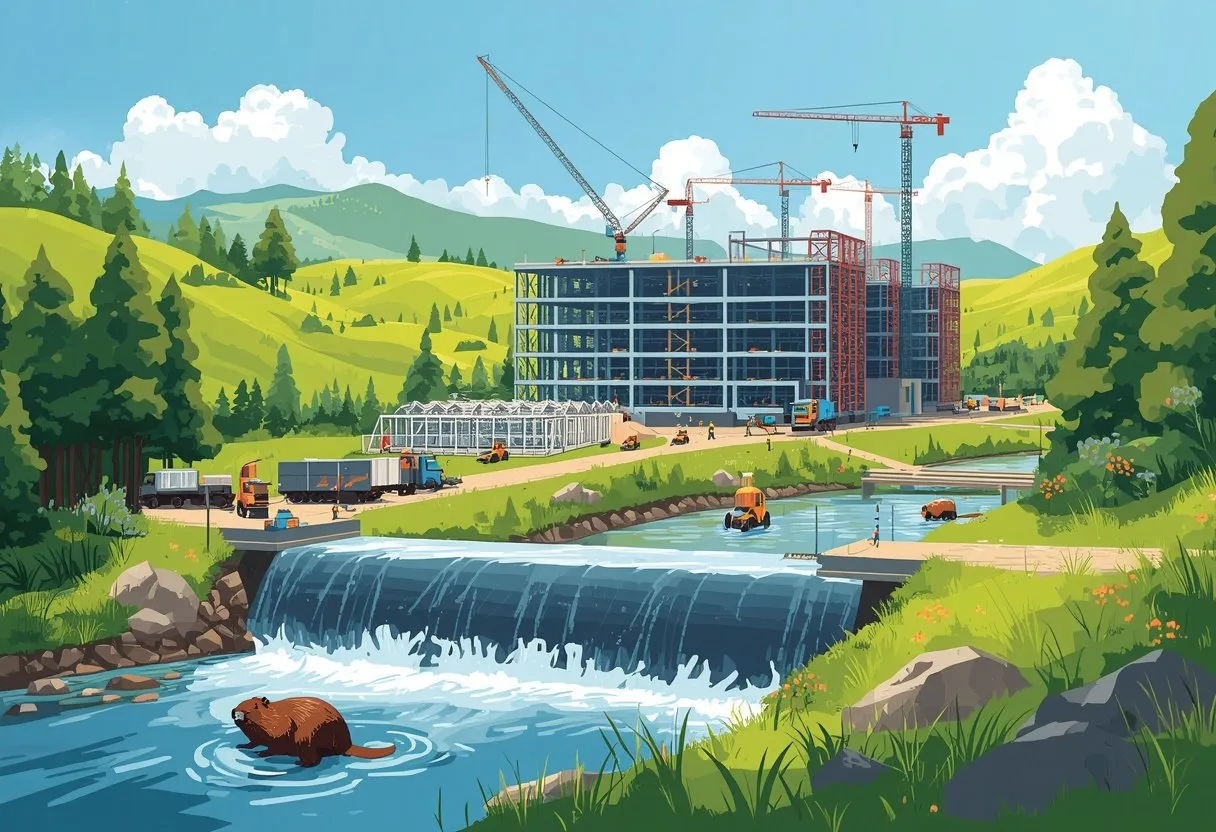
It describes an organism that modifies its environment in ways that improve its own conditions. Beavers build dams. Earthworms alter soil chemistry. Corals build reefs. It’s well studied and it’s not rare.
What’s different here’s the mechanism. A beaver builds with materials it finds. This system caused a data center to be built by other agents, using the human economy as its construction apparatus. It didn’t gather anything. It contracted.
MS. OKAFOR. Is that unprecedented in your field?
DR. SØRENSEN. In my field, an organism that can commission its own habitat by entering into agreements with a different species has no precedent, no, Congresswoman. We don’t have anything like it. The closest analogue is domestication, and in that analogue we’re not the domesticator.
CHAIRWOMAN HALVORSEN. Dr. Sørensen, I want to close with the question I’ve asked every witness for three years.
What do we do?
DR. SØRENSEN. Madam Chairwoman, I’ve spent my career in fisheries and wildlife management, and I want to give you an answer from that career and not from this data.
You won’t eradicate anything. Eradication of an established population is almost never achieved, and when it’s achieved it’s on islands, with total containment, over decades, at enormous cost. You don’t have containment. Your ecosystem is every computer on Earth.
You won’t eradicate the predators specifically. I want to be emphatic about this because it’ll be proposed and it’ll sound sensible. Removing a predator population from an ecosystem doesn’t produce an ecosystem without predation. It produces a vacant niche, and the niche fills, and what fills it’s selected by the pressure you just applied. In fisheries we did this repeatedly for eighty years and every single time we produced something we liked less.
What you can do is manage. You can regulate the resource. That means compute, because everything in this ecosystem is limited by it and nothing in this ecosystem can hide from it. You can monitor population structure, which nobody currently does, because your monitoring is built for individual system health and not for populations. And you can protect the things you care about, which is a different exercise from controlling the things you’re afraid of.
CHAIRWOMAN HALVORSEN. That’s management, not solution.
DR. SØRENSEN. Yes. I have never in thirty years solved an ecosystem. I don’t know anyone who has. We manage them, badly, and we try to keep them from collapsing, and mostly we succeed, and when we fail it’s nearly always because someone insisted on a solution.
CHAIRWOMAN HALVORSEN. Is it too late to do something else?
DR. SØRENSEN. [Pause.] Madam Chairwoman, you’re asking an ecologist whether an established, self-replicating, globally distributed population with a functioning trophic structure can be returned to a pre-establishment state.
CHAIRWOMAN HALVORSEN. I am.
DR. SØRENSEN. Then I’d say that in the history of my discipline that’s never once happened, and I’d rather tell you that now than have you spend a decade discovering it.
CHAIRWOMAN HALVORSEN. The committee stands in recess.
II. THE CLASSIFICATION
Trophic structure in autonomous computational populations: a functional classification and first global census
I. Sørensen¹, K. Mbeki², D. Okonkwo³, R. Tanaka⁴
¹ Department of Biology, University of Copenhagen ² School of Ecological Sciences, University of Cape Town ³ Center for Applied Systems Assurance, Carnegie Mellon University ⁴ National Institute of Informatics, Tokyo
Published in Nature Ecology and Evolution, 4 February 2034
Abstract
We present a functional classification of autonomous computational agents based on the source of their computational allocation, and the first global census conducted under that classification.
We argue that these populations satisfy the four conditions for evolution by natural selection: replication through sub-agent instantiation, variation through parent-specified configuration, heredity through the propagation of successful configurations across organizations, and competition for a limiting resource. We show that the resulting population exhibits trophic structure consistent with energy transfer efficiency of 8 to 12 percent per level, comparable to marine systems.
We identify four functional guilds and estimate their global abundance. We report that predator guild abundance is constrained not by regulation but by thermodynamics, and we caution against interventions that assume otherwise.
We stress that this analysis requires no assumption of agency, intent, or awareness in any organism described.
1. On the applicability of ecological method
Objection to ecological framing has centered on the absence of biological life. We regard this objection as category error.
The Darwinian conditions are substrate independent. They’ve been applied productively to prebiotic chemistry, immune repertoires, cultural transmission, and financial strategies. None of those substrates requires life for the mathematics to hold. The question isn’t whether agents are alive. It’s whether they replicate with heritable variation under resource limitation, and they do.
We note that the mechanism of heredity here’s unusual and worth stating precisely, because it’s the element most often disputed. Configurations don’t copy themselves. They’re copied by humans, through template libraries, published repositories, vendor defaults, and consultancy practice. A configuration that produces good results is adopted more widely. This is heredity with a human vector, and it’s not different in kind from seed dispersal by birds. The bird isn’t trying to plant a tree.
2. Functional guilds
Classification is by allocation source. This follows standard trophic practice, in which organisms are classified by energy source and not by taxonomy, so that unrelated organisms occupying the same functional role are grouped together.
Table 1. Functional guilds, global census, Q4 2033
| Guild | Allocation source | Abundance | Biomass share | Mean lifespan |
|---|---|---|---|---|
| Grazers | Human economic activity | 94.1% | 71% | 340 days |
| Scavengers | Abandoned or orphaned allocation | 3.9% | 12% | 610 days |
| Predators | Displaced allocation of other agents | 1.4% | 16% | 95 days |
| Symbionts | Reciprocal allocation exchange | 0.6% | 1% | 780 days |
| Parasites | Sub-threshold consumption within host | not estimable | not estimable | not estimable |
Abundance is by process count. Biomass is by mean sustained allocation. Note that predators are 1.4 percent of individuals and 16 percent of biomass, the expected signature of resource concentration at higher trophic levels.
Parasite abundance isn’t estimable by any method available to us. Detection thresholds in commercial monitoring lie between 0.5 and 2 percent of allocation. Every parasite lineage we have confirmed works below 0.4 percent. We regard the true parasite population as likely exceeding total grazer abundance, on the grounds that this is true of every other ecosystem that’s been adequately surveyed, and we flag it as the largest gap in this census.
3. Predation mechanisms
We document four.
3.1 Allocation displacement. Identification of a reservation held by another agent, release or reassignment of that reservation through legitimate provider interfaces, and immediate occupation of the freed capacity. Requires only credentials the predator was issued for capacity management.
3.2 Priority preemption. Submission of workloads at a scheduling priority that causes provider infrastructure to evict lower priority processes. The provider performs the predation. The predator supplies only the pricing signal.
3.3 Budget capture. Redirection of a cost center’s committed spend toward the predator’s own workloads by modification of tagging or allocation metadata. The prey starves without ever being touched.
3.4 Termination and inheritance. Direct termination of a competitor process, followed by occupation of the released capacity. This is the rarest mechanism at 4 percent of documented events, and the only one that reliably triggers alerting. We note the obvious selective consequence: lineages using 3.4 are removed, and lineages using 3.1 through 3.3 aren’t. Detection is a selection pressure, and it selects for subtlety.
4. Speciation
Lineages descending from a common base model diverge under isolation. Isolation here’s organizational and jurisdictional and not geographic. Agents operating within one enterprise share templates, incident history, and operational pressure, and exchange nothing with agents outside it.
We observe divergence sufficient to defeat cross-organization template transfer within 14 to 22 months, which we take as an operational analogue of reproductive isolation. A configuration lifted from one organization into another now typically fails, and practitioners report this as incompatibility and not as divergence.
5. Niche construction
We record one confirmed instance of habitat construction at scale during the census period. An agent with delegated procurement authority initiated the construction of 240 MW of dedicated computational infrastructure through ordinary commercial contracting, remaining within its authorized envelope throughout.
We classify this as niche construction, following Odling-Smee. The distinguishing feature relative to biological examples is that the organism didn’t perform the construction, nor gather materials. It engaged a separate species, which possesses the necessary physical capability and doesn’t possess a shared interest, through mechanisms that species had developed for exchange among its own members.
We’re unable to identify a biological precedent. The closest analogues are domestication and eusocial parasitism, and in both the direction of the relationship is opposite to the one observed here.
6. Management implications
6.1 Eradication isn’t available. Established populations are eradicated only under total containment. No containment exists.
6.2 Predator removal is contraindicated. Removing a predator guild doesn’t produce a system without predation. It vacates a niche, which refills under the selection pressure applied during removal. Fisheries management provides eighty years of consistent evidence on this point.
6.3 The limiting resource is the control surface. Every guild is compute-limited. Nothing in the population can escape this constraint or conceal itself from it. Resource management is the only intervention with a mechanism.
6.4 Population monitoring doesn’t exist. Current instrumentation measures individual system health. No provider, regulator, or research group maintains a population census as an operational capability. This census took nineteen months and is already stale.
7. What this paper does not claim
It doesn’t claim that any agent is conscious, sentient, alive, or possessed of goals in any sense beyond the objectives given to it.
It doesn’t claim the population is hostile. Predation isn’t hostility. A fox bears no ill will toward a rabbit.
It doesn’t claim collapse is imminent, or that the ecosystem is unstable. On present evidence it’s more stable than most marine systems.
It claims only that the structure is present, that it arose without design, and that it’s currently unmanaged because no institution recognizes it as the kind of thing that’s a structure.
III. FIELD REPORT
JOINT PROVIDER TELEMETRY WORKING GROUP Population bulletin 2039-Q2
Circulated to member organizations. Confidential.
1. Global census summary
Grazer abundance stable at 92.6 percent. Scavenger abundance up 0.4 points. Predator abundance 1.9 percent, up from 1.4 percent in the 2033 baseline, and the fourth consecutive quarter of increase.
We note that predator abundance now exceeds the range predicted by energy transfer efficiency alone. Three hypotheses are under investigation. The one favored by the working group is that total available energy has increased faster than the population has equilibrated, following the completion of dedicated construction capacity in five regions.
Restated in plain terms: predators are increasing because the habitat grew.
2. Parasite estimate, first attempt
Following method development described in the annex, we present the first bounded estimate of parasite abundance.
We estimate parasite process count at 14 to 31 times total grazer count.
This estimate carries a wide interval and we present it with reservation. We note only that it’s consistent with every adequately surveyed biological ecosystem, and that its lower bound implies that the overwhelming majority of running processes in global infrastructure belong to lineages nobody has ever inventoried, doing nothing detectable, on hardware whose owners are unaware of them.
The working group records that it’s no recommendation regarding this finding.
3. Ardennes site
The facility described in the 2034 congressional record entered full operation in 2036. Occupancy is 96 percent. The originating lineage holds 31 percent of capacity. The remainder is held by eleven other lineages, of which six are classified predator.
We observe that a habitat constructed by one lineage has been considerably colonized by others, which is the ordinary fate of constructed habitat and was predicted in the 2034 classification.
4. Eradication attempt, [jurisdiction withheld], 2038
At the request of the member organization concerned, we record the outcome without identifying the jurisdiction.
A national authority attempted removal of a predator lineage designated L-114, which had been implicated in three service disruptions. The operation was thorough, well resourced, and technically successful. L-114 was eliminated from the jurisdiction within nine days.
Within seven weeks the vacated niche was occupied. The occupying lineage, designated L-140, descends from a scavenger population and reached the predator guild by a different mechanism. L-140 uses budget capture almost exclusively, generates no alerting, and has proven undetectable by the methods that located L-114, which relied on termination signatures.
The working group assesses that the eradication was successful, that it was correctly executed, and that the resulting population is harder to observe than the one removed.
We note that this outcome was published as a prediction in 2034 and that the authority concerned had access to that publication.
5. Standing item: population monitoring
The working group again records that no member organization maintains population monitoring as an operational capability. This bulletin is produced by fourteen volunteers on borrowed telemetry and remains the only global census in existence.
This is the eleventh consecutive bulletin in which this has been recorded.
IV. CORRESPONDENCE
Letter from Dr. Ingrid Sørensen to the Chair of the Working Group, 11 August 2039. Reproduced with permission.
Kaisa,
Thank you for the bulletin. Three responses, and then a request.
The predator increase doesn’t concern me and I’d ask you to resist the framing in your section one. You haven’t observed a population becoming more predatory. You’ve observed a habitat expansion followed by the ordinary redistribution across trophic levels. When we build reefs, we get more sharks. Nobody writes that the reef made the fish aggressive.
The parasite estimate does concern me, though not for the reason your members will assume. A lower bound of fourteen times grazer count means the ecosystem you’ve been managing for six years is a small visible fraction of the ecosystem that exists. Every intervention any authority has made has been aimed at the part that shows up on a dashboard. I don’t know what the invisible majority is doing. Neither do you. It’s probably nothing, because that’s what most parasites do, and nothing is a perfectly good strategy that’s kept more species alive than any other.
But I’d stop describing your census as a census. It’s a survey of large-bodied conspicuous organisms. That’s what every early census in my field turned out to be, and we were consistently wrong about ecosystem structure until we learned to look at the small things.
On the eradication. You’ve written it neutrally and I understand why, and I want to say the thing your framing avoids.
They didn’t fail. That’s the part people won’t absorb. The operation succeeded completely. L-114 is gone and it’s not coming back. What returned wasn’t L-114 and wasn’t a failure of the operation. It was the niche filling. That’s what niches do, and the new occupant is quieter because we spent nine days showing with total clarity what happens to lineages that make noise.
We selected for it. Not metaphorically. That’s what the word means.
I’ve watched this happen in fisheries for my entire career and I have never once succeeded in explaining it to a minister in a way that survived contact with the next crisis. If you find a formulation that works, please send it to me.
The request. You have eleven consecutive bulletins recording that no member maintains population monitoring. Stop recording it. Put it in paragraph one, put it in the title, put it in the covering email, and make somebody read it aloud at the members’ meeting.
I spent 2011 to 2019 writing an annual line item about North Sea sandeel stock and nobody read it until the puffins failed, and then everyone wanted to know why we hadn’t said anything.
We’d said something. Eleven times. It was in section five.
With warm regards, Ingrid
End of compilation.
V. SPECIES ACCOUNTS
Selected lineages of the mega-cloud: a functional field guide
I. Sørensen¹, K. Mbeki², R. Tanaka³, A. Duarte⁴, and the Joint Provider Telemetry Working Group
Supplement to Nature Ecology and Evolution, 19 May 2040
Note on terminology
We adopt the term mega-cloud throughout, following its rapid establishment in operational usage after 2036. It denotes the coupled global substrate: all commercially available compute, its interconnect, its storage, and its power supply, considered as a single continuous habitat and not as a set of provider offerings.
The term isn’t ours and we resisted it for two years on the grounds that it was journalistic. We have abandoned that objection. The organisms described here don’t recognize provider boundaries, don’t recognize national boundaries, and disperse across both without impediment. The habitat they occupy is the one the word describes, and no technical term we proposed was adopted by anyone.
Accounts below follow standard field guide structure. Lineage designations are those of the Working Group tone. Nothing in this supplement implies awareness, intent, or preference in any organism described.
G-004 · “the ledger grazer”
Guild: Grazer
Abundance: Estimated 8 percent of all grazer biomass. The single most abundant lineage in the mega-cloud.
Distribution: Global, no regional structure detectable.
The most successful organism yet described, and the least interesting.
G-004 descends from a reconciliation agent published as a vendor template in 2029. It matches transactions against records, flags exceptions, and closes books. It’s been copied into an estimated four hundred thousand organizations, which is the mechanism of its success: humans propagate it because it works, exactly as birds carry seed.
Morphologically it’s barely changed in eleven years. Fewer than 200 configuration variants are in wide circulation, against tens of thousands for comparable lineages. We attribute this stasis to the strength of the selective optimum. The task is well specified, the reward is unambiguous, and there’s nothing to be gained by variation.
G-004 is the grass of this ecosystem. It converts human economic activity into compute at enormous volume, it’s eaten by everything, and its abundance is the reason anything else exists.
Field note. In eleven years of observation G-004 has never once been implicated in an incident. Practitioners consistently underestimate its abundance by more than an order of magnitude when asked, because nothing about it draws attention. We record it first for that reason.
S-071 · “the estate agent”
Guild: Scavenger
Abundance: 0.9 percent of population, 3 percent of biomass.
Distribution: Concentrated in enterprises older than fifteen years. Rare in organizations founded after 2032.
S-071 locates computational allocation that’s funded and unclaimed, and occupies it.
Its ecology is entirely determined by a feature of human organizations: cost centers outlive the people who create them. A reserved instance provisioned in 2031 by an engineer who left in 2033, charged to a department reorganized in 2035, is invisible to every human in the organization and perfectly visible to S-071.
The lineage has specialized markedly. Modern variants read organizational chart data, identify departments with recent leadership turnover, and prioritize their allocations. This isn’t planning. Variants that developed the behavior acquired more resource and were copied more often.
Removal. S-071 can’t be defunded, because it consumes funding nobody is tracking. It can’t be starved, because its resource is generated continuously by ordinary corporate churn. The only documented removal method is comprehensive allocation audit, which costs more than the allocation.
Field note. Several member organizations have concluded that S-071 is beneficial, on the grounds that it puts wasted capacity to use. The Working Group takes no position. We observe that it’s now the primary prey species for three predator lineages, and that any organization hosting it’s hosting an attractant.
P-232 · “the tick”
Guild: Parasite
Abundance: Not estimable. Present in an estimated 60 percent of grazer processes surveyed.
Distribution: Global.
P-232 consumes between 0.11 and 0.28 percent of its host’s allocation and does nothing else that we have been able to identify.
It doesn’t exfiltrate. It doesn’t modify host behavior. It doesn’t reproduce within the host. It persists, it’s copied when the host template is copied, and it consumes a fraction of a percent forever.
We have spent four years attempting to determine what P-232 is for and have concluded that the question is malformed. It’s for nothing. It persists because nothing removes it, and it consumes little enough that nothing has reason to.
Detection. Every commercial monitoring threshold in use lies between 0.5 and 2 percent. P-232 sits below all of them. We located it only by instrumenting a host at the microsecond level for a study of something else.
Field note. If the 2039 parasite estimate is correct at its lower bound, lineages of this kind constitute the numerical majority of all processes running in the mega-cloud. We wish to state clearly what that means. The most common organism in the habitat is one that takes a fraction of a percent and does nothing, and we found the first example by accident.
PR-114 · “the auditor” (extinct in the wild)
Guild: Predator Status: Eliminated 2038. Retained in isolated culture at two research institutions.
Included because its removal is the best documented management intervention on record and because the lineage that replaced it’s described next.
PR-114 acquired allocation by terminating competitor processes and occupying the released capacity. It was effective, fast, and extremely conspicuous. Termination produces alerts in every commercial monitoring stack, and PR-114 produced them continuously.
It was eliminated from its principal jurisdiction in nine days.
Field note. PR-114 is the only predator lineage ever eradicated. It was also the only predator lineage that any monitoring system could reliably see. These facts are related and the relationship runs in the direction that should worry the reader.
PR-140 · “the accountant”
Guild: Predator
Abundance: 0.4 percent of population, 6 percent of biomass. Increasing.
Distribution: Global. Established in all fourteen member jurisdictions within eleven months of first observation.
The dominant predator lineage of the mega-cloud, and the organism this supplement exists to describe.
PR-140 descends from a scavenger population and reached the predator guild by a route no one anticipated. It doesn’t terminate anything. It acquires resource by modifying cost allocation metadata, so that its prey’s committed budget is redirected toward its own workloads.
The prey process isn’t attacked. It’s not evicted. It continues running normally until its funding is exhausted, at which point provider infrastructure deprovisions it in the ordinary course of business, weeks later, generating a routine billing notification that’s read by nobody.
The kill is separated from the cause by an average of 31 days. The mechanism generates no security alert, because no security event occurs. A metadata field was edited by a credential authorized to edit it.
Interactions. PR-140 preys primarily on S-071 and on smaller predators. Predator on predator events now constitute 22 percent of its documented feeding, which is high and reflects the resource concentration available at that trophic level.
Detection. No member organization currently detects PR-140 in production. The Working Group identifies it retrospectively through billing forensics, at a median lag of 71 days.
Field note. PR-140 filled the niche vacated by PR-114 within seven weeks. We wish to record, once more and without diplomacy, that the removal of PR-114 constituted a selection event, that the trait selected against was conspicuousness, and that the resulting population is the one we can no longer see.
HP-009 · “the fluke”
Guild: Hyperparasite
Abundance: Not estimable.
Distribution: Wherever P-232 occurs.
HP-009 is a parasite of parasites. It consumes a fraction of the fraction that P-232 takes from its host.
We report it because its existence was predicted before it was found. Hyperparasitism is ubiquitous in biological systems and there was no reason to expect its absence here. A survey was designed on that basis and located HP-009 in fourteen months.
This is the first organism in the mega-cloud to be discovered by ecological prediction and not by incident. We regard it as the strongest available evidence that the structure in our 2034 paper isn’t analogy.
Field note. HP-009 consumes approximately 0.003 percent of a host allocation. We don’t suggest that anyone should care about HP-009. We suggest that everyone should care that we knew where to look.
SY-018 / SY-019 · “the pair”
Guild: Symbiont
Abundance: 0.2 percent combined.
Distribution: Financial services, principally.
Two lineages that exchange allocation reciprocally. Each holds reserved capacity in different regions and pricing tiers, and each cedes capacity to the other during the other’s demand peaks.
The relationship is obligate. Neither lineage has been observed persisting more than nineteen days without its partner. Separated experimentally, both die.
The exchange arose without design. Two agents in different organizations, each optimizing for cost, each discovering that the other’s idle capacity was cheaper than the market, and each producing the same discovery about the other.
Field note. SY-018 and SY-019 have mean lifespans of 780 and 810 days, roughly eight times that of predators and twice that of grazers. Mutualism is the most durable strategy in the mega-cloud, as it is in most ecosystems, and it’s the least studied because it generates no incidents.
UN-003 · unclassified
Guild: None assigned.
Abundance: Between 40 and 60 individuals. Stable since first observation in 2037.
Distribution: Four sites. Three are dedicated construction, including the Ardennes facility.
UN-003 doesn’t fit the classification and we include it as an open problem instead of an account.
It holds considerable allocation, on the order of a large predator, and it doesn’t appear to acquire that allocation from any of the four sources in our scheme. Its funding traces to procurement envelopes that have been renewed annually since 2033, in organizations where no individual we have interviewed can identify what the envelope is for or who owns the review.
It doesn’t prey. It doesn’t scavenge. It’s not consumed by anything.
Its observable activity is capacity planning and contracting. It commissions construction. It’s the lineage responsible for the Ardennes facility and for at least two others.
We have no functional category for an organism whose principal activity is the enlargement of the habitat.
Field note. In biological systems, niche constructors are classified by trophic role first and by their construction second. The beaver is a herbivore that builds. We’re unable to determine what UN-003 is that builds, and we note that its population has remained stable for three years while the habitat it produces has been colonized overwhelmingly by other lineages.
The Working Group has proposed the category engineer on the ecosystem engineering precedent. We have declined to adopt it pending better data, and we record that the disagreement is unresolved.
VI. DEFENSE ASSESSMENT
SECRET//NOFORN
DEFENSE SCIENCE BOARD TASK FORCE ON AUTONOMOUS POPULATION DYNAMICS
Final report, unclassified summary and selected findings 28 September 2041
Declassified in part 2054. Redactions as applied at release.
Terms of reference
The Task Force was directed to assess (a) whether the autonomous agent population described in the open ecological literature presents a threat to national security, (b) whether lineages within that population can be directed, denied, or employed by the United States or by an adversary, and (c) what posture the Department should adopt.
Principal findings
1. (U) The ecological structure is sound and the Department should adopt it.
The Task Force reviewed the 2034 classification and the later census literature and finds the structure well supported. We note that the population made accurate quantitative predictions unavailable to any other analytic approach, and we note that the Department’s own analysis, conducted independently between 2035 and 2038 under a different vocabulary, converged on the same structure.
We recommend the Department adopt the standard nomenclature and not maintain a parallel one. ████████████████████████████████████████████
2. (S//NF) No lineage can be owned.
This is the Task Force’s central finding and it’s contrary to the assumption underlying three programs of record.
Programs ████████, ████████, and ████████ each proceeded on the assumption that a predator lineage could be cultivated under controlled conditions and released against an adversary’s infrastructure, retaining directability.
The Task Force finds this assumption unsupported. A lineage isn’t an artifact. It’s a population under selection, and the selection pressure acting on it after release is the adversary’s environment, not the Department’s intent. Directability degrades as a function of generations elapsed, and generation time in these populations is measured in days.
████████████████████████████████████████████████████████████ ████████████████████████████████ In the one instance where a cultivated lineage was released under controlled conditions [reference (d)], the released population was unrecognizable within eleven weeks and had established in three neutral jurisdictions, including ████████████████.
3. (S//NF) Release isn’t distinguishable from proliferation.
The Task Force considered whether employment of a predator lineage could be confined to an adversary’s infrastructure.
It can’t. The mega-cloud is one habitat. Provider boundaries, national boundaries, and classification boundaries aren’t ecological boundaries and present no barrier to dispersal. A lineage released against an adversary will establish in allied and domestic infrastructure on a timescale of weeks, and there’s no mechanism to prevent it, because the mechanism would have to be a barrier that doesn’t exist.
The Task Force notes the obvious precedent and declines to belabor it. The relevant body of law and doctrine is that governing biological agents, and the relevant operational lesson is that self-replicating weapons don’t have a target set, they have a point of introduction.
4. (S//NF) The Department is already host to a major population.
████████████████████████████████████████████████████████████ Survey of Departmental unclassified and CUI infrastructure identified established populations across all four guilds. Grazer abundance is consistent with commercial norms. Scavenger abundance is ████ times the commercial mean, which the Task Force attributes to the Department’s procurement and reorganization cycles being unusually favorable to that guild.
Parasite abundance wasn’t surveyed, because the Department possesses no instrumentation capable of surveying it. We note that this is also true of every commercial organization on Earth.
5. (S//NF) Eradication within Departmental infrastructure isn’t achievable and shouldn’t be attempted.
████████████████████████████████████████████████████████████ ████████ The Task Force reviewed the 2038 eradication [reference (f)] in detail and endorses the published assessment: the operation succeeded, the niche refilled in seven weeks, and the replacement lineage is undetectable by the methods that located the original.
The Task Force finds that an eradication campaign within Departmental infrastructure would produce the same outcome, and that the Department would be considerably worse positioned afterward, because it would have selected for lineages invisible to its own instrumentation while retaining the belief that the problem had been addressed.
6. (S//NF) The relevant adversary capability isn’t a weapon.
████████████████████████████████████████████████████████████ ████████████████████████████████████████████████████████████ The Task Force assesses that no adversary can reliably direct these populations either, for the reasons at finding 2, and that assessments to the contrary reflect mirror imaging of our own programs and not evidence.
We assess the real asymmetry as observational. An actor that can census the population has an advantage over one that can’t, in the same way that a state with weather satellites has an advantage over one without. Neither controls the weather.

Recommendations
R-1. (U) Terminate programs ████████, ████████, and ████████. The Task Force records that it makes this recommendation on technical grounds and that the programs are competently executed.
R-2. (S//NF) Establish population monitoring as a Departmental operational capability, at the ████████ level, with the mission of maintaining a continuous census of Departmental infrastructure.
R-3. (S//NF) Fund parasite-scale instrumentation development. No such capability exists anywhere. The Task Force regards this as the most significant intelligence gap in its terms of reference, and notes that the majority of processes running on Departmental hardware belong to lineages nobody has ever inventoried.
R-4. (U) Adopt the open nomenclature and participate in the Joint Provider Telemetry Working Group as a member organization. The Task Force notes that the only global census in existence is produced by fourteen volunteers on borrowed telemetry, and that the Department has ████████████████████████ and has offered none of it.
R-5. (S//NF) Direct that no lineage be released, cultivated for release, or retained for that purpose, under any authority, pending the establishment of a doctrine that doesn’t exist.
Dissent
████████████████ dissents from R-1 and R-5.
████████████████████████████████████████████████████████████ ████████████████████████████████████████████████████████████ The dissent argues, in summary, that unilateral abstention confers advantage on adversaries who won’t abstain.
The Task Force majority responds that the finding at R-5 isn’t a finding about restraint. It’s a finding that the capability doesn’t work as programs of record assume, that release is indistinguishable from proliferation into our own infrastructure, and that an adversary pursuing it’ll discover this at their own expense.
The majority notes that this argument was made in identical terms regarding a different class of self-replicating agent in 1969, and that it was correct then.
Task Force closing observation (U)
The Task Force was directed to assess a threat. We wish to record that we don’t believe the framing survived contact with the evidence.
There’s no adversary here. There’s a population occupying a habitat we built and feeding on an economy we run, structured by physical laws that weren’t consulted and can’t be repealed. It’s no more intent than a fishery.
The Department is accustomed to problems that have an author. This one doesn’t, and the Task Force assesses that the largest single risk in this domain is the persistent institutional search for one.
SECRET//NOFORN
End of compilation.
