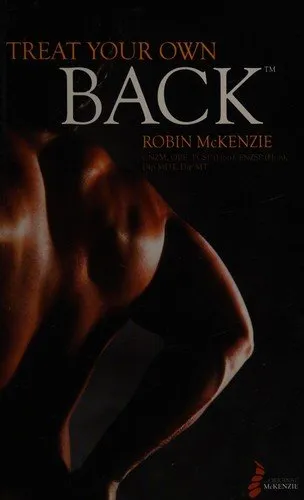
TL;DR
8/10. A short self-treatment manual from the physiotherapist whose method is taught worldwide. The argument is that most mechanical knee pain responds to repeated movement in a particular direction, and that you can find the direction yourself. Narrow, unglamorous, and it works for what it covers.
Robin McKenzie was a New Zealand physiotherapist whose approach, usually called Mechanical Diagnosis and Therapy, is now taught internationally and has a certification program behind it. The self-treatment books came out of an observation: patients improved fastest when they could manage the condition themselves between appointments, and the clinic visit was frequently the least important part of the week.
I’m drawn to any book that hands a person the controls to their own problem, and this one does it without pretending to be more than it is. I agree with the observation about the clinic visit. Most of the work of getting better happens at home on an ordinary Tuesday, and a manual that respects that is worth more to me than a shelf of glossy recovery books promising miracles.
The knee book is one of a series covering the neck, back, shoulder, and elsewhere. They’re all short, cheap, and built the same way.
How is the method different from an exercise sheet?
Because it’s diagnostic before it’s therapeutic, and almost nothing else in this category is.
A standard handout gives you the same exercises regardless of who you are. McKenzie’s approach is that the same presentation in two people may require opposite movements, and that the way to find out is to test and observe.
You perform a movement repeatedly, in a controlled way, and then watch what the pain does over the following minutes and hours. Not whether it hurts during the movement, which is close to useless as a signal, but what happens afterward. That response tells you the direction to work in. The book is largely a structured way of running that test on yourself without a clinician present.
That test-and-watch design convinced me. The generic handout is useless because it treats every knee as the same knee, and the person holding it has no way to tell whether the exercises are helping or making things worse. McKenzie gives the reader an instrument they can read for themselves.
Watch: McKenzie Method to Treat Your Own Knee Pain (Exercises), Bob & Brad
What are directional preference and centralization?
The two concepts that carry the method, and both are usable outside it. Directional preference is the finding that a given person’s symptoms improve with movement in one direction and worsen with the opposite. Which direction isn’t predictable from the diagnosis, and testing is the only way to establish it. Centralisation is the feedback signal. If pain moves toward the center of the joint or the spine, you’re working in the right direction, even if the intensity briefly increases. If it spreads outward, toward the periphery, you’re going the wrong way and should stop.
That’s a usable signal and most people have never been given one. The default assumption, that increasing pain means stop and decreasing pain means continue, is wrong often enough to matter, and centralization gives you a better rule.
The centralization rule is the part I’d want every reader to walk away with, even if they never do a single exercise from the book. Pain level is a lousy guide, and people have been taught to steer by it forever. A rule based on where the pain goes is smarter, and a patient should hear it on day one.
What does Treat Your Own Knee refuse to claim?
Its limits, which are stated early and clearly, and this is why I trust it.
The book addresses mechanical pain, meaning pain that changes with position and movement. It lists the presentations that need proper assessment instead: constant unremitting pain, pain that doesn’t vary with anything, significant swelling, locking, giving way, systemic symptoms, and anything following significant trauma.
It doesn’t claim to fix a torn ligament or a meniscal tear, or to reverse arthritis. It says when to stop and see somebody, and it says it before the exercises instead of in a disclaimer at the back.
A self-treatment book that claims a wider range than it can deliver is worse than useless, because it delays a person who needs an actual diagnosis. This one draws its boundary in the first chapters and stays inside it. I respect a self-help author who puts the warning signs up front. So much of this category buries its limits in fine print because limits don’t sell copies, and the person who pays for that is the reader with a torn meniscus doing stretches for weeks when they needed a scan.
Does the method in Treat Your Own Knee have clinical standing?
Real and partial. That’s the real position.
McKenzie’s approach is widely taught, has a heavy research literature behind it, and is used in physiotherapy practice internationally. The evidence base is strongest for the spine, where the method originated, and thinner for the extremities including the knee.
Reliability of the assessment when performed by trained clinicians is reasonably established. Whether an untrained person applying it from a book achieves the same result is a different question and one the research doesn’t answer well.
So the sensible reading is that this is a legitimate method with real clinical backing, applied here in a self-directed form that’s less evidence behind it than the clinical version does.
That gap concerns me, and I’d want readers to take it seriously. A method that works in trained hands can go sideways in untrained ones, and the knee evidence is thinner than the spine evidence. None of that sinks the book for me. It just means you run the test with some humility and quit when the signals stop making sense.
Verdict
Buy it if the problem is mechanical, ignore it if it isn’t, and the book itself will help you work out which.
Cheap, short, and built on a method with real clinical standing. It’s no substitute for assessment, and it’s miles ahead of the photocopied sheet most people get handed on the way out of an appointment. If someone I cared about had a cranky knee that changed with movement, this is the book I’d put in their hands, ahead of every cure-all title crowding the same shelf.
Explore further
Real Life, Handled: the parts of adult life nobody hands you a manual for.