TL;DR
8/10. Two volumes, 225 case reports, and the reason this body of work is harder to dismiss than the memory cases alone. A memory is a claim. A birthmark is on the body.
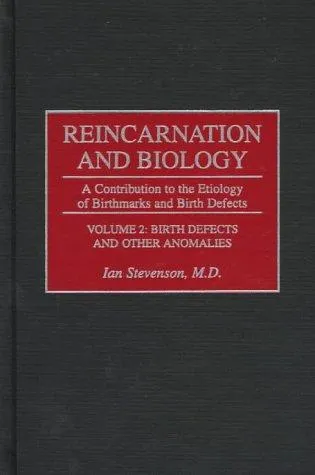
Thirty years after his founding volume, Stevenson published the study his critics have the most trouble with. It runs to two volumes and well over two thousand pages, and it’s not a book anybody reads front to back.
Anyone who dismisses Stevenson without reading him should have this volume dropped on their desk. It’s also a book I’d never tell a casual reader to buy, because two thousand pages of case reports will grind anybody down. I hold both of those opinions at once and I’m comfortable with the contradiction.
By 1997 he’d documented 210 cases in which a child’s birthmark or birth defect corresponded to a wound on the person whose life the child described. In 49 of those he obtained the dead person’s autopsy report or an equivalent medical document and could compare the mark to the recorded wound location. The two volumes contain 225 such case reports. It’s a catalog, and it’s priced and formatted as a reference work. That’s part of why almost nobody who argues about Stevenson has opened it.
What is in Reincarnation and Biology?
The physical anomalies are specific instead of vague. That’s the first thing that surprises a reader expecting hand-waving.
Hypopigmented scar-like marks with the puckered appearance of healed wounds. Port-wine stains. Moles in locations where moles almost never occur, including the soles of the feet. Malformed or missing fingers. Absent lower legs. Marks appearing in pairs on opposite sides of the body, in the positions an entry and exit wound would occupy.
A Turkish boy with the right side of his face congenitally underdeveloped described the life of a man killed by a shotgun fired at point-blank range on the right side of the head. An Indian boy born with severely malformed fingers on one hand described a life ending when a hand was caught in a fodder-chopping machine.
The Turkish boy’s case shocked me more than any other. A congenital defect on the exact side of the head where the shotgun hit is the kind of detail that makes a skeptic go quiet for a minute, and it should.
Stevenson photographed the marks. The volumes contain those photographs. That’s a large part of why the work is difficult to argue with in the abstract.
Watch: Evidence For Life After Death: Part 1 with Dr. Ian Stevenson | Theosophical Classic 2004, Theosophical Society
Why do the birthmarks matter more than the memories?
Because a memory is a claim and a birthmark is on the body.
The whole difficulty with the memory cases is that families who have met and agreed on an identification can shape statements after the fact. They can’t shape a physical mark. It was there at birth, it can be photographed, and it doesn’t change to fit a story.
The autopsy subset is where this becomes serious. Anyone can find a correspondence between a mark and a story once both are known. Comparing a mark to a wound location recorded in a medical document written before anybody was looking for a match is a different exercise, and 49 cases isn’t a large number and it’s not nothing.
The autopsy subset is where I’d want every critic to start, and it’s the part almost nobody quotes. Forty-nine cases with a paper trail written before anyone went hunting for a match deserve a real answer, and waving at coincidence doesn’t count as one. Still, the base rate problem is real and Stevenson addressed it only partially. Birthmarks are common, bodies have a lot of surface, and a mark somewhere on a person will correspond to a wound somewhere on another person more often than intuition suggests.
Where is Ian Stevenson’s method weakest in Reincarnation and Biology?
In Stevenson’s own conduct of some cases, and he published enough detail for critics to find it. That’s to his credit and doesn’t make it better.
In one case a boy named Mounzer had a birthmark on the abdomen. Stevenson sketched it, then asked the mother of the man in question where her son had been shot, then showed her the sketch for confirmation. The critic D. Scott Rogo made the obvious objection: she should have marked the location herself, on a blank diagram, before seeing anything.
That sketch business is inexcusable. It’s an obvious mistake, the kind any interviewer gets warned about early, and he made it on a case that mattered. Rogo was right, and Stevenson handed him the ammunition. Stevenson also tended to discuss the weaknesses of a case in a separate section instead of inside the case report itself. A reader gets the case at full force in one place and the caveats somewhere else. That isn’t deceptive and is a presentation choice that flatters the material. He was more honest than his reputation among skeptics suggests and less careful than his own method required. Both of those are true.
What happened to Ian Stevenson’s reincarnation research after his death?
Stevenson died in 2007 and the research continues at the University of Virginia under Jim Tucker, who has published on American cases and has narrowed the focus considerably. The field hasn’t grown. It remains a small operation producing careful case reports that mainstream psychology doesn’t engage with, and the reason isn’t simply prejudice. There’s no proposed mechanism, and a body of anomalous data without a mechanism is very difficult for a science to absorb.
I’ve got some sympathy for the scientists here. A pile of anomalies with no mechanism has nowhere to go, and nobody should be expected to rebuild biology around a photograph of a birthmark. The sensible response is to keep collecting properly, and the few people still doing it deserve more respect than they get.
What has changed is that the cases are now sometimes collected before the families meet. That’s the single methodological fix that would answer the strongest objection. There aren’t many of those, and they’re the ones worth arguing about.
Verdict
The most significant thing he produced and the least readable. Approach it as a reference instead of a book, go straight to the autopsy-verified subset, and read the criticism alongside it.
What remains after every reasonable objection is a body of cases nobody has satisfactorily explained. That’s not proof of anything and it’s not nothing either, and Stevenson would have said exactly that.
It stops at an eight for me because of the base rate problem and the sloppy interviews, both of which Stevenson could have fixed. It climbs that high because nobody has explained the autopsy cases away, and waving them off without reading them is lazy.
Explore further
The Writing Hub: craft, technique, and the books worth learning from.