TL;DR
8/10. Among the most useful books on creating believable aliens, by a physicist and longtime Analog editor. Its method, reasoning a creature from its world outward so every feature has a cause, has aged better than most craft references. Some 1990s science is dated and the focus is narrow, but the disciplined extrapolation it teaches endures.
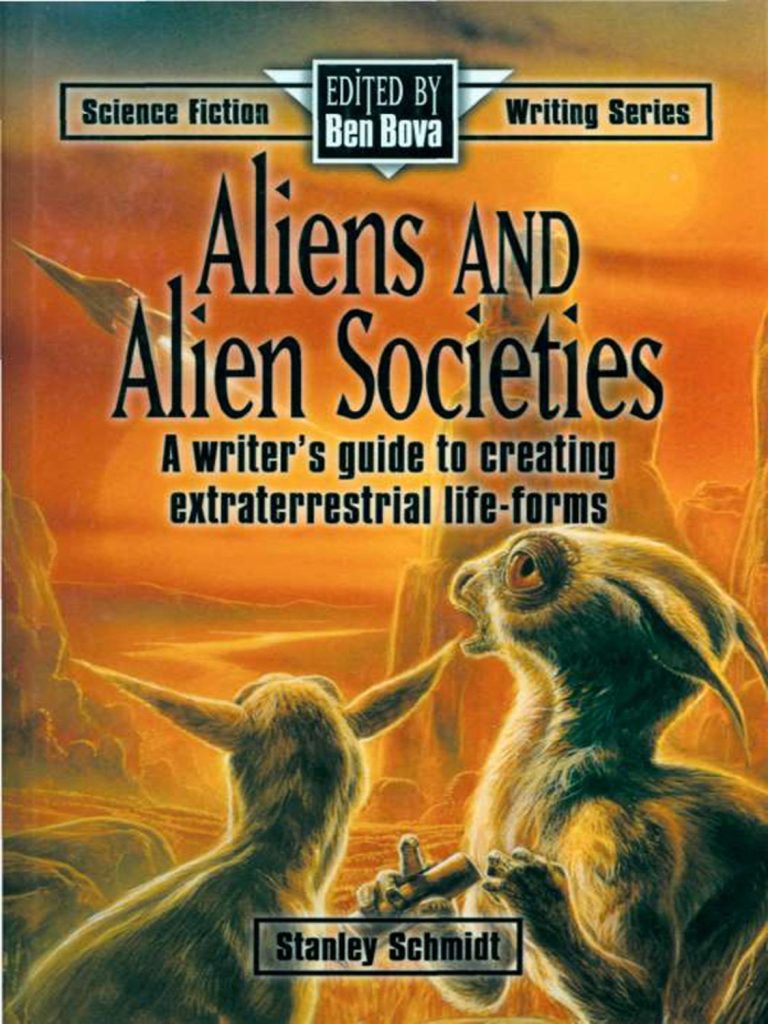
If you want to put a believable alien in your science fiction, Aliens and Alien Societies by Stanley Schmidt is among the most useful books ever written on the subject, and it holds that standing by treating alien creation as a problem of disciplined reasoning instead of free invention. Most writers build aliens by painting humans green, and it drives me nuts. Schmidt brings real scientific rigor to that task, and the result is a reference that’s stayed valuable for decades.
Schmidt is a trained physicist and was the longtime editor of Analog, the hard-science-fiction magazine. The book reflects both the scientific grounding and the editorial experience of someone who read thousands of attempts at exactly this. Part of Writer’s Digest’s Science Fiction Writing series, it’s aimed at writers who want their speculation to hold up.
Reasoning a creature into existence
The great strength is the method. It teaches you to build an alien from its world outward, reasoning from a planet’s gravity, atmosphere, star, and chemistry to the kind of life that could plausibly evolve there. Schmidt walks through how physical conditions shape biology. Then how biology shapes senses and intelligence. Then how all of it would shape a society and a psychology different from the human.
The point is that a convincing alien is a coherent consequence of its environment instead of a random assemblage of strange traits. Every feature traces to a cause. That’s the kind of disciplined extrapolation that separates good science fiction from costume drama, and it’s the best part of the book by a mile.
Keep reading
Writing aliens that feel non-human: Schmidt’s reason-from-the-world method applied to creating believable extraterrestrials.
The science, made usable
What keeps the book from being a dry science lecture is that Schmidt always bends the science toward the writer’s actual need. He covers the astronomy and biology a creator needs, gravity and biochemistry and sensory systems, but always in service of the question how do I make this creature and its culture believable on the page. He’s also realistic about where a writer can bend the rules for story and where breaking them will cost credibility, the judgment a working science fiction writer most needs.
The result is a bridge between real science and practical craft, written by someone fluent in both.
Keep reading
Writing science fiction: world-building, characters, and getting published: Schmidt’s alien-building inside the larger craft of believable SF.
What are the limits of Aliens and Alien Societies?
The caveats are about age and scope. The book dates from the mid-1990s, and while the physics and the reasoning method are timeless, thirty years of discovery have updated some of the specific science, so a careful writer will want to check current understanding on particular points. It’s also narrowly focused on alien creation, so it’s a specialized reference instead of a general science-fiction craft book, and it says little about plot, character, or the other demands of a novel.
And its hard-science approach is most valuable to writers who want scientific plausibility; a writer of softer, more fantastical science fiction will find parts of it more rigorous than their story requires.
One more honest point cuts the other way, in the book’s favor.
Even a writer who never intends to work out a planet’s biochemistry benefits from absorbing Schmidt’s underlying lesson. That lesson is about avoiding laziness, and lazy aliens are the thing in science fiction I have the least patience for. The most common failure in science fiction is the alien who’s just a human with a forehead ridge and a funny name, thinking, feeling, and behaving exactly as a twenty-first-century human would.
Schmidt’s whole method is an argument against that shortcut, a discipline for imagining a mind shaped by a different body, a different world, and a different evolutionary history. A writer can take that imaginative challenge to heart without doing a single orbital calculation, and it’ll make their aliens stranger and more convincing. The rigor is the vehicle; the main gift is the habit of asking how a different being would differ.
Is Aliens and Alien Societies worth reading?
For its important subject, creating aliens and alien societies that feel real, it’s excellent and has aged better than most craft references, because it teaches a method of disciplined reasoning instead of a list of facts.
Any science fiction writer who wants extraterrestrials more convincing than humans-in-rubber-suits should read it, checking the dated science against current knowledge as they go. It loses only a little for its age and its narrow focus. The dated science barely dents it. A rigorous, educational book that remains the standard on its subject, and any writer whose aliens are humans with forehead ridges needs it more than anyone.
Explore the hub
The Writing Hub: science fiction, world-building, and craft, gathered in one place.
Frequently Asked Questions
Other Books in the Science Fiction Writing Series Series

Other Books From – Being an Author